Lesson 15 — Coins and Buying a Snack
The capstone of the unit: learners identify coins and their values, then run a gentle "market" to buy a snack — counting coins, adding costs, checking they have enough, and using shapes, patterns, and a simple tally. All four strands of the unit come together in one real, shared activity, and money is honored as one way among many that people meet needs.
Objectives
Objectives
- D05.S1.01.01 Count, read, and write whole numbers up to 120 and use them to say how many objects are in a group.
- D05.S1.01.02 Add and subtract within 20 using objects, drawings, or counting strategies, and explain what the operation means.
- D05.S2.01.01 Identify, extend, and create repeating patterns using objects, sounds, or colors, and tell the rule of the pattern.
- D05.S2.01.02 Find the missing number in a simple number sentence such as 3 + ? = 7 and explain how they know.
- D05.S3.01.01 Compose and take apart two- and three-dimensional shapes and describe their sides, corners, and faces.
- D05.S3.01.02 Measure and compare lengths using non-standard units such as hand spans or paper clips.
- D05.S4.01.01 Collect and organize data into a simple chart or picture graph and answer questions about what it shows.
- D05.S4.01.02 Tell and write time and identify the value of coins, using them in simple real situations such as buying a snack.
Essential question
How do coins stand for value, and how do I use them to buy a snack fairly?
Key vocabulary
Materials
Standard materials
- Coins or play coins in a few values · 1 set per learner or pair Real local coins of low value, or play tokens labeled 1, 5, and 10 (adjust to the learners' currency)
- Small "snack" items with prices · 1 set Real or play items (fruit, bread, beans) with simple price tags of 1-20
- Paper or slate and a drawing tool · per learner To record buys and practice counting and number sentences
Low-tech / no-cost
- Found-object "coins" and a market Use stones, seeds, or shells as tokens with agreed values, and set up a market of real or drawn goods
- Barter and sharing Trade goods directly and talk about how people meet needs without money at all
Enriched / lab & device
- A classroom "market day" setup · 1 A table of items with prices, a till, and play money for a full buying-and-selling role play
- Pictures of money from around the world · 1 set Images of different coins and notes to honor the many ways people record value
Works in different contexts
- large-group Run a market day where half the class sells and half buys, then switch, so everyone handles coins and counts in real exchanges
- self-directed A learner sets up a small shop, prices its items, and "buys" a snack with play coins, counting and checking the cost
- outdoor-only Set up a market with gathered goods and stone or seed tokens, and trade outdoors in the open air
- multi-age Older learners act as shopkeepers who make change, while younger learners buy, count, and check the cost together
Lesson 15 — Coins and Buying a Snack
Summary
The capstone of the unit. Learners identify coins and their values, then run a gentle market to buy a snack — counting coins, adding the cost, checking they have enough, and noticing the shapes, patterns, and a simple tally along the way. All four strands of the unit come together in one real, shared activity, and money is honored as one way among many that people meet their needs.
Objectives
- Count, read, and write whole numbers up to 120 and use them to say how many objects are in a group. (D05.S1.01.01)
- Add and subtract within 20 using objects, drawings, or counting strategies, and explain what the operation means. (D05.S1.01.02)
- Identify, extend, and create repeating patterns using objects, sounds, or colors, and tell the rule of the pattern. (D05.S2.01.01)
- Find the missing number in a simple number sentence such as 3 + ? = 7 and explain how they know. (D05.S2.01.02)
- Compose and take apart two- and three-dimensional shapes and describe their sides, corners, and faces. (D05.S3.01.01)
- Measure and compare lengths using non-standard units such as hand spans or paper clips. (D05.S3.01.02)
- Collect and organize data into a simple chart or picture graph and answer questions about what it shows. (D05.S4.01.01)
- Tell and write time and identify the value of coins, using them in simple real situations such as buying a snack. (D05.S4.01.02)
Connection
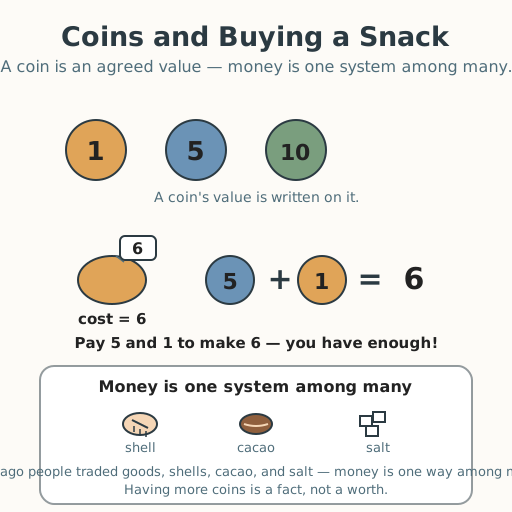
Everywhere people need things they do not make themselves, they have found a way to trade. Long ago, people traded goods directly, or used things of shared value — cowrie shells in Africa and the Pacific, cacao beans in Mesoamerica, salt, beads. Today most places use coins and notes with an agreed value. A coin is a promise: everyone agrees what it is worth, so it can be traded for a snack, a tool, or a ticket. Today you will use coins the way people do every day, all over the world — to buy something you want, fairly.
Materials
- Coins or play coins in a few values (1, 5, and 10 — adjust to the learners’ currency)
- Small “snack” items with simple prices (1–20)
- Paper or slate and a drawing tool
Preparation
- Choose coins or make play tokens with agreed values (1, 5, 10 — adapt to the local currency, and never rank any country’s money above another’s).
- Set up a “market” table with simple items and price tags.
- Prepare a small chart to tally what everyone buys.
Facilitator note
This lesson is written to the learner (“you”). It is the unit’s capstone — a celebration, not a test. The goal is that each learner can identify a few coins by their value and use them in a real “buying” exchange, while the four strands return together. Honor money as one system among many: before coins, people traded goods directly or used shells, cacao, salt, and beads; even today many exchanges are barter, gift, and sharing. Use the learners’ actual local currency where possible; if using play tokens, keep values simple (1, 5, 10). Never rank currencies or treat money as a measure of a person’s worth — having more coins is a fact, not a worth. Keep amounts within 20, and frame buying as fair exchange: the cost is agreed, and you pay what is asked. For learners who are blind or low-vision, make coins distinguishable by touch — size, edge, or texture — and count by feel and sound; for learners who are Deaf or hard of hearing, carry out the exchange in sign or with written prices. A learner who does not speak buys by pointing, placing coins, or using a communication device. Every learner buys and sells at their own pace, and every exchange is honored.
Procedure
- Gather — how do people trade? (5 min). Think: how do people get a snack, a tool, or cloth? Some trade goods, some share, and many use coins — small pieces everyone agrees are worth something. Today we open a market!
- Meet the coins (8 min). Look at your coins. What is each one worth? Say the values. Notice each coin’s shape — round like a circle, or other shapes — and feel its edge. Sort your coins into groups by value, like you sorted objects long ago.
- Count what you have (8 min). Count your coins by value, grouping into tens when you can. How much do you have in all? Write the number. This is your money for the market.
- Buy a snack (12 min). Go to the market. Choose a snack and read its cost. Count out coins to pay for it — joining small values to make the cost, just like adding. Do you have enough? Pay the seller and check: is your count the same as the price?
- Make change — the missing number (7 min). Sometimes you pay a bit more than the cost and get some back. If the snack costs 6 and you pay 10, how much comes back? Count on from 6 to 10 — four! That is the missing number: 6 + ? = 10.
- Tally the market (7 min). As a group, tally what everyone bought — one mark per snack in a simple chart. Which snack was bought the most? Which the fewest?
- Close (3 min). You counted, added, found missing numbers, used shapes, and read a chart — all to buy a snack fairly. Math is not a gate; it is how people meet their needs together, all over the world.
Differentiation
- Support: Use only one coin value (all “1s”) and buy items costing under 10; count together, touching each coin.
- Support (blind/low-vision): Use coins distinguishable by touch and count by feel and sound; a partner reads the price aloud.
- Extension: Run a shop where you sell, make change for a customer, and check your own work; or price items so two coins can buy them and write the number sentences.
Assessment
- Summative (performance/observation): Can the learner identify coins by value, count out the cost of a snack, and check the exchange, drawing on counting, adding, and missing-number reasoning from the unit?
- Artifact (portfolio): A record of the learner’s market work — their prices, their purchases, or their tally — kept as a capstone of the unit.
Home connection
At home, look at the coins your family uses, say each one’s value, and (with a grown-up) “buy” a small snack or item together, counting the coins out loud.
Resources
- Zaslavsky, C. (1999). Africa Counts: Number and Pattern in African Cultures (3rd ed.). Lawrence Hill Books. (Cowrie shells and other pre-coin forms of exchange across cultures.)
- Davies, G. (2002). A History of Money: From Ancient Times to the Present Day (3rd ed.). University of Wales Press. (The origins and variety of money, including commodity money such as cacao and salt.)