Lesson 14 — Telling and Writing Time
Learners read a clock to the hour and the half hour and write the time, using a clock face with an hour hand and a minute hand. They connect clock time to the rhythm of their own day — waking, eating, and resting — and honor that people have kept time in many ways.
Objectives
Objectives
- D05.S4.01.02 Tell and write time and identify the value of coins, using them in simple real situations such as buying a snack.
Essential question
How do I read a clock to the hour and half hour, and how do I write the time?
Key vocabulary
Materials
Standard materials
- A clock face or a drawing of one · 1 per learner or pair A real clock, a paper clock with movable hands, or a circle drawn on paper or the ground
- Paper or slate and a writing tool · per learner To write the time
Low-tech / no-cost
- A circle drawn on the ground with a stick for hands A clock face drawn in the dirt, with two sticks as hands that learners move
- The sun and the body Use the sun's position and the day's rhythm to talk about morning, noon, and afternoon
Enriched / lab & device
- A paper clock with movable hands · 1 per learner or pair A clock face with two hands that turn, for setting and reading times
- A large demonstration clock · 1 A big clock face the whole group can see and set together
Works in different contexts
- large-group Set a time on a large clock and have the whole group read it together, then take turns setting the next time
- self-directed A learner sets times on their own clock face, writes each time, and checks it against a real clock or a written answer
- outdoor-only Draw a big clock on the ground and use sticks as hands; walk the hour hand's path and set times with the body
- multi-age Older learners read the time while younger ones move the hands, then together they write it
Lesson 14 — Telling and Writing Time
Summary
Learners read a clock to the hour and the half hour and write the time. They meet the hour hand and the minute hand, set times on a clock face, and connect clock time to the rhythm of their own day — waking, eating, and resting — while honoring that people have kept time in many ways, from the sun to the clock.
Objectives
- Tell and write time and identify the value of coins, using them in simple real situations such as buying a snack. (D05.S4.01.02)
Connection
Every day has a rhythm: you wake, you eat, you play, you sleep. For a long time, people read that rhythm in the sun — high at noon, low in the evening. Then humans built clocks to mark time more evenly: water clocks, sand glasses, and the clock with hands that you will read today. A clock is a tool that helps people meet one another, catch a bus, and know when to gather. Reading it is reading the day’s rhythm made precise.
Materials
- A clock face (a real clock, a paper clock with movable hands, or a drawn circle)
- Paper or slate and a writing tool
Preparation
- Prepare a clock face for each learner or pair, with a long and a short hand.
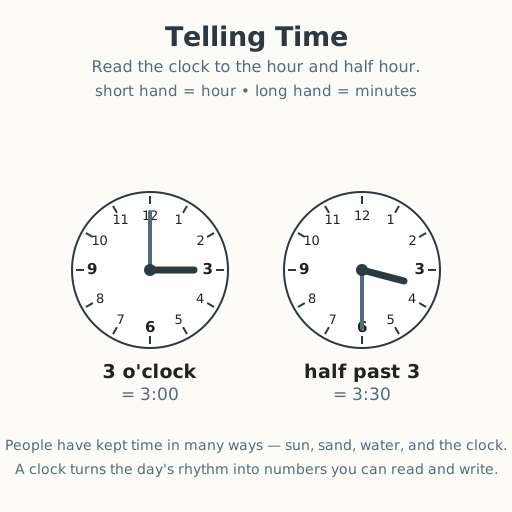
- Plan to model reading “3 o’clock” and “half past 3.”
- Have a few times from the learners’ own day ready (wake-up, meal, rest).
Facilitator note
This lesson is written to the learner (“you”). For grade 1, the standard is reading time to the hour and half hour — not minutes yet. Teach with a worked example (philosophy §13): set the clock to 3 o’clock, note the short hand on the 3 and the long hand on the 12; then move the long hand to the 6 for “half past.” The new skill is reading the position of the two hands, so always work on a real, movable clock face. Honor that timekeeping has many traditions — sundials, water clocks, bells, and calls to prayer — and that the clock is one tool, not the only truth about time. For learners who are blind or low-vision, use a tactile clock with raised numbers and hands the fingers can feel; for learners who are Deaf or hard of hearing, set and read times in sign and with the hands. A learner who does not speak sets the hands or points to the written time. Reading a clock is a skill of the hands and eyes together, and everyone can build it at their own pace.
Procedure
- Gather — the day’s rhythm (5 min). Think of your day: when do you wake? When do you eat? People have always wanted to mark these times. Today we read the tool that does it — the clock.
- Worked example — meet the hands (10 min). Watch and help: the clock has two hands. The short hand tells the hour; the long hand tells the minutes. When the long hand points straight up at the 12, it is “o’clock.” Set the short hand to 3 and the long hand to 12: it is 3 o’clock. Write it: 3:00.
- Half past (10 min). Now move the long hand down to the 6 — it has gone halfway around. That is half past. With the short hand between 3 and 4, it is half past 3. Write it: 3:30. The 30 means half of the 60 minutes in an hour.
- Set and read times (12 min). With your own clock, set these times: 2 o’clock, 6 o’clock, half past 8. Read each one aloud (or write it). Then set the times of your own day — when you wake, when you eat — and write them.
- Check with a partner (5 min). Set a time and ask a friend to read it. Then read the time your friend sets. Do you agree? If not, look at the hands again together.
- Close (3 min). A clock turns the day’s rhythm into numbers you can read and write. Now you can tell the hour and the half hour — the first step to keeping time with the whole world.
Differentiation
- Support: Read only “o’clock” times today; introduce “half past” another day, one example at a time.
- Support (blind/low-vision): Use a tactile clock with raised numbers and movable hands, and read the position of the hands by feel.
- Extension: Write the time for a few everyday events, and predict where the hands will be one hour later.
Assessment
- Formative (observation): Can the learner read a clock to the hour and half hour and write the time?
Home connection
At home, look at a clock (or a phone) at three moments — waking, a meal, bedtime — and read the time to a grown-up, then write it down.
Resources
- Van de Walle, J. A., Karp, K. S., & Bay-Williams, J. M. (2019). Elementary and Middle School Mathematics (10th ed.). Pearson. (Telling time to the hour and half hour as a grade-1 measurement skill.)