Lesson 03 — Singing and Keeping the Beat
Learners sing a simple song and keep a steady beat by clapping or tapping along. The steady beat is the song's heartbeat, and it belongs to everyone.
Objectives
Objectives
- D07.S2.01.01 Sing a simple song and keep a steady beat by clapping or tapping along.
Essential question
How do I sing a simple song and keep a steady beat along with it?
Key vocabulary
Materials
Standard materials
- A simple song everyone can learn · 1 A short song in the learners' home language or a well-known one, taught by ear
- Hands and voices · everyone The first instruments
Low-tech / no-cost
- Body percussion Clap, pat knees, tap chest — keep the beat with the body alone
- Sticks, stones, or a pot Tap a steady beat on whatever is near
Enriched / lab & device
- A drum or shaker · 1 per learner or pair Homemade or store-bought, to keep the beat and feel the vibration
- A simple song recording · 1 device Optional, to sing and clap along with
Works in different contexts
- large-group Lead call-and-response — sing one short line, the group echoes; keep the beat together like one big heartbeat
- multi-age Older learners hold the steady beat while younger learners sing, then trade; everyone keeps time together
- self-directed A learner sings a simple song, keeps the beat by clapping or tapping, and notices whether the beat stayed steady
- level-grouped Some learners tap one beat at a time; others hold a whole steady pattern; match the challenge to the learner
- outdoor-only Sing in the open air and keep the beat with feet on the ground or two stones tapped together
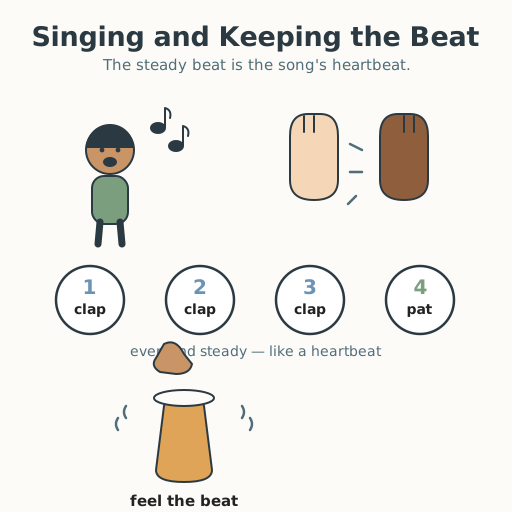
Lesson 3 — Singing and Keeping the Beat
Summary
Learners learn a simple song by ear and keep a steady beat by clapping or tapping along. They discover that a steady beat is the heartbeat of the song — the same everywhere people make music.
Objectives
- Sing a simple song and keep a steady beat by clapping or tapping along. (D07.S2.01.01)
Connection
Think of a song someone sings to you — a lullaby, a work song, a song for a celebration. In every part of the world, people sing together and keep time with their hands, their feet, or an instrument. The steady beat is the part everyone can join, whether or not they sing. Today you will sing a simple song and keep its beat steady.
Materials
- A simple song everyone can learn
- Hands and voices
Preparation
- Choose a short, simple song the learners can learn by ear (in their home language is best). Have the words ready to teach one short line at a time.
- Arrange the group in a circle so everyone can see and hear.
Facilitator note
This lesson is written to the learner (“you”) so it works in a classroom and for a self-directed learner. Singing and keeping a beat are skills, so teach them with explicit modeling and guided practice before independent trying (Kirschner, Sweller & Clark, 2006): you sing one short line, they echo; you clap one slow beat, they join. Keep the beat slow and visible. There is no “correct” voice — closeness to the beat grows with practice, and “not yet” is never “wrong.” For a learner who is Deaf or hard of hearing, make the beat visible and felt: clap and pat where everyone can see, and invite them to feel the beat as vibration by resting a hand on a drum, a tabletop, or the floor while others tap — sound is vibration the body can feel. A learner who does not sing keeps the beat by clapping, tapping, or swaying, which is full participation. Never push a shy learner to sing alone; singing together is enough.
Procedure
- Gather (5 min). Sit or stand in a circle. Pat your knees slowly and evenly — one, two, three, four. That even, steady pulse is a beat.
- Learn the song (10 min). Listen to one short line of the song, then sing it back like an echo. Learn the next line the same way, then put them together. There is no wrong voice — sing softly or loudly, or hum along.
- Keep the beat (10 min). Now sing the song while you clap or tap the steady beat. Keep it even, like a heartbeat — not faster, not slower. If you can, feel the beat as a vibration through a drum, the table, or the floor.
- Try leading (10 min). Take a turn leading the beat for the group, if you want to — clap the steady pulse while everyone sings. Trading the lead means everyone gets to make the music.
- Close (5 min). Notice how it felt to sing and keep the beat together. The steady beat is the song’s heartbeat — and it belongs to everyone.
Differentiation
- Support: Echo one short line at a time, very slowly; keep the beat with one single clap per beat, and let the learner lead with a single beat when ready.
- Support (Deaf/HH): Make the beat visible (clap and pat where everyone can see) and felt as vibration through a drum, the floor, or a tabletop; keeping the beat by touch is full participation.
- Support (non-speaking/non-singing): Keep the beat by clapping, tapping, or swaying; humming or moving along is singing enough.
- Extension: Invite learners to keep the beat with two different body sounds (pat–clap–pat–clap) while singing.
Assessment
- Formative (observation): Does the learner join the song and keep a steady beat by clapping or tapping along?
- Performance: The learner’s singing and beat-keeping, observed live.
Home connection
Teach someone at home the song you learned and clap the steady beat together. Ask them if they know another song with the same kind of heartbeat.