Lesson 04 — Loud and Soft, Fast and Slow
Learners listen to sounds they make and hear, and tell them apart two ways: loud or soft, and fast or slow. Sound has size and speed, and the body can feel both.
Objectives
Objectives
- D07.S2.01.02 Tell the difference between loud and soft, and fast and slow, sounds they hear.
Essential question
How do I tell loud from soft, and fast from slow, in the sounds I hear?
Key vocabulary
Materials
Standard materials
- Hands, voices, and feet · everyone The sounds are made with the body itself
- A small set of sound makers · 1 set A pot, a shaker, a cup, a leaf — things that make loud, soft, fast, slow sounds
Low-tech / no-cost
- Body sounds only Clap loud, tap soft, pat fast, sway slow — no objects needed
- Found objects Sticks, stones, leaves, and water for natural sounds to compare
Enriched / lab & device
- A small drum and a shaker per pair · 1 set per pair To make and feel loud/soft and fast/slow sounds as vibration
- A recording of sounds from nature and the city · 1 device Rain, wind, footsteps, bells — to listen and sort by loud/soft and fast/slow
Works in different contexts
- large-group Play a sound and have the whole group answer "loud or soft? fast or slow?" with their voices and bodies; keep turns short so many learners answer
- multi-age Older learners invent sound pairs and younger learners name them loud/soft or fast/slow
- self-directed A learner makes sounds with their body or found objects, then names each one loud or soft and fast or slow
- level-grouped Some learners sort by one pair at a time (loud/soft first); others sort by both pairs; match the challenge
- outdoor-only Listen to the world outside — rain, wind, footsteps, birds — and sort each sound by loud or soft and fast or slow
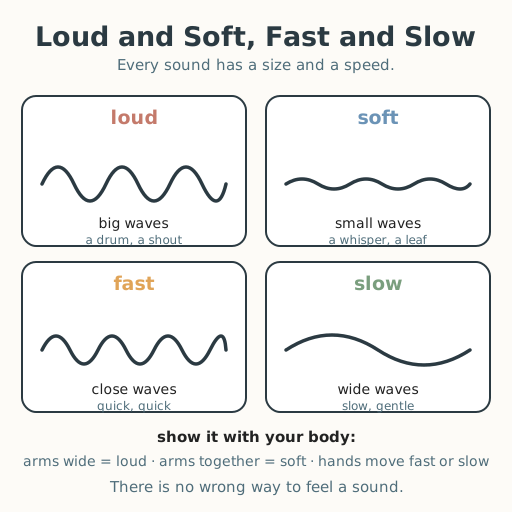
Lesson 4 — Loud and Soft, Fast and Slow
Summary
Learners explore two ways sounds differ: loud or soft, and fast or slow. They make sounds with their bodies and found objects, then listen and sort what they hear. Sound has a size and a speed, and every culture plays with both.
Objectives
- Tell the difference between loud and soft, and fast and slow, sounds they hear. (D07.S2.01.02)
Connection
Listen for a moment. Some sounds are loud — a drum, a shout, thunder — and some are soft — a whisper, a leaf falling, rain far away. Some are fast — running feet, a bird’s quick call — and some are slow — a slow wave, a long, low bell. Everywhere, music and the world itself are made of these two pairs. Today you will listen and sort sounds by loud or soft, and fast or slow.
Materials
- Hands, voices, and feet
- A small set of sound makers: a pot, a shaker, a cup, a leaf
Preparation
- Gather a few sound makers that clearly contrast (something loud, something soft).
- Arrange the group so everyone can hear and see the sound being made.
Facilitator note
This lesson is written to the learner (“you”) so it works in a classroom and for a self-directed learner. Keep contrasts big and obvious at first (“a loud clap” vs “a soft tap”), then make them finer. There is no wrong answer, but you can always ask, “what made you say soft?” — that is the thinking we want. For a learner who is Deaf or hard of hearing, teach the pairs as felt size and speed: a loud sound makes a bigger, stronger vibration and a soft one a smaller one; a fast beat moves quickly under the hand and a slow one moves gently. They sort by feeling the drum or floor, not only by hearing. A learner who does not speak answers with signals — arms wide for loud and together for soft, hands moving fast or slow. A learner who is blind or has low vision sorts by listening and by touch.
Procedure
- Gather (5 min). Close your eyes (or look down) and listen. What sound do you hear? Is it loud or soft? Is it fast or slow? These are two ways to describe any sound.
- Loud and soft (10 min). Clap loudly. Now tap your finger softly. Which is loud? Which is soft? Take turns making a loud sound and a soft sound, and let friends name which is which. If you can, feel the difference — a loud clap makes a bigger shake than a soft tap.
- Fast and slow (10 min). Pat your knees fast, then slow. Which is fast? Which is slow? Make a fast sound and a slow sound and let friends name them.
- Listen and sort (15 min). Play a sound — a pot, a shaker, a leaf, a voice, a stomp. Is it loud or soft? Is it fast or slow? Show your answer with your hands (wide for loud, together for soft; fast or slow with your hands). There is no wrong way to feel a sound.
- Close (5 min). Remember: every sound has a size (loud or soft) and a speed (fast or slow). Your ears — and your hands — can tell them apart.
Differentiation
- Support: Sort one pair at a time (loud/soft first); give very clear contrasts and let the learner echo each sound.
- Support (Deaf/HH): Sort by feeling vibration on a drum or the floor — bigger shake is loud, smaller is soft; quick beats are fast, gentle ones slow.
- Support (non-speaking): Answer with hand signals (wide/together, fast/slow).
- Extension: Invite learners to make a sound that is loud AND slow, then one that is soft AND fast, and name both parts.
Assessment
- Formative (observation): Does the learner tell loud from soft and fast from slow in sounds they hear or make?
Home connection
At home or outside, listen for three sounds. For each one, tell a grown-up: is it loud or soft, and fast or slow?