Lesson 05 — Moving to Show a Feeling
Learners move their bodies to show feelings — happy, angry, tired, and others — in response to music or a story. The body is a language for feelings, and there is no wrong way to move.
Objectives
Objectives
- D07.S3.01.01 Move their body to show a feeling such as happy, angry, or tired in response to music or a story.
Essential question
How do I move my body to show a feeling like happy, angry, or tired?
Key vocabulary
Materials
Standard materials
- Music or a short story to move to · 1 A short piece of music or a told story that suggests different feelings
- Open floor space · enough to move
Low-tech / no-cost
- The body alone Move in place, or in a small space, with no music at all
- A clapped or hummed rhythm Set the mood with voice and hands instead of a recording
Enriched / lab & device
- A few short music clips with different moods · 1 set One lively, one gentle, one slow and heavy, to move to in turn
- A mirror or a camera · 1 per group To see your own movement, or to watch it back
Works in different contexts
- large-group Move together in a circle, one feeling at a time, so everyone moves at once and no one performs alone
- multi-age Older learners name the feeling and younger learners move it; then trade
- self-directed A learner hears music or thinks of a feeling, moves to show it, and tells a grown-up or recording which feeling it was
- level-grouped Some learners show the feeling with just their face or hands; others use the whole body; match the challenge
- outdoor-only Move in a big open space to show feelings, letting the body go tall, low, fast, and slow
Lesson 5 — Moving to Show a Feeling
Summary
Learners discover that the body can speak feelings without words. To music or a story, they move to show happy, angry, tired, and feelings they choose. There is no wrong way to move — every body tells its own true story.
Objectives
- Move their body to show a feeling such as happy, angry, or tired in response to music or a story. (D07.S3.01.01)
Connection
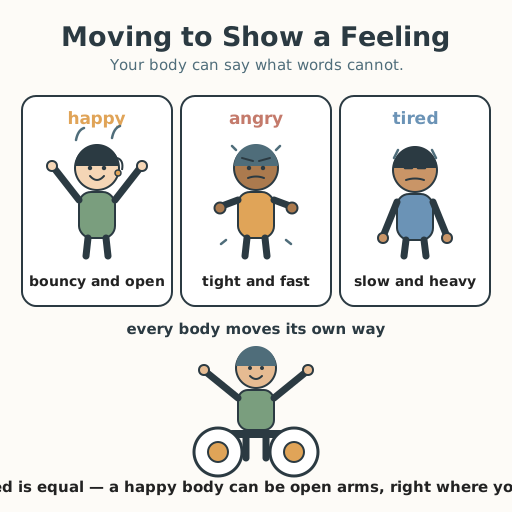
Think how your body already tells your feelings. When you are happy, you might bounce or spin; when you are tired, your arms and head grow heavy and slow; when you are angry, your body gets tight and small and fast. Everywhere in the world, people turn feelings into movement — in dance, in play, in greeting. Today you will let your body show a feeling on purpose, to music or a story.
Materials
- Music or a short story to move to
- Open floor space
Preparation
- Choose a short piece of music (or a told story) that suggests different moods.
- Clear a space big enough to move freely, and have a seated option for everyone.
Facilitator note
This lesson is written to the learner (“you”) so it works in a classroom and for a self-directed learner. Name the feelings clearly and move along with the learners — your body is a model, not a rule. There is no correct way to show a feeling; each learner’s movement is their own and every movement belongs. Never single out a learner to perform alone. A learner who uses a wheelchair or moves with support shows the feeling from where they are — a “tired” body can be a heavy head and slow hands; a “happy” body can be a bright face and open arms. A learner who is blind or has low vision follows a spoken prompt (“let your arms get heavy and slow”) or holds a partner’s elbow to feel the movement. A learner who is Deaf or hard of hearing follows your modeled movement and a visible beat — tap a drum or the floor so the feeling’s rhythm can be felt, and name feelings with sign or a gesture. A learner who does not speak shows the feeling with the body itself and “tells” how it felt by pointing or gesturing. Watching and copying is full participation.
Procedure
- Gather (5 min). Think of a feeling — happy, angry, tired. How does your body feel inside when you have that feeling? Feelings live in the body, not only the head.
- Warm up your body (5 min). Shake your hands, roll your shoulders, stretch tall. Your body is about to become a language.
- Move one feeling (10 min). Hear the music (or the story). What feeling does it suggest? Move your whole body to show it — happy might be bouncy and open; angry tight and fast; tired slow and heavy. There is no wrong way.
- Move more feelings (15 min). Change the music or the story, and move a new feeling. Try happy, angry, tired, and one more you choose — calm, excited, sad, brave. You can stay in one spot or travel through the space.
- Show and guess (10 min). Move a feeling while a friend watches. Can they guess which one? Then tell them how it felt in your body.
- Close (5 min). Remember: your body can say what words cannot. Every feeling is welcome, and every movement you make belongs.
Differentiation
- Support: Give one feeling and one clear prompt (“let your arms get slow and heavy like you are tired”); let the learner copy.
- Support (seated/adapted): Show the whole feeling from a chair — a happy face and open arms, tired shoulders, tight fists; moving just the face, hands, and shoulders is full participation.
- Support (blind/low-vision): Follow spoken movement prompts or hold a partner’s elbow to feel the movement.
- Support (Deaf/HH): Follow the modeled movement and a felt beat on a drum or the floor; name feelings with sign or gesture.
- Support (non-speaking): Show the feeling with the body; “tell” how it felt by pointing or gesturing.
- Extension: Invite learners to move a feeling that changes — start happy and slowly become tired — and name the change.
Assessment
- Formative (observation): Does the learner move their body to show a feeling in response to music or a story?
- Performance: The learner’s movement, observed live (or in a seated/adapted form).
Home connection
At home, pick a feeling and show it with your body while a grown-up guesses. Then ask them to show a feeling for you to guess.