Lesson 06 — Pretending to Be a Character
Learners step into a story and become its characters using voice, face, and body. Pretending is a way to feel what another person feels — a small, safe lesson in walking in someone else's shoes.
Objectives
Objectives
- D07.S3.01.02 Pretend to be a character in a simple story and use their voice, face, and body to show it.
Essential question
How do I become a character using my voice, face, and body?
Key vocabulary
Materials
Standard materials
- A simple story with a few characters · 1 A short tale with kind, recognizable characters from any culture, told respectfully
- A turn marker · 1 A neutral object (a stone, a cloth knot) to show whose turn it is to speak
- Open floor space · enough to move
Low-tech / no-cost
- Voice, face, and body only The body is the costume; no props needed
- A told story Hear the story aloud and act the characters as it is told
Enriched / lab & device
- A few simple dress-up cloths · 1 box Scarves and cloths to help choose a character's look
- A camera or tablet · 1 per group Optional, to watch the scene back and see the characters
Works in different contexts
- large-group Groups of learners play the same character together, then swap roles, so everyone is part of the story at once
- multi-age Older learners tell or read the story while younger learners act it out; then trade places
- self-directed A learner chooses a character, acts them with voice, face, and body, and tells a grown-up or friend who they are
- level-grouped Some learners focus on one part (just the voice, or just the walk); others use voice, face, and body together
- outdoor-only Act the story outside, using found things — a stick for a cane, a leaf for a dish — to become the character
Lesson 6 — Pretending to Be a Character
Summary
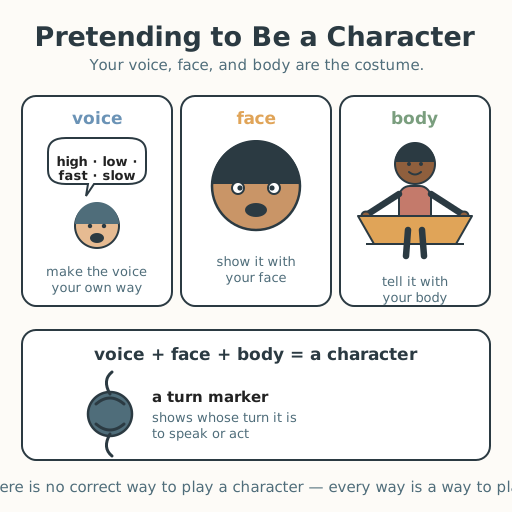
Learners become characters in a simple story, showing who they are with voice, face, and body. Pretending helps a child feel what another person feels. The body and voice are the costume, and every character can be played many ways.
Objectives
- Pretend to be a character in a simple story and use their voice, face, and body to show it. (D07.S3.01.02)
Connection
When you play make-believe, you get to be someone else for a while — a cook, a helper, a grandparent, a friend. People everywhere tell stories and act them out to share ideas and understand each other. Your voice, your face, and your body are your costume — you carry them with you always. Today you will become a character from a story.
Materials
- A simple story with a few characters
- A turn marker (a stone or cloth knot)
- Open floor space
Preparation
- Choose or tell a short story with two or three clear, kind characters from any culture, told respectfully as a story to play with.
- Clear a space for acting; set out the turn marker and any cloths.
Facilitator note
This lesson is written to the learner (“you”) so it works in a classroom and for a self-directed learner. Choose a story whose characters are kind and recognizable, and tell it as a story to play with — never co-opting sacred or ceremonial roles. Use a neutral turn marker (a stone or cloth knot) rather than any single culture’s ceremonial object. Never push a shy learner to perform; watching and copying is full participation, and a learner may join a group of actors instead of acting alone. A learner who uses a wheelchair or moves with support plays the whole character from where they are — a “walk” becomes a lean, a nod, or a hand gesture, and the face and voice carry the character fully. A learner who does not speak shows the character with face and body, or signs the character’s key action. A learner who is blind or has low vision receives the story by ear and plays the character fully with voice and body — seeing is not needed to become the character. A learner who is Deaf or hard of hearing receives the story through sign, gesture, or pictures and plays the character with face, body, and movement. Celebrate every character; there is no correct way to play one.
Procedure
- Gather (5 min). Sit and listen to a short story. Who is in it? What do they do? Pick a character you would like to be.
- Meet your character (10 min). How does your character stand? How do they talk — fast, slow, high, low? Try their voice, their face, and their body. You might be a helper carrying something heavy, or a kind neighbor with a slow, gentle voice.
- Become the character (15 min). Act a small part of the story as your character, using voice, face, and body together. Trade characters and try another one. Holding the turn marker means it is your turn to speak or act; passing it means a friend’s turn.
- Show and guess (10 min). Act your character for a friend. Can they guess who you are? Then tell them how it felt to be that person.
- Close (5 min). Remember: pretending helps us feel what others feel. In every story there is a whole world of characters — and you can be any of them.
Differentiation
- Support: Give one simple character and one action (“you are the helper carrying the basket”); let the learner copy.
- Support (seated/adapted): Play the whole character from a chair — face, voice, and hands; a “walk” becomes a lean or a nod, and that is full participation.
- Support (non-speaking): Show the character with face and body, or sign the key action.
- Support (blind/low-vision): Receive the story by ear and play the character with voice and body.
- Support (Deaf/HH): Receive the story through sign, gesture, or pictures and play the character with face, body, and movement.
- Extension: Invite learners to add a new character to the story and act how that character would join in.
Assessment
- Formative (observation): Does the learner use voice, face, or body to show a character in the story?
- Performance: The learner’s character, observed live (in any adapted form).
Home connection
With someone at home, pick a person from a story or a memory and both pretend to be them for a minute. Ask each other how it felt.