Lesson 07 — Building with a Plan
Learners think of a purpose, make a simple plan, and build something for it — a tower, a bridge, a boat, a little home. Building is thinking with the hands, and every structure has a reason to be.
Objectives
Objectives
- D07.S4.01.01 Build something with a simple plan in mind and tell what it is for.
Essential question
How do I build something with a plan in mind and tell what it is for?
Key vocabulary
Materials
Standard materials
- Blocks, boxes, or cups · a pile per group Anything that stacks and joins
- Tape, string, or cloth · per group For joining parts together
Low-tech / no-cost
- Sticks, stones, sand, or mud Build with what the ground gives; mud joins and holds
- Hands and found objects Cups, leaves, twigs, and stones — build with whatever is near
Enriched / lab & device
- A building set with connectors · 1 set per group Interlocking pieces for a sturdier structure
- A picture of one local and one far-away structure · 1 set A house, a bridge, a boat, or a basket to inspire ideas
Works in different contexts
- large-group Divide into small build teams, each with its own material pile, and have a quick "show and tell" of what each team made and what it is for
- multi-age Older learners help plan and hold pieces steady while younger learners stack and press; build one thing together
- self-directed A learner says or sketches a plan, builds it, and tells a grown-up, friend, or the mirror what it is for
- level-grouped Group by build experience — some start with one purpose and two materials, others plan a bigger structure — and match the challenge
- outdoor-only Build from nature — stick bridges, stone towers, leaf boats — planning the purpose before you start
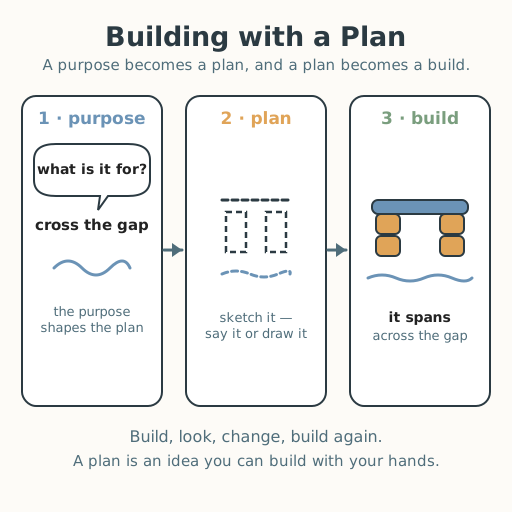
Lesson 7 — Building with a Plan
Summary
Learners start with a purpose, make a simple plan, and build something for it. They discover that builders everywhere — of homes, bridges, boats, and baskets — think first about what the thing is for. A plan is an idea you can build with your hands.
Objectives
- Build something with a simple plan in mind and tell what it is for. (D07.S4.01.01)
Connection
Think of the things people build everywhere — a house to keep out rain, a bridge to cross a river, a basket to carry food, a boat to float. Every one begins with the same question: what is it for? The answer is the purpose, and it shapes the plan. Today you will choose a purpose, make a simple plan, and build something for it.
Materials
- Blocks, boxes, or cups
- Tape, string, or cloth for joining
Preparation
- Gather building materials into piles for small groups or individuals.
- Set out a few simple joiners (tape, string, cloth) so structures can hold together.
Facilitator note
This lesson is written to the learner (“you”) so it works in a classroom and for a self-directed learner. Keep the plan simple — a spoken sentence or a few sketched lines is enough; a written plan is not required. Ask “what is it for?” rather than “what is it?” — purpose is the heart of this strand. If a build falls over, treat it as information, not failure: “what could you change so it stands?” Honor every structure; a wobbly tower is still a thinker’s tower. A learner with limited fine motor can direct a partner who stacks and presses, or build from larger, lighter pieces. A learner who is blind or has low vision builds by feel, with a partner or grown-up naming the parts out loud, and tells the purpose by touch. Every plan and every build belongs.
Procedure
- Gather (5 min). Look at the materials. What could you build with them? Think of one thing with a purpose — a tower to reach high, a bridge to cross a gap, a boat to float, a little home to hold a toy.
- Make a plan (5 min). Before you build, say or think your plan: what will it do? What will hold it up? You can say it, point to the parts, or sketch a few lines in the air or on the ground.
- Build (20 min). Stack, join, and arrange to match your plan. If it wobbles, that is a clue — try a wider base or a tighter join. Build, look, change, build again. Your plan can change as you learn.
- Tell what it is for (10 min). Show your build to a friend or grown-up and tell (or point to) what it is for and which part does the job.
- Close (5 min). Remember: builders everywhere turn a purpose and a plan into something useful. Your hands just did that too.
Differentiation
- Support: Offer one purpose and one simple plan (“build a tower of five blocks”) and model a steady base.
- Support (fine motor): Use larger, lighter pieces, or build with a partner who stacks while the learner plans and directs.
- Support (non-speaking): Tell the purpose by pointing to the part that does the job.
- Support (blind/low-vision): Build by feel; a partner names the parts and the learner tells the purpose by touch.
- Extension: Invite learners to plan two different builds for the same purpose and tell which one works better.
Assessment
- Formative (observation): Does the learner build something with a plan in mind and tell (or show) what it is for?
- Artifact (portfolio): A photo or drawing of the build and its purpose, kept in the portfolio.
Home connection
At home, pick a small purpose — carrying toys, holding water, keeping a door open — and build something for it from what you find. Tell a grown-up what it is for.