Lesson 04 — Washing My Hands
Learners practice a complete handwashing routine on their own — wet, lather, scrub every surface, rinse, and dry — learn when to wash, and discover how soap and water carry germs away, all while using water with care.
Objectives
Objectives
- D03.S4.01.01 Perform daily self-care routines such as washing hands, brushing teeth, and dressing with growing independence.
Essential question
How do I wash my hands to keep myself and others healthy?
Key vocabulary
Materials
Standard materials
- Soap and water · 1 station A sink, basin, bucket, or pour jug with safe water and soap
- A towel or clean cloth · per learner For drying hands
Low-tech / no-cost
- A bucket or bowl of water and soap or ash Handwashing works with running water, a pour jug, or ash when soap is scarce; demonstrate with what is available
- Voice and body Practice the handwashing motions in the air while singing; no water needed to learn the moves
Enriched / lab & device
- A timer or a short song · 1 A 20-second song or timer so learners wash long enough
- Glitter or washable paint · small amount Sprinkle a pinch on hands to show how soap and water wash "germs" away
Works in different contexts
- large-group Demonstrate once at a visible station, then send small groups to wash on their own while others sing the song and practice the motions in the air
- self-directed A learner follows the steps at a basin alone, singing to time themselves, then checks their own hands for missed spots
- outdoor-only Wash at an outdoor tap, a stream (only with safe water), or a shared jug; conserve water by wetting, lathering with the water off, then rinsing
- multi-age Older learners check that younger ones reach fingers, thumbs, and wrists, while each learner still does the washing themselves
- level-grouped Learners who can already do the steps wash fully on their own; others practice the motions in the air with support before trying at the station
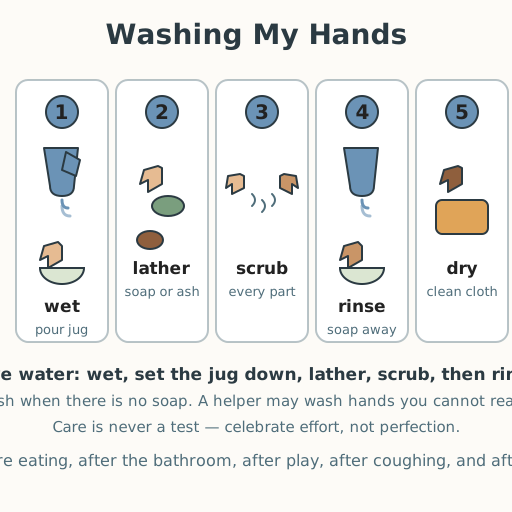
Lesson 4 — Washing My Hands
Summary
Learners practice a complete handwashing routine with growing independence — wet, lather, scrub every surface, rinse, and dry — and learn when to wash. They discover how soap and water carry germs away, and they use water with care so there is enough for everyone. Care is never a test.
Objectives
- Perform daily self-care routines such as washing hands with growing independence. (D03.S4.01.01)
Connection
Your hands touch everything: a door, a pet, the ground, a friend’s hand, your food. Washing your hands is one of the simplest, most powerful ways to keep yourself and the people around you healthy. Whether you wash at a sink, a tap, a bucket, a pour jug, or a stream, the trick is the same: water, soap, and a good scrub. Today you will practice doing it all by yourself.
Materials
- Soap and water (a sink, basin, bucket, or pour jug with safe water)
- A towel or clean cloth for drying
Preparation
- Set up a handwashing station with safe water and soap (or ash, if soap is scarce).
- Have a short 20-second song ready to time the scrub.
- Plan how water will be conserved — where water is scarce, use the wet–lather–rinse method.
Facilitator note
This lesson is written to the learner (“you”). Model the steps slowly, then step back — Grade 1 is about growing independence. Watch each learner and gently support, but let them do the washing. Honor every context: where water is scarce, teach the “wet, turn off (or put the jug down), lather, rinse” method that saves water, and note that ash can work when there is no soap. Where a learner cannot use their hands, a caregiver or older peer can help wash them — the goal is clean hands, not doing it alone. Care is never a test — celebrate effort, not perfection. A learner who does not use a speaking voice points or acts out the steps; a learner who is blind or has low vision is guided through each motion hand-over-hand. A learner who is deaf or hard of hearing follows the steps by watching the demonstration from the front and using picture step cards or hand-over-hand modeling, since every step is shown, not only told. The health facts here are from the World Health Organization: clean hands with soap remove germs that cause sickness. This lesson extends Kindergarten’s “Washing Hands, Washing Me” (U.00.002) into independent practice.
Procedure
- Gather (5 min). Think of all the things your hands touched today. Hands carry tiny things you cannot see — we call them germs — that can make bodies sick. Washing hands washes germs away.
- Remember the steps (5 min). Say the steps and practice the motions in the air:
- Wet your hands.
- Lather them with soap (or rub with ash).
- Scrub every part: palms, backs, between fingers, thumbs, wrists, and under nails.
- Rinse the soap away.
- Dry with a clean cloth.
- Save water (5 min). Where water is precious, wet your hands, turn the water off (or put the jug down), then lather and scrub — and only then rinse. Water is a treasure; use just enough.
- Wash for real, on your own (15 min). Go to the station and wash your hands by yourself, doing all five parts. Sing a short song while you scrub — about 20 seconds is enough. Then check your own hands: did I miss a spot?
- When do we wash? (10 min). Name the times hands need washing: before eating, after the bathroom, after playing outside, after coughing or sneezing, and after touching an animal. Point to a partner and share one time you will remember.
- Close (5 min). Show your clean hands. Washing your hands on your own is a small act of care — for you and for everyone around you.
Differentiation
- Support: Practice the motions in the air first, then wash together once before trying alone; use a picture step card if it helps.
- Support (deaf/hard-of-hearing): Stand where the learner can see your face and hands; pair each step with its picture card and a clear visual model.
- Support (motor-difference): A caregiver or peer assists with parts that are hard, while the learner leads as much as they can.
- Extension: Invite learners to teach the six steps to someone younger and to notice one more way to save water while washing.
Assessment
- Formative (observation): Can the learner wash their hands with growing independence, showing the steps and naming one time to wash?
- Self: The learner checks their own hands for missed spots after washing.
Home connection
Wash your hands on your own before one meal today. Show a grown-up that you can do all the steps, and notice one way to save water while you wash.
Resources
- World Health Organization, “Hand hygiene” (why and how to clean hands): https://www.who.int/teams/integrated-health-services/infection-prevention-control/hand-hygiene