Lesson 08 — Trusted Adults and Asking for Help
Learners name their trusted adults at home, school, and in their neighborhood, and practice asking for help clearly when they feel unsafe or uncomfortable — the gentle capstone of the unit's safety strand.
Objectives
Objectives
- D03.S4.01.02 Know that their body belongs to them and tell a trusted adult if someone makes them feel unsafe or uncomfortable.
Essential question
Who are my trusted adults, and how do I ask for help when I feel unsafe or uncomfortable?
Key vocabulary
Materials
Standard materials
- A "help hand" template · per learner A hand outline to fill with trusted adults — one per finger
- Crayons · per learner For drawing trusted adults
- Scenario cards · 1 set Simple picture cards of times to ask for help — a cut, feeling sick, feeling scared or unsafe, feeling lost
Low-tech / no-cost
- The learner's own hand Trace a hand in the air or in the dirt and name one trusted adult per finger; no paper needed
- Voice and body Practice the help words aloud and act out asking a trusted adult; no cards needed
Enriched / lab & device
- A "who can help" picture chart · 1 A chart of trusted adults — caregiver, teacher, nurse, neighbor — to name who to ask
- Role-play puppets or dolls · 1 set To act out asking a trusted adult for help
Works in different contexts
- large-group Practice the help words together, then let pairs role-play with a doll while others draw their help hands
- self-directed A learner traces their hand, fills each finger with a trusted adult, and practices the help words with a grown-up or older peer
- outdoor-only Act out asking for help on a walk — a scrape, feeling lost — and practice finding the nearest safe grown-up; trace a hand in the dirt
- multi-age Older learners play the "trusted adult" in role-plays so younger learners can practice asking a real person
- level-grouped Some learners practice one help phrase; others ready for more name three trusted adults and practice telling in order
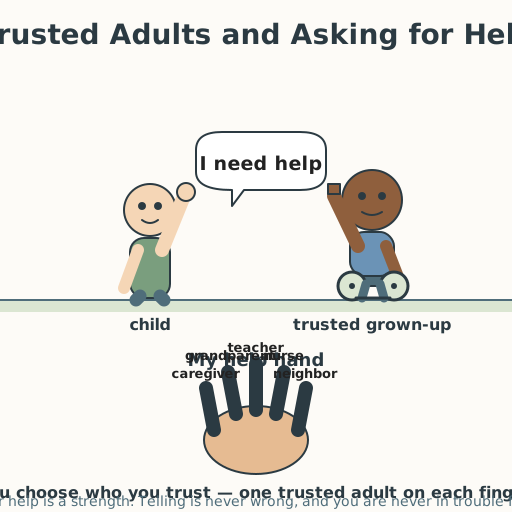
Lesson 8 — Trusted Adults and Asking for Help
Summary
Learners name their trusted adults at home, at school, and in their neighborhood, and practice asking for help clearly when they feel unsafe or uncomfortable. They learn that asking for help is a strength and that telling is never wrong — the gentle capstone of the unit’s safety strand.
Objectives
- Know that their body belongs to them and tell a trusted adult if someone makes them feel unsafe or uncomfortable. (D03.S4.01.02)
Connection
If you fell and hurt your knee, you would tell a grown-up. If something about your body or a touch made you feel unsafe or uncomfortable, you would tell a grown-up too — that is just as important, and just as brave. Some grown-ups are trusted adults: people who listen to you and help you. Today you will name your trusted adults and practice asking for help.
Materials
- A “help hand” template (a hand outline)
- Crayons
- Scenario cards (a cut, feeling sick, feeling scared or unsafe, feeling lost)
Preparation
- Prepare a “help hand” template — a hand outline with five fingers.
- Prepare simple scenario cards of times to ask for help.
- Read the facilitator note fully, including the safeguarding guidance, before teaching.
Facilitator note
This lesson is written to the learner (“you”). Read this note fully before teaching.
- Keep the tone warm, calm, and reassuring. Asking for help is a strength, never a weakness, and telling is never wrong.
- Help each learner name trusted adults who are realistically available to them. If a learner names no one at home, gently guide them toward a teacher, nurse, school counselor, or neighbor — without pressure and without implying anything about their family.
- Frame “keep telling” supportively, as persistence, not as “adults won’t believe you”: if the first grown-up is busy or doesn’t understand, tell another one, and another, until someone listens and helps.
- Honor every way of asking: speaking, signing, pointing, showing a picture, or tapping a shoulder all work. A learner who is deaf or hard of hearing practices in their sign language or points to the scenario and help cards; face the learner for every demonstration so the words are visible on the lips and hands.
- If a child discloses abuse or an unsafe situation: stay calm; believe them; thank them for telling you; do not promise secrecy; do not press for details or ask leading questions; tell your designated safeguarding lead and follow your local child-protection procedure immediately.
- The “my trusted adults” help hand is a unit portfolio artifact; keep learners’ drawings. This lesson builds on Kindergarten’s “Asking for Help” (U.00.002) and closes the unit’s safety strand.
Procedure
- Gather (5 min). Remember last time: your body belongs to you, and if something makes you feel unsafe or uncomfortable, you tell a trusted adult. Today we will learn who your trusted adults are and how to ask for help.
- Who is a trusted adult? (10 min). A trusted adult is a grown-up who listens to you and helps you. At home, that might be a caregiver, a grandparent, an aunt, or an uncle. At school, a teacher, a nurse, or a counselor. In your neighborhood, a trusted neighbor. You get to choose who you trust — a trusted adult is someone you feel safe with.
- How do I tell? (15 min). Practice the words in a clear, calm voice: “I need help.” “I feel unsafe.” “Someone touched me in a way I didn’t like.” You can also sign, point, show a picture, or tap a shoulder — every way of asking works. Take turns with a partner or a doll, one of you asking, one listening.
- Keep telling until someone helps (5 min). If the first grown-up is busy or doesn’t understand, tell another one — and another — until someone listens and helps. Telling is never wrong, and you are never in trouble for telling.
- Draw your “help hand” (10 min). Trace your hand. On each finger, draw or write one trusted adult you could tell. This is your help hand — keep it where you can see it.
- Close (5 min). Say it together: “Asking for help is a strength. I am never in trouble for telling. Keeping my body safe is my right.”
Differentiation
- Support: Use two or three scenarios and practice one help phrase many times; model the words and a calm voice.
- Support (non-speaking): Practice asking with a sign, a picture card, or a point; fill the help hand with drawn faces rather than words.
- Extension: Invite learners to add a third trusted adult and to practice telling two adults in order, as they would if the first were busy.
Assessment
- Formative (observation): Can the learner name at least two trusted adults and practice asking for help clearly, in their own way?
- Portfolio: The “my trusted adults” help-hand drawing becomes a unit portfolio artifact.
Home connection
With a grown-up, name your trusted adults and practice saying “I need help” in a clear, calm voice. Keep your help hand somewhere you can see it.