Lesson 07 — My Body Belongs to Me
Learners discover, gently and without fear, that their body belongs to them — that "no" and "stop" are always okay, that they may decline a hug or handshake, and that if a touch makes them feel unsafe or uncomfortable they can tell a trusted adult.
Objectives
Objectives
- D03.S4.01.02 Know that their body belongs to them and tell a trusted adult if someone makes them feel unsafe or uncomfortable.
Essential question
Who does my body belong to, and what can I do if a touch feels unsafe or uncomfortable?
Key vocabulary
Materials
Standard materials
- A doll or stuffed animal · 1 For gentle, pretend role-play so practice is not about real bodies
- Paper and crayons · per learner For a "my body, my rules" drawing
- A "yes / stop" picture card · 1 A simple visual a learner can point to when they mean "no" or "stop"
Low-tech / no-cost
- Voice and body Practice saying "no, thank you" and "stop" in a clear, calm voice; no cards needed
- Found objects Use a doll, a stuffed toy, or a friend (pretend) to practice consent words
Enriched / lab & device
- A picture book about body boundaries · 1 A gentle, age-appropriate story about consent and saying no
- A "my trusted adults" template · per learner A hand outline to fill with trusted adults (links to the next lesson)
Works in different contexts
- large-group Practice consent words together in the circle, then let learners take turns with a doll; keep every role-play pretend and gentle
- self-directed A learner reads or hears the steps, practices saying "no, thank you" and "stop" with a doll, and draws one rule about their body
- outdoor-only Practice the words while walking or in a quiet spot; use a stick figure drawn in the dirt to talk about "my body, my rules"
- multi-age Older learners model calm, clear "no/stop" words and help younger ones practice; an older peer may act as the trusted adult in role-play
- level-grouped Some learners practice one consent phrase; others ready for more name who they would tell, linking toward the next lesson
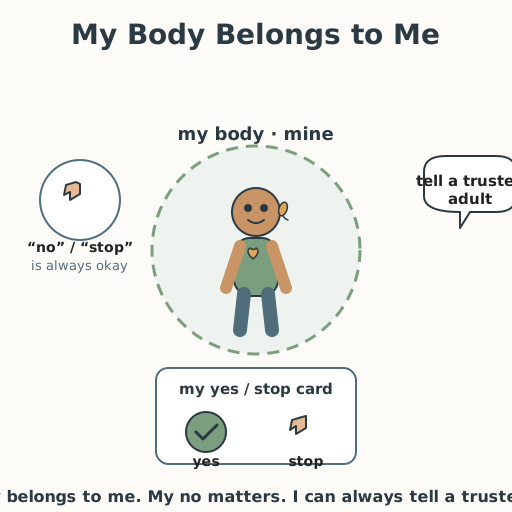
Lesson 7 — My Body Belongs to Me
Summary
Learners discover, gently and without fear, that their body belongs to them. They learn that “no” and “stop” are always okay, that they may decline a hug or handshake and be respected, and that if a touch makes them feel unsafe or uncomfortable they can tell a trusted adult. The message is empowering, never frightening, and never places fault on the child.
Objectives
- Know that their body belongs to them and tell a trusted adult if someone makes them feel unsafe or uncomfortable. (D03.S4.01.02)
Connection
You have spent this unit caring for your body — washing it, feeding it, dressing it. Caring for your body also means knowing one big, true thing: your body belongs to you. It is yours. Because it is yours, you get to say who touches you and how, and you get to say “no” or “stop” any time. Today you will practice saying what is true: my body belongs to me.
Materials
- A doll or stuffed animal for gentle, pretend role-play
- Paper and crayons
- A “yes / stop” picture card
Preparation
- Choose a soft doll or stuffed animal to stand in for bodies during practice, so role-play stays gentle and pretend.
- Prepare a simple “yes / stop” picture card a learner can point to.
- Read the facilitator note fully, including the safeguarding guidance, before teaching.
Facilitator note
This lesson is written to the learner (“you”). This is the unit’s most sensitive lesson. Read this note fully and prepare yourself before teaching.
- Keep it gentle and brief. The message is empowering — “tell a trusted adult” — never “be afraid of everyone.” Do not use frightening or graphic content, and do not go beyond “tell a trusted adult” for any question about unsafe touch.
- Do not use anatomical names. Stay with “the parts of your body that your clothes cover are private — they belong only to you.” Nothing more is needed at this age.
- Model and practice consent in your own classroom today: a child may decline a hug or a handshake, and that refusal is respected. Greetings differ around the world — hugs, handshakes, joined palms, bows, cheek-kisses — but consent applies to all of them: a child may decline any touch they do not want. Say “no” or “stop” is always okay, and when a friend says it, we stop right away and listen.
- Never imply a child is at fault. If anything makes a child feel unsafe or uncomfortable, it is never their fault, and they are never in trouble for telling.
- Keep all practice with the doll or stuffed animal, never with real bodies.
- If a child discloses abuse or an unsafe situation: stay calm; believe them; thank them for telling you; do not promise secrecy; do not press for details or ask leading questions; tell your designated safeguarding lead and follow your local child-protection procedure immediately.
- Honor every way of saying no: a learner who does not use a speaking voice may sign, point to the “stop” card, raise a hand, or show a picture. A learner who is blind or has low vision practices the words aloud and is told the “yes/stop” card by touch. A learner who is deaf or hard of hearing practices in the sign language they use and points to the “yes/stop” card; keep all demonstrations where they can be clearly seen.
- This lesson builds on Kindergarten’s “My Body Is My Home” and “Asking for Help” (U.00.002) and leads into the next lesson on trusted adults.
Procedure
- Gather (5 min). Put your hand over your heart. This body is yours — your only one, your whole life long. It belongs to you. You have cared for it in this unit, and caring for it also means knowing it is yours.
- Your body belongs to you (10 min). Because your body is yours, no one may touch you in a way you do not want. The parts of your body that your clothes cover are private — they belong only to you. Other people’s bodies belong to them, too, and we treat every body with care and respect.
- “No” and “stop” are always okay (15 min). You may always say “no, thank you” or “stop” — even to a grown-up, even to someone who loves you, even to a friend — if a touch or a game makes you uncomfortable. People around the world greet in many ways — a hug, a handshake, a kiss on the cheek, joined palms, or a bow — and whatever the greeting, your body is still yours: you may choose to skip a hug, a handshake, or any touch you do not want. And when a friend says “no” or “stop,” we stop right away and listen. Practice with the doll: say “no, thank you” and “stop” in a clear, calm voice — or sign, or point to the “stop” card. Every way of saying no works.
- Safe and uncomfortable feelings (10 min). A safe touch is one you welcome — a hug you asked for, a high-five, holding hands on a walk. An uncomfortable touch is one that makes your body feel “no” inside — your tummy tight, your heart fast, wanting to get away. If anything makes you feel unsafe or uncomfortable, you can say “stop” and tell a trusted adult. It is never your fault, and you are never in trouble for telling.
- Draw “my body, my rules” (5 min). Draw one thing only you decide about your body — who you hug, when you say stop, who helps you wash.
- Close (5 min). Say it together: “My body belongs to me. My no matters. I can always tell a trusted adult.”
Differentiation
- Support: Role-play with the doll and practice one phrase many times; model the words and a calm voice.
- Support (non-speaking): Practice “no/stop” with a sign, a raised hand, or a point to the “yes / stop” card.
- Extension: Name two trusted adults you could tell if something felt wrong — a bridge to the next lesson on asking for help.
Assessment
- Formative (observation): Can the learner say (or show, in their own way) that their body belongs to them, that “no/stop” is always okay, and that they can tell a trusted adult?
- Self: The learner names one person they could tell if something felt unsafe or uncomfortable.
Home connection
With a trusted grown-up, practice saying “my body belongs to me” and “no, thank you.” Talk together about the trusted adults you could tell if something ever felt wrong.