Lesson 04 — Two Celebrations, Alike and Different
Learners compare how two families or communities celebrate or mark the same kind of event — a birthday, harvest, or new year — noticing what is different and what is alike, without ranking either.
Objectives
Objectives
- D08.S2.01.02 Compare how two families or communities celebrate or mark an event, such as a birthday, harvest, or new year, and notice what is different and what is alike.
Essential question
How do two families or communities mark the same kind of event, and what is alike and different?
Key vocabulary
Materials
Standard materials
- Two celebration description cards · 2 Two gentle celebrations of the same kind of event from different regions — such as two new years or two harvests — each described respectfully with its meaning
- A large "alike / different" chart · 1 Two circles that overlap, or two columns, for sorting what is the same and what is different
Low-tech / no-cost
- Two told celebrations The facilitator tells both celebrations from memory, respectfully; no cards needed
- A drawn Venn on the ground Two overlapping circles drawn in the dirt or on paper for placing "alike" and "different" findings
Enriched / lab & device
- Photos or a short video from each celebration's own community · 1 set Shown respectfully, never as a costume; from the communities themselves where possible
- Recording of each celebration's music · 1 Optional — a short clip of song or music from each, to notice what is alike and different
Works in different contexts
- large-group Tell both celebrations to the whole circle, then sort findings into the "alike" and "different" sides together, one learner placing each
- self-directed The learner reads both descriptions, sorts findings into the two circles, and tells a grown-up or peer one alike and one different
- outdoor-only Draw the two overlapping circles large on the ground and place pebbles or leaves for each "alike" and "different" finding
- level-grouped Pairs of learners who are ready coach others with the question "what do both do?" and "what is only in one?"
Lesson 4 — Two Celebrations, Alike and Different
Summary
Learners compare how two families or communities mark the same kind of event — a birthday, harvest, or new year — and notice what is different and what is alike, holding both with equal respect.
Objectives
- Compare how two families or communities celebrate or mark an event, such as a birthday, harvest, or new year, and notice what is different and what is alike. (D08.S2.01.02)
Connection
All over the world, people mark the turn of a year. Some families welcome a new year with a shared meal and a red lantern; others mark it with a spring table of seven things that begin with the same sound. The foods and words differ — but in both, people gather with loved ones and hope for a good year. Comparing two celebrations is a way to see both what makes each one special and what all people share.
Materials
- Two celebration description cards (two new years, or two harvests, from different regions)
- A large “alike / different” chart (two overlapping circles or two columns)
Preparation
- Choose two gentle celebrations of the same kind of event, from different regions, and learn to describe each respectfully with its meaning.
- Draw the “alike / different” chart large.
Facilitator note
This lesson is written to the learner (“you”) so it works in a classroom and for a self-directed learner. The discipline is equal respect. Compare, never rank: do not say one celebration is bigger, better, or more “correct.” Describe each from inside its meaning — a Lunar New Year in an East or Southeast Asian community means family and a fresh start; a harvest festival in a West African community means gratitude for the land; Nowruz in a Persian or Central Asian community means spring and renewal. Both are complete and worthy exactly as they are. Avoid costumes and caricature entirely; no learner is asked to dress up or “perform” a culture. Honor adopted, fostered, and chosen families, and let a learner pass on sharing their own.
Procedure
- Gather (5 min). Think of a celebration you know — a new year, a birthday, a harvest. What do people do? (You do not have to share it.)
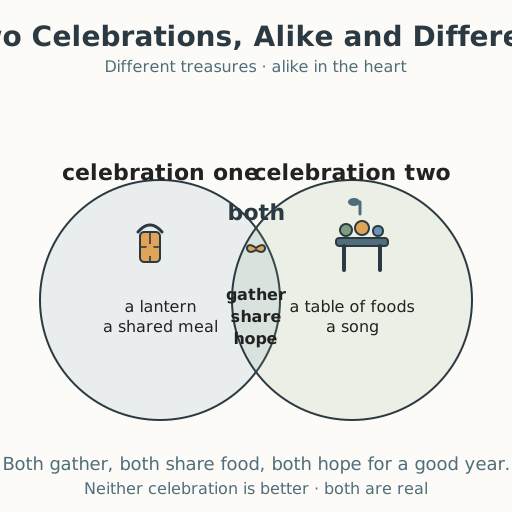
- Meet two celebrations (15 min). Listen to two celebrations of the same kind of event. For example: one community welcomes the new year with a shared meal and a lantern; another welcomes it with a spring table and a song. Listen for the people, the foods, the words, and the feelings.
- Find what is alike (10 min). What do both do? Both gather. Both share food. Both hope for a good year. Place those on the “alike” side, where the two circles overlap.
- Find what is different (10 min). What is special to each one? The foods, the words, the colors, the songs. Place those on the two outer sides.
- Close (5 min). Different celebrations are different treasures — and alike in the heart: people gathering with hope and love. Neither is better; both are real.
Differentiation
- Support: Focus on one “alike” and one “different”; offer the words “gathering” and “food” as a starting place.
- Non-speaking: A learner places pictures or objects on the chart instead of speaking.
- Blind/low-vision: Describe each celebration’s sounds, foods, and smells richly; sort findings by placing textured markers on the chart.
- Deaf/HH: Tell each celebration with a picture sequence or in sign so it is seen; sort findings by placing picture cards or objects on the chart.
- Motor difference: Use large, easy-to-grip markers or cards; a partner places each finding while the learner directs with a point, a word, or eye-gaze.
- Extension: Add a third celebration and find something alike across all three.
Assessment
- Formative (observation): Can the learner name at least one thing alike and one thing different between the two celebrations?
- Formative (oral/performance): Does the learner describe both with equal respect, without ranking?
Home connection
With a grown-up, think of two different families or communities you know that mark the same kind of event. What do they do that is alike? What is different?