Lesson 05 — My Place — Land, Water, Weather, Living Things
Learners describe the place where they live — its land, water, weather, and living things — and name one way that place shapes how people live there.
Objectives
Objectives
- D08.S3.01.01 Describe the place where they live, including land, water, weather, and living things, and one way it shapes how people live there.
Essential question
What is my place like, and how does it shape how people live here?
Key vocabulary
Materials
Standard materials
- A "my place" picture frame or chart · 1 per learner A page divided into four parts — land, water, weather, living things — for drawing or pasting
- Paper and crayons · per learner For drawing the place and how people live there
Low-tech / no-cost
- Direct observation Look out a window or step outside — the land, sky, water, and living things are the materials
- Found objects from the place A stone, a leaf, a feather, a cup of water — things to touch that tell about the place
Enriched / lab & device
- Photos of the local place in two seasons · 1 set To compare how the same place looks and how people live in it across the year
- A guest who knows the land · 1 Optional — an elder or local knowledge-keeper shares how the place shapes life here
Works in different contexts
- large-group Fill the four-part chart together on a big board, the whole group calling out one thing for each part
- self-directed The learner observes and fills their own four-part chart, then tells a grown-up or peer one way the place shapes life
- outdoor-only Do the whole lesson outside, gathering one real thing for each of the four parts — a stone, a handful of water or dry soil, a cloud to name, a leaf
- multi-age Older learners write the four labels while younger learners draw or place the found objects
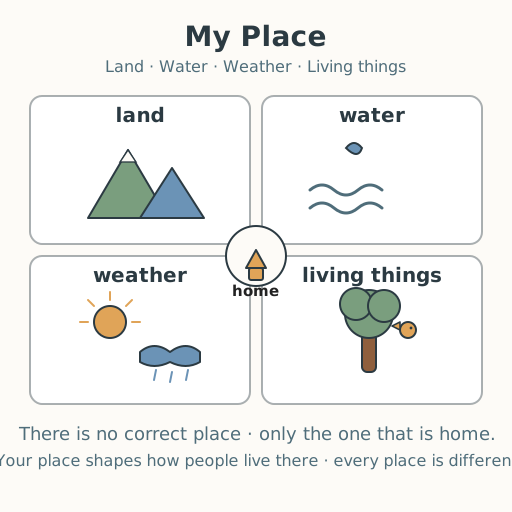
Lesson 5 — My Place: Land, Water, Weather, Living Things
Summary
Learners describe the place where they live — its land, water, weather, and living things — and name one way that place shapes how people live there. There is no “correct” place; there is only the place that is home.
Objectives
- Describe the place where they live, including land, water, weather, and living things, and one way it shapes how people live there. (D08.S3.01.01)
Connection
Every home sits in a particular place: flat and wide, or hilly, or by the sea, or in the mountains. Some places are hot and dry, some cold and snowy, some warm and rainy. The place you live shapes little everyday things — what people wear, how they build their homes, what they grow or catch to eat, where their water comes from. Looking closely at your own place is how geography begins.
Materials
- A “my place” chart divided into land, water, weather, and living things
- Paper and crayons
Preparation
- Choose a way to observe the local place: a window, a short step outside, or remembered and shared descriptions.
- Prepare the four-part chart for each learner.
Facilitator note
This lesson is written to the learner (“you”) so it works in a classroom and for a self-directed learner. No travel is needed — the place learners already live is the whole subject. Never rank places: a desert is not “worse” than a forest, a city is not “better” than a farm. Say “different places, different ways of living,” and mean it. Honor every home shape: some learners have moved, some live in two homes, some live in a new place. No one must tell a moving story; the place they live now is enough, and “home” may be more than one place. For a learner who is blind or has low vision, use touch and sound — a stone, a leaf, a cup of water, the feel of wind — and describe the place aloud together. The four parts (land, water, weather, living things) are a concrete anchor, not a test.
Procedure
- Gather (5 min). Think of your home. What is the ground like there — flat, hilly, sandy, rocky, grassy?
- Observe your place (10 min). Look out, step outside, or remember. Find one
thing for each of the four parts:
- Land — is it flat, hilly, or mountainous? What is on it?
- Water — is there a river, a sea, a pond, or rain? Where does water come from?
- Weather — is it hot, cold, rainy, dry, or does it change a lot?
- Living things — what plants and animals live here with you?
- Fill your chart (15 min). Draw or place one thing in each of the four parts. You may draw, or touch a real stone, leaf, or cup of water and describe it.
- How the place shapes life (10 min). Ask: because the place is like this, what do people do? Do they build homes for heat or for cool? Do they grow certain foods or fish? Do they carry water or catch rain? Name or show one way.
- Close (5 min). There is no correct place — only the one that is home. Your place has shaped how you and your neighbors live, just as every place shapes its people.
Differentiation
- Support: Fill two of the four parts together, and offer one “how it shapes life” idea to choose from.
- Blind/low-vision: Build the place’s story from touch and sound — hold a stone, feel the wind, hear the birds — and describe each part aloud.
- Non-speaking: Point to pictures, place found objects in the four squares, or act out the weather, instead of speaking.
- Deaf/HH: Observe the place with your eyes — colors, shapes, moving clouds and leaves — and name or sign each of the four parts from what you see.
- Motor difference: Use larger found objects that are easy to hold, or have a partner place each object in its square while the learner directs and describes.
- Extension: Describe the same place in another season and how life there changes with it.
Assessment
- Formative (observation): Can the learner name or show land, water, weather, and living things for their place?
- Formative (oral/performance): Can the learner name one way the place shapes how people live there?
Home connection
With a grown-up, step outside or look out a window. Name one thing you see for land, water, weather, and living things. How does your place shape something your family does — what you wear, grow, or eat?