Lesson 02 — Why a Character Made That Choice
Learners listen to a gentle story, give one reason why a character made a good choice and one reason why a character made a hurtful choice, and discover that reasons help us understand people — without excusing hurt.
Objectives
Objectives
- D09.S1.01.02 Give one reason why a character in a story made a good or a hurtful choice.
Essential question
Why did a character in a story make a good or a hurtful choice?
Key vocabulary
Materials
Standard materials
- A short story about a character making a choice · 1 A gentle, everyday story where a character makes a good and then a hurtful choice (see Facilitator note)
- Two puppets or soft toys · 2 To retell the story and act out reasons
Low-tech / no-cost
- Voice and body Tell the story aloud and act it out together; no book or toys needed
- Drawn story strip Draw three moments of the story on paper or in the dirt
Enriched / lab & device
- A picture book with a clear choice · 1 Any gentle picture book where a character's choice is clear and a reason can be guessed
- A recording of the story · 1 Optional audio so learners can revisit the story and its reasons independently
Works in different contexts
- large-group Tell the story once, then retell it while the group calls out a possible reason for each choice
- self-directed The learner reads or hears the story, then tells or writes one reason for the character's good choice and one for the hurtful choice
- outdoor-only Tell the story as a walk-and-tell, pausing to ask "why did the character do that?" at each turn of the path
- multi-age Older learners tell the story to younger ones and help them find reasons for each choice
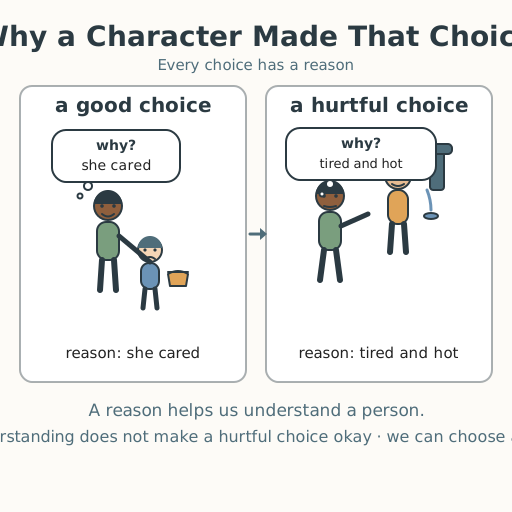
Lesson 2 — Why a Character Made That Choice
Summary
Learners listen to a short, gentle story and practice giving one reason why a character made a good choice and one reason why a character made a hurtful choice. Reasons help us understand people; they do not make a hurtful choice okay.
Objectives
- Give one reason why a character in a story made a good or a hurtful choice. (D09.S1.01.02)
Connection
When a friend acts in a way you do not understand, you sometimes ask, “Why did they do that?” Looking for a reason helps you understand the person — maybe they were scared, or tired, or trying to help. Understanding is not the same as saying a hurt is fine. It is the beginning of caring about people. All over the world, people tell stories to wonder why others do what they do.
Materials
- A short story about a character making a choice
- Two puppets or soft toys
Preparation
- Choose or prepare a short, gentle story with one clear good choice and one clear hurtful choice (see the example below).
- Set up a small space for retelling with puppets or soft toys.
Facilitator note
Written to the learner (“you”). Keep the story small and everyday — no frightening or heavy content at this age. A sample story: Amara and the water queue. Amara waits in a long line to fill her family’s water pot. Ahead of her, a smaller child drops her cup. Amara leaves her spot to help the child pick it up (a good choice). Later, tired and hot, Amara pushes past the person in front of her to the tap (a hurtful choice). Wonder together: why did she help? (she cared; the child was smaller and sad.) Why did she push? (she was tired and hot and wanted to be first.) Notice that the reason for the hurtful choice — being tired — helps us understand Amara, but it does not make pushing okay. Name the act, never the child; Amara is not “bad,” she made a hurtful choice and can choose again. A learner who does not speak aloud gives a reason by pointing to a picture of the reason (a tired face, a caring heart) or by signing; a learner who is deaf or hard of hearing follows the story through sign, the drawn story strip, a picture book, or by watching the puppets, and gives the reason by signing or pointing; a learner who is blind or low-vision hears the story told clearly and gives the reason aloud; a learner with a motor difference can direct a partner to move the puppets. A learner may always pass.
Procedure
- Gather (5 min). Think of a time you wondered, “Why did they do that?” Every choice has a reason — something behind it.
- Hear the story (10 min). Listen to the story — or follow it by sign, the drawn strip, a picture book, or by watching the puppets. Find the moment the character made a good choice, and the moment they made a hurtful choice.
- Wonder why (15 min). For each choice, finish the sentence: “I think they did it because…” Give one reason. Maybe they were scared, or tired, or trying to help, or wanted to be first. Wonder together — there can be more than one reason.
- Act it out (10 min). With the puppets, show one choice and its reason. A learner who does not move the puppets can point to the reason or direct a partner.
- Close (5 min). Reasons help us understand people. Understanding a hurtful choice does not make it okay — but it is the first step to caring.
Differentiation
- Support: Focus on one choice at a time; offer two picture reasons to choose from (a tired face, a caring heart). A non-speaking learner points to the picture reason.
- Extension: Invite learners to invent a small reason for a choice of their own and share it, or to find a second reason for the same choice.
Assessment
- Formative (observation): Can the learner give one reason for a character’s good or hurtful choice?
- Performance: The acted-out choice and its reason, shared with the group.
Home connection
At home, tell the story to someone and ask them, “Why do you think the character did that?” Listen to their reason and share yours.