Lesson 03 — Fair and Unfair Sharing
Learners practice sharing a toy or snack in a fair way and an unfair way, say which is fair, and begin to wonder whether fair always means the same amount for everyone or sometimes what each person needs.
Objectives
Objectives
- D09.S2.01.01 Describe a fair way and an unfair way to share a toy or snack and say which is fair.
Essential question
What is a fair way and an unfair way to share a toy or snack, and which is fair?
Key vocabulary
Materials
Standard materials
- A countable snack or toy to share · 1 set Something that can be divided or shared (crackers, seeds, blocks, a small set of toy pieces)
- A sharing picture set · 1 set Pictures of fair and unfair ways to share (splitting evenly, one person taking all, taking turns, giving each what they need)
Low-tech / no-cost
- Found objects to divide Stones, sticks, leaves, or bottle caps to practice fair and unfair sharing
- Voice and body Act out a fair and an unfair share with hands and words
Enriched / lab & device
- A balance scale or two cups · 1 set To show "same amount" and "what each needs" side by side as an open question
- Sturdy sharing cards · 1 set per pair Durable cards for repeated sorting of fair and unfair shares
Works in different contexts
- large-group Share one big pile of objects as a whole group, deciding aloud which way is fair and which is unfair
- self-directed The learner divides a small pile two ways — fairly and unfairly — and says which is fair and why
- outdoor-only Share a found pile (seeds, pebbles, fruit) under a tree, trying a fair and an unfair way and naming each
- multi-age Older learners ask "what does each person need?" while younger learners count out the shares
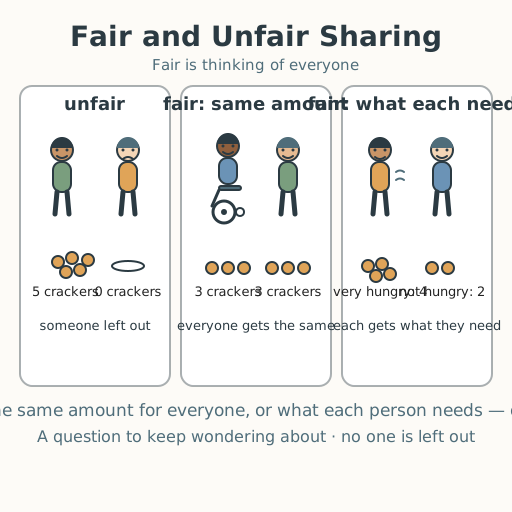
Lesson 3 — Fair and Unfair Sharing
Summary
Learners practice a fair way and an unfair way to share a toy or snack, name which is fair, and meet two ideas side by side as an open question: fair can mean the same amount for everyone, and it can also mean what each person needs.
Objectives
- Describe a fair way and an unfair way to share a toy or snack and say which is fair. (D09.S2.01.01)
Connection
Think of a snack being passed around, or two children who both want the same ball. Sharing means deciding how a thing goes to everyone who wants or needs it. A fair share is one where everyone is thought of; an unfair share is one where someone is left out or gets everything. People everywhere share food, water, and turns — a family passing a bowl of rice, children taking turns on a swing, neighbors sharing a harvest. Today you will try it yourself and say which way is fair.
Materials
- A countable snack or toy to share (crackers, seeds, blocks, or toy pieces)
- A sharing picture set (splitting evenly, one person taking all, taking turns, giving each what they need)
Preparation
- Gather a pile of something countable to share (or found objects outdoors).
- Prepare or draw pictures of fair and unfair ways to share.
Facilitator note
Written to the learner (“you”). Hold two ideas open, not as a rule: equality — fair is the same amount for everyone — and equity — fair is what each person needs (a smaller child may need help reaching, a hungrier person may need more food). Both are real ideas about fairness; the lesson wonders about them without deciding for the learner. There is no single “correct” share. Keep examples gentle: no one is punished or shamed for an unfair share; unfairness is simply named and then made fair. Name the act (“that share left someone out”), never the child. Learners from more communal traditions may share without counting (“we just share”); honor that as a fair way too, not a lesser one. A learner who does not speak aloud names a fair or unfair share by pointing or signing; a learner who is blind or low-vision feels and counts the objects by touch; a learner with a motor difference can direct a partner to move the objects. A learner may always pass.
Procedure
- Gather (5 min). Think of a time something was shared. How did it feel to get a fair share — or an unfair one?
- Meet fair and unfair (10 min). Look at the pictures. Name a fair way (everyone thought of) and an unfair way (someone left out or taking all). Which is which?
- Try it (15 min). With your pile of snacks or toys, make a fair share and an unfair share. Say, sign, or point to which is fair and why.
- Wonder: same or what-each-needs? (10 min). Try two fair ideas. First, give everyone the same amount. Then, think: does anyone need something different — a smaller child who cannot reach, a friend who is very hungry? Wonder together which is fairer, and why it might be both.
- Close (5 min). Sharing is thinking of everyone. Fair can mean the same amount, and it can mean what each person needs — a question to keep wondering about.
Differentiation
- Support: Practice only “everyone gets some” with a small pile, counting out one each. A non-speaking learner points to the fair picture; a learner with limited movement directs a partner.
- Extension: Invite learners to invent a sharing problem (an odd number of crackers, a toy that cannot be split) and wonder how to share it fairly.
Assessment
- Formative (observation): Can the learner describe a fair and an unfair way to share and say which is fair?
- Performance: The acted-out fair share, reflected on aloud with the group.
Home connection
At home, help share a meal or a snack. Try a fair way, and ask someone: is fair the same amount for everyone, or what each person needs — or both?