Lesson 04 — What Everyone Needs to Feel Safe and Treated Well
Learners name one thing every person in the class needs to feel safe and treated well — a kind word, being listened to, space for their body, a name said kindly — and build a shared class list together.
Objectives
Objectives
- D09.S2.01.02 Name one thing every person in the class needs to feel safe and treated well.
Essential question
What does every person in our class need to feel safe and treated well?
Key vocabulary
Materials
Standard materials
- A large shared sheet or poster · 1 For building a class "safe and treated well" list together
- Markers or crayons · per learner
- A soft object as a turn marker · 1 A small cloth, stone, or ball to pass so each person's idea is heard
Low-tech / no-cost
- One shared cloth or drawn ground Draw or lay out the list on cloth, the ground, or a shared sheet
- Voice and body Each learner names one thing everyone needs; no paper needed
Enriched / lab & device
- Picture cards of needs · 1 set Images for a kind word, a listening ear, space for one's body, a name said kindly, a helping hand
- A recording or photo of the class list · 1 To display the finished list on a wall or share it with families
Works in different contexts
- large-group Pass the turn marker around a big circle so every voice is heard, not just the loudest; record each idea on the shared sheet
- self-directed The learner thinks of one thing everyone needs and writes or draws it, then shares it with a grown-up or peer
- outdoor-only Build the list on the ground with found objects, one object per need, in a circle everyone can see
- multi-age Younger learners name the need; older learners help write or draw each one onto the shared list
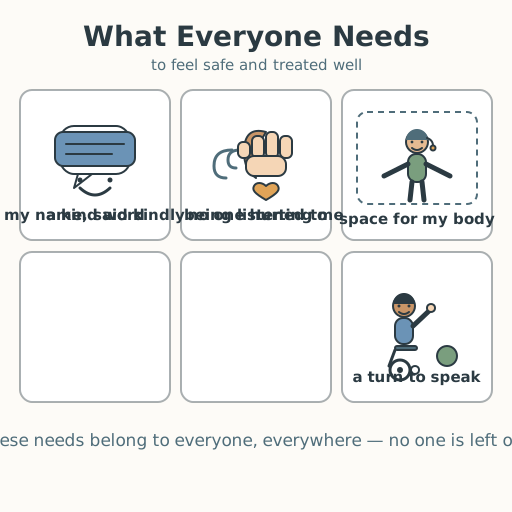
Lesson 4 — What Everyone Needs to Feel Safe and Treated Well
Summary
Learners name one thing every person in the class needs to feel safe and treated well, and build a shared class list. The lesson holds one firm idea: these needs belong to every person — no one is left out.
Objectives
- Name one thing every person in the class needs to feel safe and treated well. (D09.S2.01.02)
Connection
Think of how you know you are safe and treated well somewhere — someone says your name kindly, there is room for your body, people listen when you speak, no one hurts you. Every person needs these things, not just some people. In every classroom, family, and village on Earth, people build a place where everyone can feel safe and treated well. Today you will name what your class needs and write it down together.
Materials
- A large shared sheet or poster
- Markers or crayons
- A soft object as a turn marker
Preparation
- Prepare a large shared sheet or clear space to build the class list.
- Have the turn marker ready; arrange a circle so every voice can be heard.
Facilitator note
Written to the learner (“you”). This lesson is about every person, not “most people” — the heart of egalitarianism is that needs are universal. Keep it concrete for age ~6: a kind word, being listened to, space for one’s body, a name said kindly, no one hurting you, a turn to speak. If you use a passing object so each person is heard, call it a turn marker — a small cloth, stone, or ball. People everywhere in the world find ways to make sure one voice is heard at a time; a passing object is one simple, respectful way to do that. The marker is a reminder to listen while someone else speaks, not a decoration. The marker also serves accessibility: a learner who does not speak aloud holds the marker and points, signs, or gestures their idea; a learner who is blind or low-vision feels the marker pass into their hands and names their need aloud; a learner with a motor difference can have a partner place the marker for them while they show their idea. Every voice matters — not just the loudest or fastest. A learner may always pass. This is not a test of right answers; every need offered is a real contribution.
Procedure
- Gather (5 min). Think of a place where you feel safe and treated well. What makes it feel that way?
- Wonder: what does everyone need? (10 min). Name one thing every person in the class needs — a kind word, being listened to, space for their body, a name said kindly, no one hurting you. Why does every person need it, not just some?
- Pass the turn marker (15 min). In the circle, pass the turn marker. When you hold it, name (or show, point, or sign) one thing everyone needs. Everyone else listens. Add each idea to the shared list.
- Make our list (10 min). Draw or write one need on the class sheet. Look at all the needs together — this is what your class needs to feel safe and treated well.
- Close (5 min). These needs belong to everyone, everywhere. Your class now has its own words for taking care of each other.
Differentiation
- Support: Offer picture cards of needs to point to; model one idea (“everyone needs a kind word”). A non-speaking learner points to a picture; a learner with limited movement directs a partner to write for them.
- Extension: Invite learners to wonder whether these needs are the same at home, at the market, or in a village far away — and to share what they think.
Assessment
- Formative (observation): Can the learner name one thing every person in the class needs to feel safe and treated well?
- Artifact (portfolio): The class “safe and treated well” list, kept on the wall and copied into learners’ portfolios.
Home connection
At home, ask: what does every person in our family need to feel safe and treated well? Share your class list and hear theirs.