Lesson 05 — Making a Class Rule With a Reason
Learners take part in making a class rule, each idea carrying a reason, and make a shared choice where every voice matters — not just the loudest or fastest.
Objectives
Objectives
- D09.S3.01.01 Take part in making a class rule or choice and give one reason for their idea.
Essential question
How do we make a class rule together, each idea with a reason?
Key vocabulary
Materials
Standard materials
- A class rule chart · 1 A large sheet or poster to record each proposed rule and its reason
- A soft object as a turn marker · 1 A small cloth, stone, or ball passed so each person's idea is heard
- Choice tokens · per learner A pebble, seed, or mark so each learner can show their choice
Low-tech / no-cost
- Voice and body Raise a hand, stand in a circle, or hold up one or two fingers to show a choice; no tokens needed
- A shared drawn chart Draw the rules and reasons on the ground, cloth, or a shared sheet
Enriched / lab & device
- Laminated rule-and-reason cards · 1 set Reusable cards pairing a rule with a picture reason for a durable class chart
- A photo or recording of the decision · 1 To display the finished rule chart and the reason behind it
Works in different contexts
- large-group Gather ideas with the turn marker, then have the whole group show its choice with tokens or raised hands and count together
- self-directed The learner writes or draws a rule and its reason, then shares it with a grown-up or peer for their thoughts
- outdoor-only Hold the decision in a circle outdoors, recording rules on the ground with marks and reasons told aloud
- multi-age Older learners scribe the reasons while younger learners give the ideas and show their choice
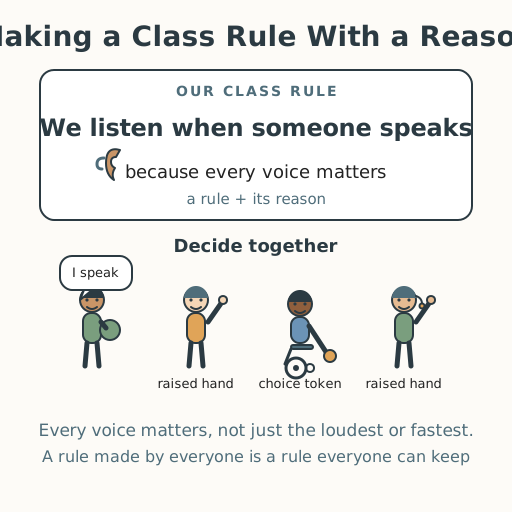
Lesson 5 — Making a Class Rule With a Reason
Summary
Learners propose a rule that helps everyone feel safe and treated well, give one reason for their idea, and take part in a shared choice. The lesson practices making decisions together, with every voice heard.
Objectives
- Take part in making a class rule or choice and give one reason for their idea. (D09.S3.01.01)
Connection
Think of a game you play with friends. To play together, you have to agree on how it goes — who goes first, what counts as a turn. A rule is a shared idea that helps everyone live, work, and play together safely and fairly. People everywhere make rules together — a village deciding when to draw water, a family deciding how to share chores. Today you will help make a rule for your own class, and give a reason for your idea.
Materials
- A class rule chart (large sheet or poster)
- A soft object as a turn marker
- Choice tokens (a pebble, seed, or mark per learner)
Preparation
- Prepare the class rule chart and a place to record ideas and reasons.
- Have the turn marker and choice tokens ready; arrange a circle.
Facilitator note
Written to the learner (“you”). This lesson teaches making decisions together, not obeying a teacher’s rule. Rules here are questions about how we live well together, not commands to obey — invite learners to wonder what the class needs, then propose a rule and a reason. If you use a passing object so each person is heard, call it a turn marker — a small cloth, stone, or ball. People everywhere find ways to make sure one voice is heard at a time; a passing object is one simple, respectful way to do that. The marker reminds everyone to listen while one person speaks — it is not a decoration. Every voice matters — not just the loudest or fastest; invite quieter voices and show that a good idea can come from anyone. A learner who does not speak aloud proposes their rule by pointing to a picture, signing, or having a peer voice it; a learner who is blind or low-vision names their rule and reason aloud and hears the choices read back; a learner with a motor difference shows their choice by directing a partner or using eye gaze, and their idea is recorded. Choice can be shown many ways — a raised hand, a token, a step into a circle, a nod. Never require anyone to speak in front of the group; a learner may always pass. The goal is a rule the class chose together with reasons, not a rule handed down.
Procedure
- Gather (5 min). Think of a game. What rule makes it work? Why does that rule help everyone?
- Propose a rule (15 min). Pass the turn marker. When you hold it, suggest a rule that helps everyone feel safe and treated well — or point to a picture, sign, or have a peer voice your idea. For each idea, give one reason: “This rule helps because…” Record each rule and reason on the chart.
- Choose together (15 min). Look at the ideas. Show your choice — a token, a raised hand, a step into a circle, or a nod. Count together. The choice everyone helped make becomes the class rule.
- Say it in our own words (5 min). Together, say the rule and its reason. Make sure it is a rule the whole class helped build.
- Close (5 min). You made a rule together, with reasons. A rule made by everyone is a rule everyone can keep.
Differentiation
- Support: Offer three ready-made rule ideas with picture reasons to choose from; a non-speaking learner points or nods to choose. A learner with limited movement directs a partner to place their token.
- Extension: Invite learners to wonder what might happen if a rule were made by only one person and no one else had a voice — and why everyone’s voice matters.
Assessment
- Formative (observation): Can the learner take part in making a class rule and give one reason for their idea?
- Performance: The learner’s proposal and its reason, recorded on the class chart.
Home connection
At home, suggest one small family rule with a reason (“we wash hands before eating because…”). Hear what others propose and why.