Lesson 06 — A Small Job That Helps
Learners do a small job that helps the classroom or school and tell how it helped, discovering that helping is a contribution everyone can make — not a reward for a few.
Objectives
Objectives
- D09.S3.01.02 Do a small job that helps the classroom or school and tell how it helped.
Essential question
What small job can I do that helps our classroom or school, and how does it help?
Key vocabulary
Materials
Standard materials
- A class job chart · 1 A simple chart of small jobs (water the plants, tidy the shelf, help carry, sharpen pencils, care for a class animal, if there is one)
- Job picture cards · 1 set One picture for each small job, so a learner can choose by pointing
Low-tech / no-cost
- Real objects in the room A watering cup, a cloth, a shelf to tidy — the actual job, no cards or chart needed
- Voice and body Name and act out each job together
Enriched / lab & device
- A rotating job wheel or chart · 1 A durable chart where jobs rotate so everyone takes a turn, not a few
- A photo or drawing of each job done · 1 set To build a class "jobs that help" display or album
Works in different contexts
- large-group Assign or rotate jobs in small teams, and have each team show what it did and how it helped
- self-directed The learner chooses one small job, does it, and tells or writes how it helped
- outdoor-only Do a job that helps the shared outdoor space — clear a path, water a plant, gather litter safely — and tell how it helped
- multi-age Older learners partner with younger ones to do a job together and talk through how it helped
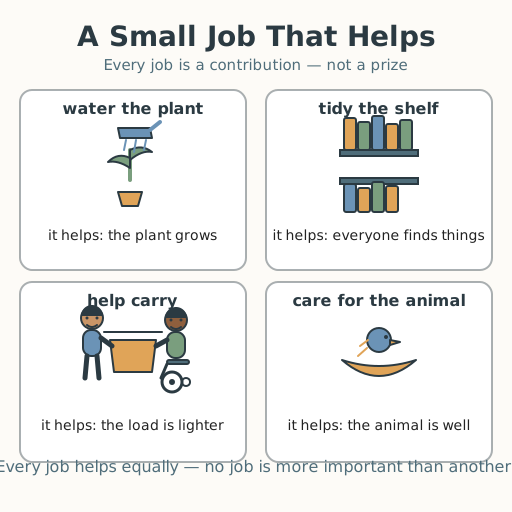
Lesson 6 — A Small Job That Helps
Summary
Learners do a small job that helps the classroom or school and tell how it helped. Helping is framed as a contribution everyone can make, not a reward to win or a way to rank children.
Objectives
- Do a small job that helps the classroom or school and tell how it helped. (D09.S3.01.02)
Connection
Think of the small things that make your home or classroom a good place to be — plants watered, the floor clear, pencils ready, a friend helped to carry something. When you do one of these, you are contributing: you are helping the place and the people in it. Everywhere in the world, people do small jobs that help everyone — a child sweeping the family’s courtyard, a neighbor watching a pot of soup, someone carrying water for an elder. Today you will do one small job and tell how it helped.
Materials
- A class job chart (water the plants, tidy the shelf, help carry, sharpen pencils, care for a class animal, if there is one)
- Job picture cards
Preparation
- Choose a few safe, real small jobs learners can actually do in your space.
- Prepare the job chart and picture cards, and gather any objects the jobs need.
Facilitator note
Written to the learner (“you”). The central commitment is contributions, not rewards, and no ranking: a job is something everyone can do to help, not a prize for the “best” child or a way to sort children into helpers and non-helpers. Every job matters equally — watering a plant helps as much as carrying a book; do not rank jobs as “big” or “small” in worth. Rotate jobs so everyone takes a turn, and celebrate the helping, never compare children. Keep jobs safe and concrete for age ~6. A learner who does not speak aloud chooses a job by pointing to a card and tells how it helped by pointing, signing, or gesturing; a learner who is blind or low-vision does a job by touch and names how it helped aloud; a learner with a motor difference can do a job by directing a partner or by choosing a job that suits how they move, and their help counts fully. A learner may always pass. The aim is that every learner can say, in their own way, “I helped, and here is how.”
Procedure
- Gather (5 min). Think of a time you helped at home or in class. How did your help make things better?
- Meet the jobs (10 min). Look at the job chart and picture cards. Name each job and wonder: who does it help, and how?
- Do a small job (15 min). Choose one small job — point to its card, or pick up the real object. Do the job carefully. A learner who needs a partner can do it together.
- Tell how it helped (10 min). Tell a partner (or show, sign, or point): “I helped by… and it helped because…” Listen to how their job helped too.
- Close (5 min). Every job helped, and every helper’s contribution matters. Your class is better because you helped.
Differentiation
- Support: Offer two jobs to choose from; model the sentence “I helped by… and it helped because…” A non-speaking learner points to the job and to a picture of who it helped.
- Extension: Invite learners to notice another job the class or school needs and propose it for the chart, with a reason.
Assessment
- Formative (observation): Can the learner do a small job and tell how it helped?
- Performance: The job done and the learner’s own words about how it helped.
Home connection
At home, do one small job that helps your family and tell a grown-up how it helped.