Lesson 07 — Words for My Feelings in a Conflict
Learners practice using words — "I feel… when… I need…" — to say how they feel during a small, gentle conflict, with many ways to express a feeling.
Objectives
Objectives
- D09.S4.01.01 Use words to say how they feel during a conflict and listen when a friend says how they feel.
Essential question
How do I use words to say how I feel when there is a conflict?
Key vocabulary
Materials
Standard materials
- A feelings picture board · 1 Faces and symbols for happy, sad, mad, scared, left out, calm — so a learner can point to a feeling
- "I feel… when… I need…" sentence strip · 1 A three-part visual with pictures for each part of the sentence
- Two puppets or soft toys · 2 For acting out a gentle conflict and saying how each feels
Low-tech / no-cost
- Voice and body Say and act out the feelings with face and hands; no board or strip needed
- A drawn feelings strip Draw the three-part sentence on paper or the ground
Enriched / lab & device
- Laminated feelings cards · 1 per learner A durable personal set of feelings pictures for the classroom peace corner
- A slow-breathing visual or soft squeeze object · 1 set A calm-down tool to use before saying how you feel
Works in different contexts
- large-group Act out a gentle conflict with two puppets while the group calls out the feeling and the "I feel… when… I need…" words
- self-directed The learner follows the sentence strip alone, pointing to a feeling and practicing the words aloud or by sign
- outdoor-only Use a real small conflict over a found object and practice saying how you feel right there
- multi-age Older learners model the sentence first, then younger learners try it with their own gentle example
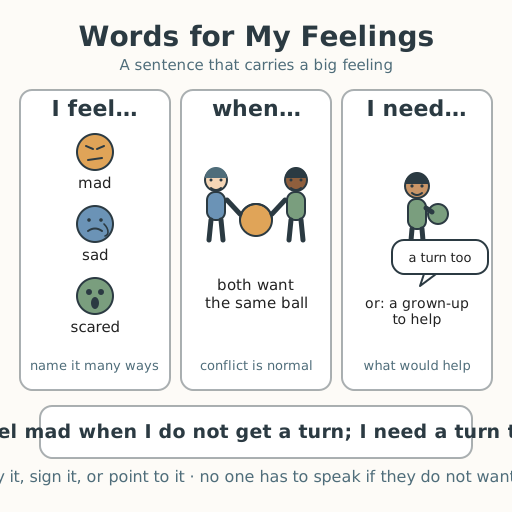
Lesson 7 — Words for My Feelings in a Conflict
Summary
Learners practice saying how they feel during a small, gentle conflict using the sentence “I feel… when… I need…” They learn that feelings can be named in many ways — spoken, signed, pointed to, or acted out — and that no one has to speak if they do not want to.
Objectives
- Use words to say how they feel during a conflict and listen when a friend says how they feel. (D09.S4.01.01 — saying how I feel)
Connection
When two people want the same thing, feelings can get big fast — mad, sad, scared, or left out. Conflict is just a word for when two people want different things at the same time. It is not bad to have a conflict; what helps is using words to say how you feel. Everywhere in the world, people solve small conflicts by saying how they feel and what they need. Today you will practice saying how you feel.
Materials
- A feelings picture board (happy, sad, mad, scared, left out, calm)
- An “I feel… when… I need…” sentence strip
- Two puppets or soft toys
Preparation
- Prepare the feelings board and the three-part sentence strip.
- Set up a small space for acting out a gentle conflict with puppets.
Facilitator note
Written to the learner (“you”). This lesson teaches expressing feelings, not winning. Conflict is named as normal and okay — two people wanting different things — never as a child “being bad.” No child is ever the problem; the conflict is the thing we solve together. Keep the conflict gentle (both want the same ball, the same swing) and free of blame. “Use your words” means however a learner expresses themselves — spoken words, sign, a gesture, pointing to a feeling on the board, eye gaze, or a communication board; a grown-up or peer can voice what they point to or sign. Learners who are deaf or hard of hearing follow the strip by sight and sign; learners who are blind or low-vision hear the sentence named and touch a textured feeling card; learners with a motor difference can point with a partner’s help or direct the partner to move the puppets while they show the feeling. Never require anyone to speak or perform in front of the group; a learner may always pass. The sentence is a scaffold, not a script to obey — wonder together about other words that could work. (This lesson’s partner, listening, comes next.)
Procedure
- Gather (5 min). Think of a time two people wanted the same thing. What feelings came up?
- Meet the feelings (10 min). Look at the feelings board. Name each feeling (say, sign, or point). A conflict is when two people want different things at once — it is okay, and it can be solved.
- Learn the sentence (10 min). Practice: “I feel… (name a feeling) when… (what happened) I need… (what would help).” Say it, sign it, or point to each part on the strip.
- Act it out (15 min). With the puppets, show a small conflict — both want the same ball. Take a breath, then say how you feel: “I feel mad when I do not get a turn; I need a turn too.” A learner who does not move the puppets can point to the feeling or direct a partner.
- Close (5 min). Naming your feeling is the first step in solving a conflict. Words can carry a big feeling so it does not hurt anyone.
Differentiation
- Support: Practice only “I feel…” first, pointing to a face on the board; a non-speaking learner points to the feeling. Model the full sentence word by word.
- Extension: Invite learners to try a second feeling for the same conflict and notice how the need changes (“I feel scared… I need a grown-up to help”).
Assessment
- Formative (observation): Can the learner use words (or a supported way) to say how they feel during a conflict?
- Performance: The acted-out “I feel… when… I need…” with the puppets, reflected on aloud.
Home connection
At home, when a feeling gets big, try “I feel… when… I need…” with someone you trust.