Lesson 04 — Who Made It, and for Whom?
Learners discover that every picture, poster, and story has a maker — an author or illustrator — and an audience it was made for. They name both for a real example, then make their own picture and say who made it and for whom.
Objectives
Objectives
- D10.S2.01.02 Say who made a simple picture, poster, or story and who it was made for.
Essential question
Who made a picture, poster, or story, and who was it made for?
Key vocabulary
Materials
Standard materials
- A simple poster or sign to look at together · 1 A real, simple poster such as "Wash your hands," a market sign, or a classroom rule poster
- A picture book with a visible author and illustrator · 1 Any picture book whose cover or title page names the person who wrote it and the person who drew it
- Paper and crayons · per learner
Low-tech / no-cost
- A poster or sign made by a learner, a grown-up, or the group Any hand-made sign or picture in the room; ask who made it and who it was made for — no printed book needed
- Voice and body Tell a one-sentence "message" and act out who made it and who it is for (a song for a baby, a sign for visitors, a joke for a friend)
Enriched / lab & device
- A small set of simple posters or book covers from around the world · 1 set A market sign, a festival poster, a children's book cover — one at a time, to name the maker and the audience
- A device to record a spoken message · 1 per group Optional; learners record "who I am and who this is for" and listen back
Works in different contexts
- large-group Look at one shared poster together; the group says who made it and who it is for, then each learner makes their own picture with a maker and an audience in mind
- self-directed A learner chooses a picture, poster, or book, figures out (or guesses) who made it and who it is for, and then makes their own and states both
- outdoor-only Find a sign, a marking, or a poster outdoors (a shop sign, a road sign, a drawn notice) and ask who made it and who it is for
- multi-age Older learners read the author and illustrator names aloud and coach younger ones in saying who the book was made for
Lesson 4 — Who Made It, and for Whom?
Summary
Learners learn that every picture, poster, and story has a maker — someone who made it — and an audience — someone it was made for. They look at a real poster and a picture book to find the maker and the audience, then make their own picture and say who made it and who it is for. The lesson is about noticing, never about shaming: no message is “hiding” anything here, it simply has a maker and a friend it was made for.
Objectives
- Say who made a simple picture, poster, or story and who it was made for. (D10.S2.01.02)
Connection
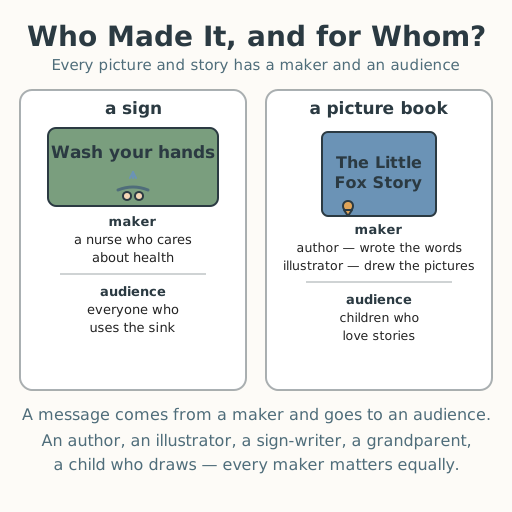
Everything you see that someone made — a sign on a door, a poster on a wall, a picture in a book, a story told at bedtime — was made by a person and made for a person. The person who made it is the maker (in a book, the author writes the words and the illustrator draws the pictures). The person it was made for is the audience. A “Wash your hands” sign was made by someone who cares about health, for everyone who uses the sink. Today you will learn to ask two gentle questions about any picture or story: who made it? and who is it for?
Materials
- A simple poster or sign to look at together
- A picture book with a visible author and illustrator
- Paper and crayons
Preparation
- Choose a simple, real poster or sign whose maker and audience are easy to name.
- Pick a picture book whose cover or title page clearly names the author and illustrator.
- Set out paper and crayons.
Facilitator note
This lesson is written to the learner (“you”). The goal is a first, gentle step toward media literacy: every message has a maker and an audience. Keep it warm and matter-of-fact — we are noticing, never accusing. No message is being framed as “sneaky” or “trying to trick you”; at six, the point is simply that pictures and stories come from someone and go to someone. Do not shame any media or screen. Honor the many kinds of makers: an author, an illustrator, a sign-writer, a grandparent who tells stories, a child who draws. All are makers, and no kind of maker is better than another. For a learner who is blind or has low vision, read the maker’s name aloud and describe the picture; the learner names the maker and audience from the description. A non-speaking learner can point to the maker’s name and to a picture of the audience (a child, a grown-up, everyone) to show the answer. When learners make their own picture, every audience is welcome — a sibling, a pet, a friend, the whole class.
Procedure
- Gather (5 min). Look at the poster on the wall. Someone made it. Who might that be, and who is it for?
- Meet the maker and the audience (10 min). Look at the poster or sign. Say who made it (a grown-up, a shopkeeper, a learner, a doctor) and who it is for (everyone who uses the sink, people visiting the market, the class). Every picture has these two friends: the one who made it and the one it was made for.
- Find the maker in a book (10 min). Look at the picture book. On the cover or title page, find the name of the person who wrote the words (the author) and the person who drew the pictures (the illustrator). Point to each name and say it. Now ask: who was this book made for? (Little children like you, or a baby, or everyone who loves stories.)
- Make your own (10 min). Draw a picture — a sign, a card, or a picture for a friend. When you finish, say: “I made this, and I made it for ___.” You are now the maker, and you chose the audience.
- Share and ask (5 min). Show your picture to a partner. Ask them the two questions: “Who made it?” and “Who is it for?” Then answer for your own.
- Close (5 min). Every picture and every story comes from a maker and goes to an audience. When you look at something someone made, you can wonder: who made this, and who is it for?
Differentiation
- Support: Name the maker and audience of one picture together aloud, then draw a picture and name both with help.
- Blind/low vision: Hear the maker’s name read aloud and the picture described; name the maker and audience from the description.
- Deaf/hard of hearing: Share the maker and audience with sign, pictures, and acting; the learner signs or points to the maker’s name and to the audience to show both.
- Non-speaking: Point to the maker’s name and to a picture of the audience to show who made it and who it is for.
- Motor differences: Say or signal the maker and audience while a partner draws; or direct a partner’s hands to make the picture while the learner chooses who it is for.
- Extension: Make two versions of one picture — one for a baby and one for a grown-up — and tell how you changed it for each audience.
Assessment
- Formative (observation): Can the learner say who made a simple picture, poster, or story and who it was made for?
- Artifact (portfolio): The learner’s own picture, with “made by ___ for ___” recorded by the facilitator.
Home connection
At home, find one thing someone made — a sign, a picture, a book, or a song. Ask a grown-up (or guess) who made it and who it is for. Then make a small picture for someone at home and tell them: “I made this for you.”