Lesson 05 — My Body Gives Me Clues
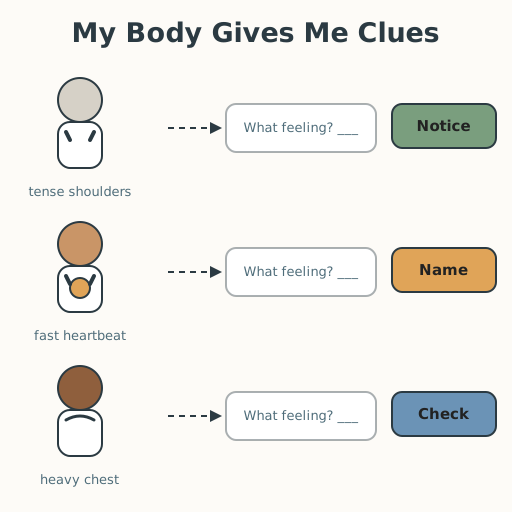
Learners reverse the body map: instead of naming a feeling and finding its spot, they start from a body signal — tight shoulders, a fast heart, a heavy chest — and guess and check the feeling, using a simple Notice, Name, Check routine.
Objectives
Objectives
- D01.S1.02.02 Notice where a feeling shows up in the body, such as tense shoulders or a fast heartbeat, and name the feeling.
Essential question
When my body sends a signal, how do I use it to name my feeling?
Key vocabulary
Materials
Standard materials
- Body clue cards · 1 set Each card shows a body signal (tight shoulders, fast heart, heavy chest, hot face) with a blank for the feeling guess
- Feeling name cards · 1 set Mad, frustrated, sad, disappointed, scared, excited, nervous, calm
- Chart paper and markers · 1 set To write the three-step check — Notice, Name, Check
Low-tech / no-cost
- Voice and body Describe a body signal aloud and act it out; say your guess with no cards
- A stick or finger to write in sand Draw the body signal and the feeling name in the sand
Enriched / lab & device
- A printed 'my body clues' page · 1 per learner A page with body signals on one side and feeling names to match on the other
- A simple heartbeat or breathing timer · 1 per group Optional, to feel a real fast heart after jumping, then a slow heart after resting
Works in different contexts
- large-group Read each body signal aloud and invite the whole group to act it out, then call out feeling guesses together
- self-directed A learner matches each body signal to a feeling name alone, then does the Notice, Name, Check steps on their own body
- outdoor-only Run or jump in place, feel the fast heart, rest, feel it slow — then name what each body signal means
- level-grouped Learners ready to extend notice a body signal in a real moment during the day and record it on a slip
Lesson 5 — My Body Gives Me Clues
Summary
Learners reverse yesterday’s body map. Now they start from a body signal — tight shoulders, a fast heart, a heavy chest, a hot face — and use it to guess the feeling, then check the guess. They learn a three-step routine, Notice, Name, Check, and practice it on their own bodies.
Objectives
- Notice where a feeling shows up in the body, such as tense shoulders or a fast heartbeat, and name the feeling. (D01.S1.02.02)
Connection
You are standing in line for the swing and your shoulders are up near your ears and your jaw is tight. You did not decide to feel this way — your body already told you. Now you can read the clue: tight shoulders and a tight jaw often mean mad or frustrated. Your body sends clues first; the words come second. Learning to read the clue lets you catch a feeling early, before it gets very big.
Materials
- Body clue cards
- Feeling name cards
- Chart paper and markers
Preparation
- Prepare the body clue cards and the feeling name cards.
- Write the three steps large: Notice, Name, Check.
- Set out a small space where learners can jump and rest to feel a real heartbeat.
Facilitator note
This lesson is written to the learner (“you”). The “check” step matters: a body signal can mean more than one feeling (a fast heart can be scared or excited), so the guess is checked with the situation. Honor that a guess is a guess — the learner is the expert on their own body. Never insist a learner’s signal means a particular feeling. Keep the heartbeat activity short and inclusive; any learner can feel their heart by resting a hand on their chest, seated or standing.
Procedure
- Gather (5 min). Yesterday you found where feelings live in your body. Quick check: where does mad often live? (Tense shoulders, hot face.) Where does sad often live? (Heavy chest.) Today you read your body’s clues backward — signal first, feeling second.
- Meet the three steps (10 min). Learn Notice, Name, Check. Notice the body signal. Name your best guess of the feeling. Check it against what is happening. Example: you notice your heart is beating fast — you guess scared — you check: is something scary happening, or is it your birthday tomorrow? Fast heart can mean scared or excited. The situation is the check.
- Match signals to feelings (15 min). Look at each body clue card. Point to the feeling name you guess: tight shoulders and a tight jaw (mad or frustrated); a fast heart and quick breath (scared or excited); a heavy, slow chest (sad or disappointed); hot cheeks (mad); a fluttery tummy (nervous). Remember: some clues point to more than one feeling — that is why we check.
- Feel it for real (10 min). Jump or march in place for a moment, then stop and rest your hand on your chest. Notice: your heart is fast. Now sit still and breathe slowly. Notice: your heart slows. Say the three steps out loud for what you noticed: Notice (fast heart), Name (excited, maybe), Check (I was just moving!).
- Close (5 min). Your body talks first, your words come second. When you Notice, Name, and Check, you can catch a feeling early — while it is still small enough to hold.
Differentiation
- Support: Work with two body signals at a time; act out each one and offer two feeling choices.
- Extension: Keep a one-day “clue log” — record one body signal you noticed, your guess, and the check, in words or drawings.
Assessment
- Formative (observation): Can the learner name a plausible feeling from a described body signal and check it against a situation?
- Self-check: The learner says the three steps — Notice, Name, Check — for one signal they felt today.
Home connection
Tonight, notice one body signal in someone at home (tight shoulders, a fast breath, a big sigh) and ask kindly, “Are you feeling okay?” — then listen.
Resources
- CASEL SEL Framework (self-awareness competency): https://casel.org/fundamentals-of-sel/