Lesson 06 — My Strengths
Learners identify their personal strengths — things they can do well — by noticing, asking, and trying, and record them on a star chart. They begin to see themselves as capable, and to see that every person has strengths of their own.
Objectives
Objectives
- D01.S2.02.01 Identify their personal strengths and one thing they are still learning to do.
Essential question
What am I good at, and how do I know?
Key vocabulary
Materials
Standard materials
- My Strengths page (star chart) · 1 per learner Stars to fill with things the learner can do well, plus one empty "still learning" star
- Crayons and pencils · per learner
- A small box or basket · 1 To collect written "strength notes" classmates give each other
Low-tech / no-cost
- A blank sheet folded or drawn with stars Draw your own stars on any paper and write or draw one strength in each
- Voice and a partner Tell your strengths aloud to a partner instead of writing them
Enriched / lab & device
- A printed 'My Strengths' booklet · 1 per learner A multi-page booklet with a star per page, to add to across the unit and keep in a portfolio
- Tablet or camera · 1 per group Record a learner showing a strength in action (kicking a ball, reading a page, helping a friend)
Works in different contexts
- large-group Brainstorm strength ideas together first, then learners fill their own stars in small groups and share one aloud
- self-directed A learner fills their stars alone, then reads them to a trusted person or records them in a journal; if working with a partner or sibling, each writes one strength about the other and swaps, so everyone gives and receives exactly one
- outdoor-only Find or gather a natural object for each strength (a steady stone for patience, a strong stick for building) and add it to a star
- multi-age Older learners scribe the strengths a younger learner names, then share one strength they notice in their partner
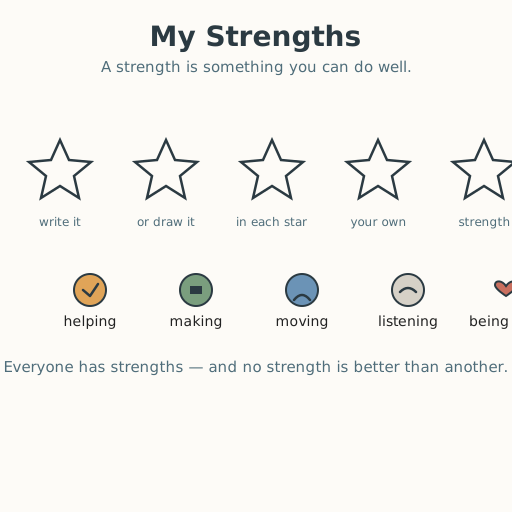
Lesson 6 — My Strengths
Summary
Learners identify their personal strengths — things they can do well — and record them on a star chart. They learn that a strength is not about being “the best,” but about something you can do well and feel good doing. They also see that everyone has strengths, and no one strength is better than another.
Objectives
- Identify their personal strengths and one thing they are still learning to do. (D01.S2.02.01)
Connection
Think of a time you did something and thought, “I am good at this.” Maybe you shared your snack with a friend who forgot theirs — you are good at being kind. Maybe you climbed to the top of the mango tree, or read a whole page out loud, or made your little cousin stop crying. A strength is something you can do well and feel good doing. Everyone has some — not the same ones, and that is what makes a group strong.
Materials
- “My Strengths” page (star chart)
- Crayons and pencils
- A small box or basket for strength notes
Preparation
- Prepare the star chart (several empty stars, one labeled “still learning”).
- Set out crayons and pencils.
- Arrange partners for sharing, and the box for strength notes.
Facilitator note
This lesson is written to the learner (“you”). Strengths come in many kinds — helping, making, moving, listening, thinking, caring, telling stories, being patient. Never rank them (a fast runner is not “better” than a kind friend). Some learners will say they have no strengths; help them find one by noticing something they did that day. Keep the focus on capability, not comparison. Ensure every learner receives at least one note: assign each child a secret strength partner so every child writes and receives exactly one. The empty “still learning” star is a preview of the next lesson — leave it unfilled today if that feels right.
Procedure
- Gather (5 min). You have been learning to read your feelings. Now you look at something just as important: what you can do well. Today you find your strengths.
- What is a strength? (10 min). A strength is something you can do well and feel good doing. It can be big (building a bridge out of sticks) or quiet (listening when a friend is sad). It can be in your body (running, dancing), your hands (drawing, fixing), your heart (sharing, being kind), or your head (figuring things out, remembering). No kind is better than another.
- Find your strengths (15 min). Look at your star chart. Fill each star with a strength — draw it or write it. Stuck? Try three ways to find one: notice (what do people thank you for?), ask (turn to a partner and ask, “What is one thing I am good at?”), and try (what did you do today that felt good and worked?).
- Strength notes (10 min). Your facilitator gives you a secret “strength partner” — someone in the group, and someone has you, too. On a slip, write or draw one strength you see in your partner. Fold it and put it in the box. When the notes are read out, every person gets exactly one note — the one their partner wrote for them. Noticing strengths in others is a strength too.
- Close (5 min). You are a person with strengths. They are part of who you are. Hold your star chart and say one strength out loud, or just look at it and smile.
Differentiation
- Support: Offer picture choices of strengths (a helping hand, a running figure, a drawing hand) and scribe the words the learner says.
- Extension: Add a strength you want to grow more of, and one small thing you could do today to practice it.
Assessment
- Formative (observation): Can the learner name at least one personal strength, in words, drawing, or movement?
- Artifact (portfolio): The “My Strengths” star chart.
Home connection
Ask someone at home to tell you one strength they see in you, and add it to your star chart.
Resources
- CASEL SEL Framework (self-awareness competency): https://casel.org/fundamentals-of-sel/