Lesson 10 — Pause Before I Act
The capstone lesson. Learners put the whole unit together into one routine — Pause, Name, Choose — practicing how to stop before reacting, name the feeling (using their look-alike words and body clues), and name the choice they are about to make. They revisit their strengths and their calm-down tools as the choices in their hands.
Objectives
Objectives
- D01.S3.02.02 Pause before reacting and name the choice they are about to make.
- D01.S1.02.01 Use feeling words to tell the difference between similar emotions, such as mad and frustrated or sad and disappointed.
- D01.S3.02.01 Name two strategies for managing strong feelings and choose one to use on their own.
- D01.S2.02.01 Identify their personal strengths and one thing they are still learning to do.
Essential question
How do I pause before I act, and name the choice I am about to make?
Key vocabulary
Materials
Standard materials
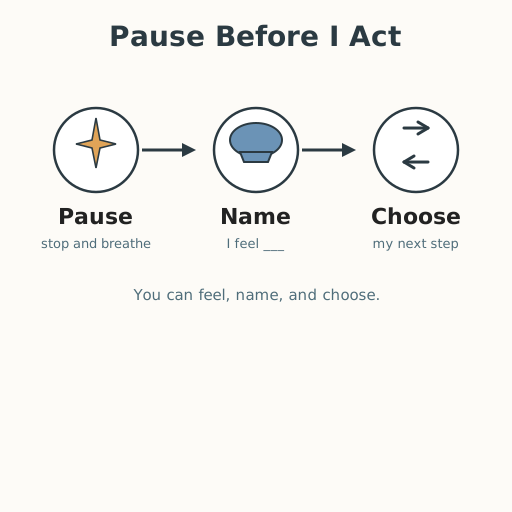
- Pause, Name, Choose steps poster · 1 Three big steps with icons — pause (a stop hand), name (a speech bubble), choose (two arrows)
- Choice cards · 1 set Simple choice pairs (yell or breathe, grab or ask, throw or put down, run or count)
- A soft bell or chime · 1 Optional, to signal the pause
Low-tech / no-cost
- Voice and body Say the three steps aloud and act them out; no poster or cards needed
- A drawn stop hand in the sand Draw the pause step on the ground and step through Name and Choose
Enriched / lab & device
- A laminated 'Pause, Name, Choose' card for each desk or bag · 1 per learner A small reminder card to carry all day
- A short role-play recorded on a tablet · 1 per group Learners act out a pause-before-acting moment and watch it back
Works in different contexts
- large-group Practice the three steps together as a whole group with a shared scenario, then have pairs role-play their own
- self-directed A learner reads the steps, practices a scenario alone or with a trusted person, and records their choice
- outdoor-only Walk the three steps on the ground — step to Pause, step to Name, step to Choose — for each scenario
- level-grouped Learners ready to extend name the choice *and* the likely result of each option, thinking one step ahead
Lesson 10 — Pause Before I Act
Summary
The capstone lesson. Learners put the whole unit together into one routine: Pause, Name, Choose. They practice stopping before they react, naming the feeling (using their look-alike words and body clues), and naming the choice they are about to make. They revisit their strengths and calm-down tools as the choices already in their hands.
Objectives
- Pause before reacting and name the choice they are about to make. (D01.S3.02.02)
- Use feeling words to tell the difference between similar emotions, such as mad and frustrated or sad and disappointed. (D01.S1.02.01)
- Name two strategies for managing strong feelings and choose one to use on their own. (D01.S3.02.01)
- Identify their personal strengths and one thing they are still learning to do. (D01.S2.02.01)
Connection
A feeling can rush in fast — a toy grabbed, a turn skipped, a tower knocked over — and before you know it, your hand is already moving. Pausing is the brave little stop in the middle: a breath, a hand held open, a moment to think. Then you can choose what happens next instead of just letting it happen. You have been building everything you need for this all unit long: words to name feelings, clues from your body, and calm tools to reach for. Today you put them together.
Materials
- Pause, Name, Choose steps poster
- Choice cards
- A soft bell or chime (optional)
Preparation
- Prepare the three-step poster and the choice cards.
- Choose a few simple scenarios for practice (toy grabbed, turn skipped, tower knocked over).
- Arrange space for role-play.
Facilitator note
This lesson is written to the learner (“you”). The capstone is a routine, not a test. Model the three steps yourself with a real, mild scenario first, then guide practice, then let learners role-play. Never shame a child whose first instinct was to react — the point is that pausing is a skill that grows with practice. “Name” uses the unit’s vocabulary (mad vs. frustrated, sad vs. disappointed) and body clues; “Choose” uses the calm tools and the learner’s own strengths. A learner may choose anything safe; there is no single “right” choice — the win is that they paused and named it.
Procedure
- Gather (5 min). This is your last lesson in “My Feelings & My Strengths.” Look back: you learned to tell look-alike feelings apart, to read your body’s clues, to name your strengths and what you are still learning, and to calm a big feeling. Today you put it all into one superpower: Pause, Name, Choose.
- Meet the three steps (10 min). Pause — stop, take one breath, hold your hand open. Name — say what you feel, using your exact words: “I feel frustrated, not just mad, because my trying is not working.” Choose — name the choice you are about to make: “I could yell, or I could use my calm breath.” You do not have to choose perfectly — you just have to see the choice.
- Practice together (15 min). Hear a scenario: “Your friend knocks over the tower you worked so hard on.” Walk the three steps out loud: Pause (breath), Name (“I feel mad — something blocked me — and also frustrated, because my trying got knocked down”), Choose (“I could push them, or I could take three slow breaths and say ‘That made me mad’”). Try it with two more scenarios.
- Role-play your own (10 min). With a partner, act out a moment from your own day where a feeling rushed in. Practice Pause, Name, Choose together. Then name one strength you used — being brave, being kind, being patient.
- Close (5 min). You are a person who can feel, name, and choose. That is your strength, and you are still growing it — and that is exactly right. Pause, Name, Choose. You can do this anywhere, all your life.
Differentiation
- Support: Use only two steps (Pause, Choose) at first; provide the feeling word as a choice (“Is it mad or frustrated?”) during Name.
- Extension: For each choice, name what might happen next (“If I yell…, if I breathe…”), thinking one step ahead.
Assessment
- Formative (observation): Can the learner pause in a role-play, name the feeling, and name a choice before acting?
- Performance: The learner demonstrates Pause, Name, Choose in a role-play.
- Artifact (portfolio): The “Pause Before I Act” check-in — the learner’s name for the choice they made — added to the unit portfolio alongside their strengths chart.
Home connection
Teach Pause, Name, Choose to someone at home, and try it together the next time a small thing goes wrong.
Resources
- CASEL SEL Framework (self-management and responsible decision-making): https://casel.org/fundamentals-of-sel/