Lesson 13 — An Explanation with a Reason
Learners write a simple explanation — a topic plus a reason — about something they know how to do, learning that explaining means telling what and why.
Objectives
Objectives
- D04.S3.02.02 Write a simple informative or opinion piece that states a topic or opinion and gives a reason.
Essential question
How do I explain how or why something works, with a reason?
Key vocabulary
Materials
Standard materials
- Something the learner knows how to do · 1 A small skill to explain — tying a knot, washing a pot, planting a seed
- An explanation frame · 1 Lines for the topic and the reason, in the home language
Low-tech / no-cost
- A real object or action to explain Explain something done with the hands, right in front of you
- The explanation said aloud Say the topic and the reason out loud before writing
Enriched / lab & device
- An explanation poster template · 1 A page with room for the topic, the reason, and a diagram
- A recording of the spoken explanation · 1 Record the explanation as a portfolio artifact
Works in different contexts
- large-group Build one class explanation together on the board, the group supplying the reason, before learners write their own
- self-directed A learner picks something they know, writes the topic and one reason, then reads it back and checks the reason explains the topic
- multi-age Older learners explain a skill to younger ones first, then both write — older with a fuller reason, younger with one short reason
- level-grouped Groups explain at their own level — a spoken topic and reason, a filled frame, or a short explanation with a diagram
- outdoor-only Explain something outdoors — how to find water, how a plant drinks rain — with a reason you can see in the world around you
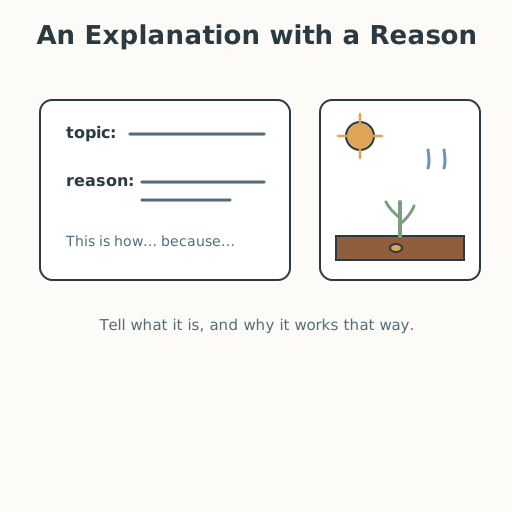
Lesson 13 — An Explanation with a Reason
Summary
Learners write a simple explanation: a topic (something they know how to do or how something works) and a reason (why it works that way). Explaining is the other side of the opinion coin — the informative side.
Objectives
- Write a simple informative piece that states a topic and gives a reason. (D04.S3.02.02)
Connection
You already know how to do many things: wash a pot, feed an animal, find your way home, make a friend smile. To explain is to share that knowing — to tell what it is or how it works, and why. A recipe, a field guide, a neighbor’s advice: these are all explanations. When you can explain a thing with a reason, your knowledge can travel to someone else, in your language, in your script.
Materials
- Something the learner knows how to do (or how something works)
- An explanation frame (topic + reason)
Preparation
- Prepare the explanation frame (a line for the topic, a line for the reason).
- Gather a few real objects or actions learners can explain.
Facilitator note
This lesson is written to the learner (“you”) so it works in a classroom and for a self-directed learner. This lesson pairs with yesterday’s opinion: an opinion says “I think… because…,” while an explanation says “this is how/what… because…” — both state a topic and give a reason, so both serve the same standard (D04.S3.02.02). Model one full explanation before learners write, then guide and release. The topic should be something the learner genuinely knows — no research needed at this level, just honest know-how. The reason must explain the topic, not decorate it. Work in the home language. A learner may speak, sign, dictate, draw a diagram, or write — the explaining is the learning.
Procedure
- Gather (5 min). Think of one thing you know how to do well. Today you will explain it to someone else.
- Meet explanation (5 min). To explain is to tell two things: the topic (what it is or how it works) and the reason (why it works that way). “This is how… because…”
- Watch a model (5 min). Listen to one full explanation: a topic and a reason that explains it.
- Say it first (10 min). Choose your topic — something you know. Say your explanation aloud: “This is how… because…” Say it in your home language.
- Write it (15 min). Write your topic on one line and your reason below. Add a small diagram if it helps. Read it back and check: does the reason explain the topic?
- Close (5 min). You turned your knowing into words someone else can use. That is the gift of explanation — it lets knowledge travel.
Differentiation
- Support: Explain a single, very familiar action (washing hands); dictate to a scribe if writing is hard today.
- Support (non-speaking): Show the action or point to a diagram and give the reason by sign, picture, or device — the explanation is the learning.
- Extension: Add a second reason, or a “then” step that tells what happens next.
Assessment
- Formative (observation/portfolio): Can the learner state a topic and give a reason that truly explains it, in their home language?
Home connection
Explain to someone at home how you do one small thing — with the reason — and ask them to try it your way.
Resources
- CASEL SEL Framework (communication and relationship skills): https://casel.org/fundamentals-of-sel/