Lesson 12 — My Opinion and My Reason
Learners state an opinion about a familiar choice and give one reason for it, using an "I think… because…" frame in their home language.
Objectives
Objectives
- D04.S3.02.02 Write a simple informative or opinion piece that states a topic or opinion and gives a reason.
Essential question
How do I state my opinion and give a reason for it?
Key vocabulary
Materials
Standard materials
- A small set of friendly opinion prompts · 1 set Everyday choices to have an opinion about, in the home language
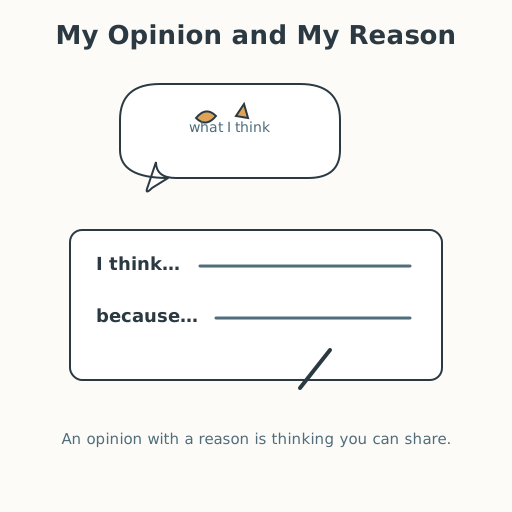
- An opinion frame · 1 Two lines — "I think…" and "because…" — in the home language
Low-tech / no-cost
- Two objects to compare Choose which you prefer and say why, using whatever is at hand
- The opinion frame said aloud Say "I think… because…" out loud before writing
Enriched / lab & device
- Opinion sentence strips · 1 set Pre-printed frames the learner completes and then reads back
- A recording of the learner's opinion · 1 Record the spoken opinion-and-reason as a portfolio artifact
Works in different contexts
- large-group Take a quick show of hands on a friendly question, then have a few volunteers give their opinion and reason aloud
- self-directed A learner writes their opinion and reason, then reads it back and checks that the "because" part really gives a reason
- multi-age Older learners model disagreeing kindly; younger learners practice saying "I think… because…" with one reason
- level-grouped Groups write at their own level — a spoken frame, a filled sentence, or a full opinion with two reasons
- outdoor-only Form an opinion about something seen outdoors — the best spot to sit, the best shade tree — and give a reason you can point to
Lesson 12 — My Opinion and My Reason
Summary
Learners state an opinion about a familiar, friendly choice and give one reason for it, using an “I think… because…” frame. An opinion with a reason is the beginning of thinking that others can weigh and answer.
Objectives
- Write a simple opinion piece that states an opinion and gives a reason. (D04.S3.02.02)
Connection
Every day you hold opinions: this food is tastier, this game is fairer, this path home is shorter. An opinion alone is just a feeling named out loud; an opinion with a reason is something a friend can think about and answer. When you say “I think… because…,” you let others meet your thinking instead of just hearing it — the start of every fair decision people make together.
Materials
- Friendly opinion prompts (everyday choices to have an opinion about)
- An opinion frame (“I think… because…”)
Preparation
- Prepare a few friendly, low-stakes opinion prompts (no right answer, nothing personal or hurtful).
- Prepare the opinion frame in the home language.
Facilitator note
This lesson is written to the learner (“you”) so it works in a classroom and for a self-directed learner. Opinions here are friendly and low-stakes — favorite fruits, games, seasons — never about people’s worth, and never used to rank learners. Model one full “I think… because…” before learners write, then guide and release. The reason must actually support the opinion; a reason that just restates the opinion (“I think mango is best because I like mango”) is gently guided toward a real reason (“because it is sweet and cool”). Disagreement is welcome and kind: learners may hold different opinions with different good reasons, and both can be right. Work in the home language; every language has its own words for “I think” and “because.” A learner may speak, sign, dictate, or write the opinion — the reasoning is the learning.
Procedure
- Gather (5 min). Think of a food, game, or place you love. That is your opinion — what you think or feel.
- Meet opinion and reason (5 min). An opinion is what you think. A reason tells why you think it. When you add “because,” your opinion becomes something others can think about.
- Watch a model (5 min). Listen to one full example: “I think… because…” Notice how the reason explains the opinion.
- Say it first (10 min). Pick a prompt. Say your opinion aloud with your reason: “I think… because…” Say it in your home language.
- Write it (15 min). Write your opinion and your reason on the frame. Read it back and check: does the “because” part really explain why?
- Share and listen (5 min). Read your opinion to a partner and listen to theirs. It is fine to disagree — you can both have good reasons.
- Close (5 min). An opinion with a reason is thinking you can share. Next, we use a reason to explain how something works.
Differentiation
- Support: Complete the frame aloud and have a scribe write it; begin with a two-word reason, then grow it.
- Support (non-speaking): Sign, point to pictures, or use a device to give the opinion and its reason — the reasoning is the learning.
- Extension: Give two reasons for one opinion, and tell which reason is the stronger one.
Assessment
- Formative (observation/peer): Can the learner state an opinion and give a reason that truly supports it, in their home language?
Home connection
Tell someone at home one opinion and one reason tonight — “I think… because…” — and listen to theirs.
Resources
- CASEL SEL Framework (respectful disagreement and relationship skills): https://casel.org/fundamentals-of-sel/