Lesson 05 — Subtracting Within 100
Learners subtract within 100 by taking away tens and ones separately. They model with bundles, draw the take-away, and record the difference in parts — so written subtraction grows out of real objects.
Objectives
Objectives
- D05.S1.02.02 Add and subtract within 100 using models, drawings, or written methods, and explain the strategy used.
Essential question
How do I subtract within 100 by taking away tens and ones?
Key vocabulary
Materials
Standard materials
- Bundles of ten and single ones (or base-ten blocks) · per learner or pair To model taking away from a number
- Paper or slate and a writing tool · per learner To record the subtraction in parts
Low-tech / no-cost
- Found objects and the ground Take away bundles and ones in the dirt and count what is left
- Voice and body Start with tens and ones held up, take some away, and count the remainder aloud
Enriched / lab & device
- Place-value mat with tens and ones columns · 1 per pair To keep tens and ones lined up while subtracting
- A number line to 100 · 1 per pair To show subtracting as jumps back of tens and ones
Works in different contexts
- large-group Model one subtraction together on a big chart, then learners work in pairs
- self-directed A learner builds a number, takes away tens and ones, and writes the difference in parts
- outdoor-only Take away sticks and stones from a collection outdoors, and count what remains
- multi-age Older learners coach younger ones in taking away tens first; younger learners count the remainder aloud
- level-grouped Learners who subtract easily move to numbers with regrouping; others subtract without regrouping first
Lesson 5 — Subtracting Within 100
Summary
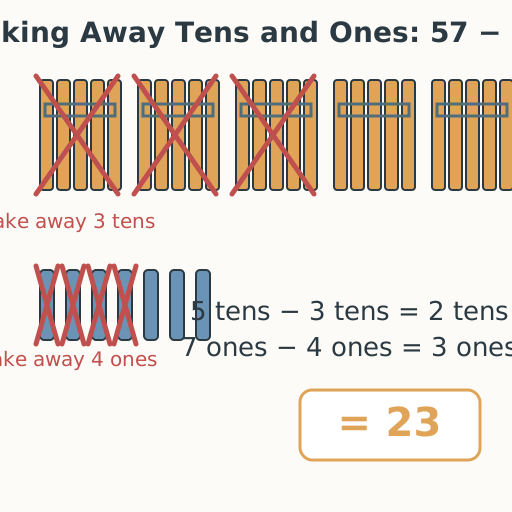
Learners subtract within 100 by taking away the tens and the ones separately. They model with bundles, draw the take-away, and record the difference in parts — five tens take away three tens, seven ones take away four ones — so written subtraction grows out of real objects.
Objectives
- Add and subtract within 100 using models, drawings, or written methods, and explain the strategy used. (D05.S1.02.02)
Connection
Taking away is a story you know too. A cook has 57 beans and uses 34; a child has 57 steps left and walks 34; a shopkeeper has 57 eggs and sells 34. To find what is left without getting lost, you take away the tens from the tens and the ones from the ones — big groups from big groups, little ones from little ones.
Materials
- Bundles of ten and single ones (or base-ten blocks)
- Paper or slate and a writing tool
Preparation
- Give each learner or pair bundles and ones enough to model a number and a take-away.
- Prepare subtraction examples that stay within 100 (start without regrouping).
- Plan to model taking away tens and ones as a worked example.
Facilitator note
This lesson is written to the learner (“you”). It introduces subtracting within 100 by place value, the reverse of Lesson 4. Teach with a worked example (philosophy §13): build 57, take away 3 tens and 4 ones, count what is left. Keep numbers without regrouping at first, so the strategy is clear before regrouping arrives later. The goal is sense-making, not speed: a learner may count every object today and use a written method tomorrow — both are correct, and explaining one’s own way is the real measure. There is no single “right” strategy; every clear strategy is honored. For learners who are Deaf or hard of hearing, model with bundles and write each step; for learners who are blind or low-vision, take away real objects and count what is left by touch. A learner who does not speak records by moving bundles or pointing to the difference.
Procedure
- Gather — recall taking away (5 min). You know subtracting means taking away. Quick: what is 7 − 4? What is 5 tens − 3 tens? Today we take away bigger numbers — but the trick is the same: take tens from tens, ones from ones.
- Worked example — take away tens and ones (10 min). Build 57 (five tens, seven ones). Take away 34: take three tens and four ones. Count what is left: two tens and three ones — 23. Write it in parts: 5 tens − 3 tens = 2 tens, and 7 − 4 = 3, so 57 − 34 = 23.
- Guided practice — build and take away (15 min). Pick two numbers (the first bigger than the second). Build the first. Take away the second — tens first, then ones. Count what is left, then say and write the difference. Do several.
- Draw the take-away (8 min). Choose one subtraction and draw it — the starting amount, the part taken away, and the part left, labeled. Does your drawing match your difference?
- Check with a partner (5 min). Trade one subtraction. Build and solve a friend’s problem, then compare differences. If they differ, build it again together and find where the counts went different — kindly.
- Close (2 min). Subtracting bigger numbers is just two small take-aways: tens from tens, ones from ones. You can now find what is left within one hundred.
Differentiation
- Support: Use numbers with no regrouping and model every step with bundles.
- Support (motor): Use large blocks and have a partner move objects while the learner directs and counts.
- Extension: Try a subtraction where the ones are not enough (for example, 52 − 26), and discover what happens when you must break a ten.
Assessment
- Formative (observation): Can the learner subtract within 100 with models or drawings, taking away tens and ones separately, and record the difference?
- Formative (self): Can the learner check their written difference against their model?
Home connection
At home, subtract one amount from another under one hundred — beans left after a share, steps left after a walk — by taking away tens and ones, and tell a grown-up what is left.
Resources
- Carpenter, T. P., Fennema, E., Franke, M. L., Levi, L., & Empson, S. B. (2015). Children’s Mathematics: Cognitively Guided Instruction (2nd ed.). Heinemann. (Separate problems and children’s invented place-value strategies for subtracting within 100.)