Lesson 06 — Many Ways to Add and Subtract
Learners solve addition and subtraction problems within 100 in several ways — with models, drawings, number lines, and breaking apart — and practice explaining the strategy they chose. Many strategies are right; explaining is the learning.
Objectives
Objectives
- D05.S1.02.02 Add and subtract within 100 using models, drawings, or written methods, and explain the strategy used.
Essential question
How do I choose and explain a strategy for adding or subtracting within 100?
Key vocabulary
Materials
Standard materials
- Bundles of ten and single ones (or base-ten blocks) · per learner or pair One modeling strategy for adding and subtracting
- Paper or slate and a writing tool · per learner To draw and record strategies
- A number line to 100 (optional) · 1 per pair A second strategy: jumping by tens and ones
Low-tech / no-cost
- Found objects and the ground Use sticks, stones, and a line drawn in the dirt as models and number line
- Voice and body Count on and count back aloud, stepping forward and backward
Enriched / lab & device
- Open number line strips (blank) · 1 per learner Blank number lines for learners to draw their own jumps
- Strategy cards · 1 set Cards naming strategies (model, drawing, number line, break apart, count on/back) to sort
Works in different contexts
- large-group Solve the same problem several ways as a whole group, charting each strategy and naming it together
- self-directed A learner solves one problem three ways and writes a sentence explaining which they prefer and why
- outdoor-only Solve problems by stepping a number line on the ground and by moving objects, then explain each way aloud
- multi-age Older learners model a strategy while younger learners try it, then they trade strategies and compare
- level-grouped Learners who are ready explain two or three strategies in writing; others explain one strategy aloud with a model
Lesson 6 — Many Ways to Add and Subtract
Summary
Learners solve addition and subtraction problems within 100 in several ways — with models, drawings, number lines, and by breaking numbers apart — and practice explaining the strategy they chose. The heart of the lesson is that many strategies are right, and explaining your own way is where the learning lives.
Objectives
- Add and subtract within 100 using models, drawings, or written methods, and explain the strategy used. (D05.S1.02.02)
Connection
People reach the same place by many roads. Two cooks both make a soup, but each has their own way; two travelers reach the market by different paths; two builders raise a wall with different tools. Numbers are like this too: there is more than one way to find 46 + 23, and every honest way that reaches the right answer is a good way. What matters is that you can explain your road to someone else.
Materials
- Bundles of ten and single ones (or base-ten blocks)
- Paper or slate and a writing tool
- A number line to 100 (optional)
Preparation
- Have bundles and ones, paper, and number lines ready.
- Prepare one addition and one subtraction problem for the whole group to try several ways.
- Plan to name strategies aloud: model, drawing, number line, break apart, count on, count back.
Facilitator note
This lesson is written to the learner (“you”). It is the explaining lesson — the goal is not one method but many, and a learner who can say how they solved it shows deeper understanding than one who only gives the answer (Carpenter et al., 2015). Model the same problem two or three ways as worked examples (philosophy §13), then let learners choose their own. Chart each strategy and name it, so strategies become a shared vocabulary, not a race. Never rank strategies or learners: a slower strategy that a learner understands is better than a fast one they do not. For learners who are Deaf or hard of hearing, model with objects and write each step; for learners who are blind or low-vision, count on and back with real objects and a raised number line. A learner who does not speak explains by pointing, moving objects, or drawing — all of these are explaining.
Procedure
- Gather — recall two ways (5 min). This week you added by joining tens and ones, and subtracted by taking them away. Today you learn that there are even more ways — and you get to choose and explain your own.
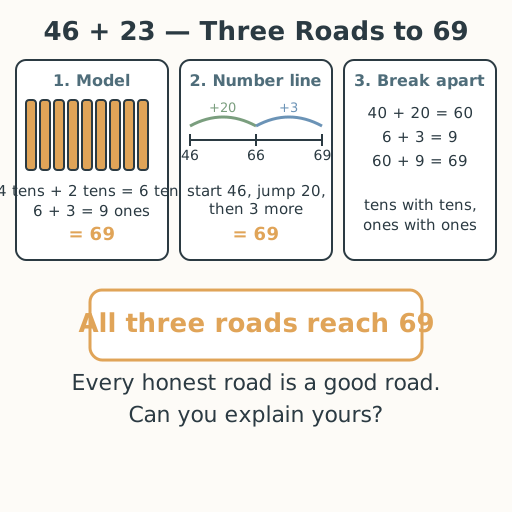
- Worked example — one problem, three ways (12 min). Solve 46 + 23 together three ways. Way 1: build it with bundles (4 tens + 2 tens, 6 + 3 → 69). Way 2: a number line — start at 46, jump 20, then 3 → 69. Way 3: break apart — 46 + 23 = 40 + 20 + 6 + 3 = 69. Name each strategy.
- Choose your own way (12 min). Solve 54 + 38 and 62 − 27. Pick the strategy you like best for each. Draw or write your steps.
- Explain it (10 min). Tell a partner (or write): how did you solve it? What did you do first, next, last? Why did you choose that way? Listen to their way too — is it different? Both can be right.
- Share the map (4 min). Together, name all the strategies used today. Notice how many roads led to the same answer.
- Close (2 min). In math, there is no one right road. What matters is that you can find an answer honestly and explain your path to someone else.
Differentiation
- Support: Model one strategy at a time and have the learner explain with the objects in front of them; accept a drawing as the explanation.
- Support (non-speaking): The learner explains by moving objects, drawing, or pointing to each step; acting it out is explaining.
- Extension: Solve one problem three different ways and write which way you would teach to a friend and why.
Assessment
- Formative (observation): Can the learner solve within 100 using at least one strategy and explain their steps in their own words?
- Formative (peer/self): Can the learner hear a friend’s different strategy and see that it is also correct?
Home connection
At home, solve one addition and one subtraction problem with a grown-up, each of you a different way, and explain your ways to each other.
Resources
- Carpenter, T. P., Fennema, E., Franke, M. L., Levi, L., & Empson, S. B. (2015). Children’s Mathematics: Cognitively Guided Instruction (2nd ed.). Heinemann. (Children’s invented strategies and the value of explaining them.)