Lesson 07 — Growing Patterns
Learners tell a growing pattern from a repeating one and build growing patterns — staircases that add one more each step. They learn to describe how a pattern grows: what changes from one step to the next.
Objectives
Objectives
- D05.S2.02.01 Identify and extend growing patterns and describe how the pattern changes from one step to the next.
Essential question
How do I tell a growing pattern from a repeating pattern, and how does a growing pattern change from one step to the next?
Key vocabulary
Materials
Standard materials
- Small objects · about 30 per learner or pair Counters, seeds, pebbles, or blocks for building patterns
- Paper or slate and a drawing tool · per learner To draw and label growing patterns
Low-tech / no-cost
- Found objects and the ground Build growing patterns with sticks, leaves, or stones laid in rows in the dirt
- Voice and body Make a growing pattern with claps and steps — one clap, then two, then three
Enriched / lab & device
- Pattern cards with growing sequences · 1 set Picture sequences that grow (staircases, towers, rows of dots) to order and extend
- A hundreds chart · 1 per pair To see number patterns grow by counting on
Works in different contexts
- large-group Build one growing pattern together on the floor, each learner adding the next step, then describe the change aloud
- self-directed A learner builds a growing pattern, says how each step grows, and draws the next two steps
- outdoor-only Build growing staircases with stones or footprints outdoors and name how each row grows
- multi-age Older learners ask "how does it grow?" while younger learners add the next step and answer
- level-grouped Learners who spot growth quickly describe how much it grows each time; others build and extend step by step
Lesson 7 — Growing Patterns
Summary
Learners tell a growing pattern from a repeating one, then build growing patterns — staircases that add one more each step. They learn to say how a pattern grows: what changes from one step to the next.
Objectives
- Identify and extend growing patterns and describe how the pattern changes from one step to the next. (D05.S2.02.01)
Connection
Some patterns repeat — day and night, bead colors on a necklace — and some patterns grow. A plant grows one leaf, then two, then three; steps of a staircase rise one at a time; a tower grows a block taller each time you add one. When you see how a pattern grows, you can predict what comes next — and prediction is how people plan a garden, build a staircase, or guess tomorrow’s weather.
Materials
- About 30 small objects (counters, seeds, pebbles, blocks)
- Paper or slate and a drawing tool
Preparation
- Give each learner or pair about 30 objects.
- Prepare a repeating pattern and a growing pattern to compare.
- Plan to model building a growing staircase as a worked example.
Facilitator note
This lesson is written to the learner (“you”). It builds on Grade 1’s repeating patterns and introduces growing patterns — the new idea is describing change, not just repetition. Start by recalling a repeating pattern, then contrast it with a staircase that grows. Teach building and describing a growing pattern as a worked example (philosophy §13): “one block, then two, then three — it grows by one each step.” Patterns are found in every culture — in woven cloth, in songs, in the steps of a dance — and naming the change is a kind of poetry about structure. No one’s speed at seeing a pattern measures their smartness; noticing is a skill that grows with practice, at each learner’s own pace. For learners who are Deaf or hard of hearing, build with objects and point to each change; for learners who are blind or low-vision, build patterns by touch and feel each row grow. A learner who does not speak shows the change by pointing or adding the next step.
Procedure
- Gather — recall repeating patterns (5 min). Last year you made repeating patterns: red, blue, red, blue — the same thing over and over. Say one repeating pattern you remember. Today we meet a different kind: patterns that grow.
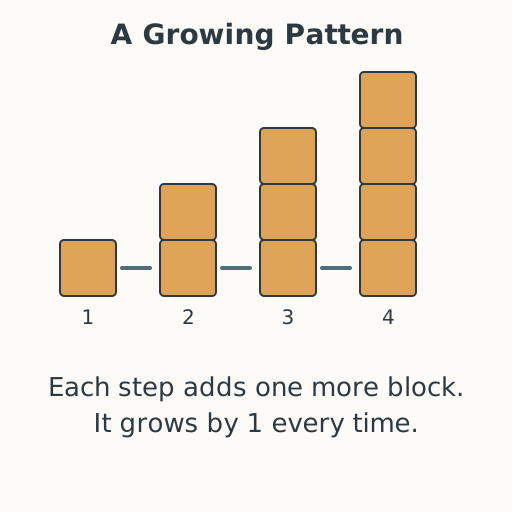
- Worked example — a growing staircase (10 min). Build a staircase with blocks: one block, then two blocks, then three, then four. Look at it. Is it repeating? No — it grows. How does it grow? Each step has one more than the step before. Say it: “it grows by one each step.”
- Build your own (15 min). Use your objects to build a growing staircase. Start with one, then two, then three, then four. Say how it grows. Now try a pattern that grows by two: two, four, six, eight. How is it different?
- Draw and label (8 min). Draw one growing pattern. Draw an arrow and write how it changes from one step to the next (“add one more,” “add two more”).
- Check with a partner (5 min). Trade patterns. A friend says how your pattern grows and adds the next step. Do you agree? Talk it through kindly if not.
- Close (2 min). A growing pattern is change you can see coming. When you can say how it grows, you can guess what comes next — and that is the start of prediction.
Differentiation
- Support: Build only the “add one” staircase and say “one more” for each step.
- Support (motor): Use large blocks and have a partner place them while the learner directs and describes.
- Extension: Build a pattern that grows by three, or a staircase that grows on both sides, and describe the change.
Assessment
- Formative (observation): Can the learner build a growing pattern and describe how it changes from one step to the next?
- Formative (self): Can the learner add the next step and check it matches the rule?
Home connection
At home, build a growing staircase with stones, beans, or toys and tell a grown-up how it grows each step.
Resources
- Clements, D. H., & Sarama, J. (2014). Learning and Teaching Early Math: The Learning Trajectories Approach (2nd ed.). Routledge. (Growing patterns and describing change from one term to the next.)