Lesson 08 — Extending and Describing Growing Patterns
Learners extend growing patterns several steps and state the rule in words — "it grows by two each time." They predict the next step, check it against the rule, and begin to describe change precisely.
Objectives
Objectives
- D05.S2.02.01 Identify and extend growing patterns and describe how the pattern changes from one step to the next.
Essential question
How do I extend a growing pattern and describe exactly how it changes from one step to the next?
Key vocabulary
Materials
Standard materials
- Small objects · about 40 per learner or pair Counters, seeds, or blocks for building and extending patterns
- Paper or slate and a drawing tool · per learner To draw, extend, and write the rule of a pattern
Low-tech / no-cost
- Found objects and the ground Extend growing patterns built from leaves, sticks, or stones in the dirt
- Voice and body Extend a growing clap-and-step pattern, adding one more each round
Enriched / lab & device
- Growing pattern cards with a missing step · 1 set Sequences with a step missing, for learners to fill in the next step
- Number patterns on a hundreds chart · 1 per pair To extend number patterns like 2, 4, 6, 8 by counting on
Works in different contexts
- large-group Extend a growing pattern as a whole group, one learner adding each step while the class states the rule
- self-directed A learner extends a pattern several steps, states its rule, and checks their extension against the rule
- outdoor-only Extend a growing pattern of stones, leaves, or footprints outdoors and state how each row grows
- multi-age Older learners state the rule while younger learners extend the pattern, then they check each other
- level-grouped Learners who extend easily describe the rule in words and predict a far step; others extend step by step
Lesson 8 — Extending and Describing Growing Patterns
Summary
Learners extend growing patterns several steps and put the change into words — the rule. They predict the next step, check it against the rule, and grow comfortable describing change precisely: “it grows by two each time.”
Objectives
- Identify and extend growing patterns and describe how the pattern changes from one step to the next. (D05.S2.02.01)
Connection
When a gardener plants rows of corn and adds two more plants each row, when a builder lays steps that rise the same height each time, when a song adds one drumbeat each verse — the change has a rule. If you can name the rule, you can say what comes next without even looking. Naming the rule of change is how people in every land build things that are steady and true.
Materials
- About 40 small objects (counters, seeds, blocks)
- Paper or slate and a drawing tool
Preparation
- Give each learner or pair about 40 objects.
- Prepare a few growing patterns to extend (growing by one, by two, and by three).
- Plan to model extending and stating a rule as a worked example.
Facilitator note
This lesson is written to the learner (“you”). It extends Lesson 7 from seeing growth to predicting it: the learner names the rule and uses it to go further. Teach with a worked example (philosophy §13): show 2, 4, 6, 8 dots, state “it grows by two,” and build the next step to check. The rule is a sentence, not a symbol — honor every clear wording. Patterns appear in weaving, music, and building across cultures, and naming a pattern’s rule is a small act of shared understanding. A learner who predicts a step and then corrects it has not failed — they have used feedback, which is exactly how learning works. For learners who are Deaf or hard of hearing, extend patterns with objects and point to each change; for learners who are blind or low-vision, build by touch and say the rule aloud. A learner who does not speak shows the rule by adding the next step or pointing.
Procedure
- Gather — recall growing patterns (5 min). Yesterday you built staircases that grew by one. What was the rule? Say it. Today we extend patterns and name their rules.
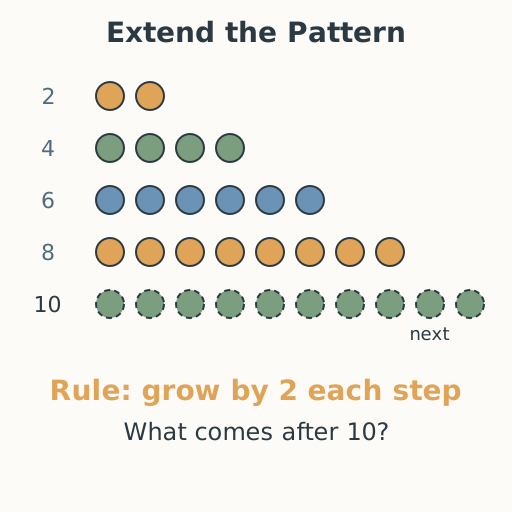
- Worked example — extend and name the rule (10 min). Look at a pattern of dots: 2, 4, 6, 8. How does it grow? It grows by two. Build the next step: ten dots. The rule is “add two each step.” Now say a later step — what comes after ten? Twelve.
- Guided practice — extend patterns (15 min). Build and extend patterns that grow by one, by two, and by three. For each, say the rule, then build the next two steps and check: does each step follow the rule?
- Write the rule (8 min). Choose one pattern. Draw it, draw the next two steps, and write the rule in your own words (“it grows by three”).
- Check with a partner (5 min). Trade patterns. A friend reads your rule and extends your pattern another step. Does it match? Talk it through kindly if not.
- Close (2 min). A pattern’s rule is its secret. When you can name the rule, you can see the future of the pattern — one step, and many steps ahead.
Differentiation
- Support: Extend only the “grow by one” pattern and say “one more” each step.
- Support (motor): Use large objects and have a partner place them while the learner names the rule.
- Extension: Predict a far step (for example, the tenth step of a “grow by two” pattern) and explain how you know.
Assessment
- Formative (observation): Can the learner extend a growing pattern and state its rule in their own words?
- Formative (peer): Can the learner read a friend’s rule and extend the pattern one more step correctly?
Home connection
At home, make a growing pattern with things you find — leaves, buttons, grains of rice — and teach a grown-up the rule, then show them the next three steps.
Resources
- Clements, D. H., & Sarama, J. (2014). Learning and Teaching Early Math: The Learning Trajectories Approach (2nd ed.). Routledge. (Extending patterns and verbalizing the rule of change.)