Lesson 09 — Finding the Missing Number
Learners solve one-step addition and subtraction stories with a missing number — "I had some, I spent 4, now I have 6." They act the story out, write it as a number sentence with a blank, find the missing number, and check by putting it back.
Objectives
Objectives
- D05.S2.02.02 Solve one-step addition and subtraction problems with a missing number in a real context, such as sharing or spending.
Essential question
How do I find a missing number in a one-step addition or subtraction story, and how do I know I am right?
Key vocabulary
Materials
Standard materials
- Small objects · about 50 per learner or pair Counters, seeds, or coins for acting out missing-number stories
- Paper or slate and a writing tool · per learner To record the number sentence with a blank or a box
Low-tech / no-cost
- Found objects and the ground Act out sharing and spending stories with seeds or stones, finding what is missing
- Voice and body Act out the story with fingers and hands, holding up the missing amount
Enriched / lab & device
- Story cards with a missing number · 1 set Picture-and-word stories such as "I had some, I spent 4, now I have 6"
- A simple balance or pan scale · 1 To feel what a missing amount means — making both sides the same
Works in different contexts
- large-group Act out one missing-number story as a whole group, then solve it together with objects
- self-directed A learner reads a story, acts it out, writes the number sentence with a box, and finds the missing number
- outdoor-only Tell sharing and spending stories about gathered things and solve them on the ground
- multi-age Older learners tell the story while younger learners act it out and find the missing number
- level-grouped Learners who find missing numbers easily write their own stories; others act out ready-made stories
Lesson 9 — Finding the Missing Number
Summary
Learners solve one-step addition and subtraction stories where a number is missing — “I had some seeds, I gave away 4, now I have 6.” They act the story out with objects, write it as a number sentence with a blank, find the missing number, and check by putting it back.
Objectives
- Solve one-step addition and subtraction problems with a missing number in a real context, such as sharing or spending. (D05.S2.02.02)
Connection
Sometimes you know the ending and one part, but not the start. A child shares some mangoes and has a few left — how many did they start with? A shopper spends some coins and has some left — how many did they have at first? A fisher sells some fish and keeps the rest. Finding the missing number is how we figure out the beginning of a story when we only know the middle and the end.
Materials
- About 50 small objects (counters, seeds, coins)
- Paper or slate and a writing tool
Preparation
- Give each learner or pair about 50 objects.
- Prepare a few missing-number stories about sharing, spending, or gathering.
- Plan to model finding the missing number as a worked example.
Facilitator note
This lesson is written to the learner (“you”). It is the “missing number” lesson — the unknown can be at the start, middle, or end of the story, which is a genuine stretch for seven- and eight-year-olds. Teach with a worked example (philosophy §13): tell the story, act it out, write a sentence with a blank, find the missing number, and check by putting it back. The check is the key habit — the learner proves the answer, not just states it. Keep stories small, real, and fair (sharing and spending, never winning or losing as worth). There is no “math person” and no “not-a-math person”; every learner can find a missing number, each in their own way and at their own pace. For learners who are Deaf or hard of hearing, tell the story in sign or pictures and act it out with objects; for learners who are blind or low-vision, act it out with real objects by touch. A learner who does not speak shows the missing number by holding up objects or pointing.
Procedure
- Gather — recall the two moves (5 min). You know adding (joining) and subtracting (taking away). Today a story hides one number, and you find it.
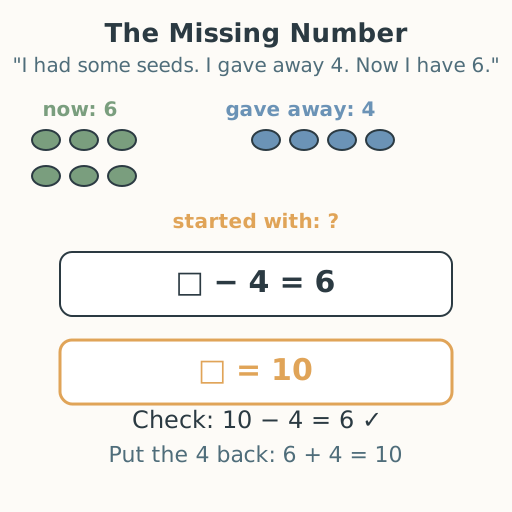
- Worked example — the hidden start (10 min). Listen: “I had some seeds. I gave away 4. Now I have 6.” How many did I start with? Act it out: make the “now” — 6 seeds. Put back the 4 I gave away. That is 10. The missing number is 10. Write it: □ − 4 = 6, and □ = 10. Check: 10 − 4 = 6. Yes!
- Guided practice — act and find (15 min). Hear more stories, one at a time. For each: act it out, write the number sentence with a blank, find the missing number, and check by putting it back. Try stories where the missing number is at the start, in the middle, and at the end.
- Write your own (8 min). Make up one sharing or spending story with a missing number. Write the number sentence with a blank. Trade with a friend and solve each other’s.
- Check together (5 min). Read your friend’s answer to your story. Does putting the number back make the story true? If not, act it out together — kindly.
- Close (2 min). A missing number is a little mystery, and you are the detective. Act the story, find the number, and check it back. Every story has an answer you can find.
Differentiation
- Support: Use stories where the missing number is at the end (“6 + 4 = □”) before hiding the start; act out every step.
- Support (motor): Have a partner move objects while the learner directs and finds the number.
- Extension: Write two different stories (one add, one subtract) with the same missing number, and show how the check works for each.
Assessment
- Formative (observation): Can the learner act out a missing-number story, write the sentence with a blank, find the missing number, and check it?
- Formative (self): Can the learner put their answer back into the story to prove it is right?
Home connection
At home, make up a sharing or spending story with a missing number for a grown-up, and solve it together with small objects.
Resources
- Carpenter, T. P., Fennema, E., Franke, M. L., Levi, L., & Empson, S. B. (2015). Children’s Mathematics: Cognitively Guided Instruction (2nd ed.). Heinemann. (Start-unknown and change-unknown problems as the missing-number problem types.)