Lesson 10 — Shapes by Their Attributes
Learners name shapes by their attributes — how many sides, how many angles, which sides are equal. They sort a set of shapes by these features and discover that the attributes, not the color or size, decide a shape's name.
Objectives
Objectives
- D05.S3.02.01 Identify and draw shapes with given attributes, such as a certain number of angles or equal sides.
Essential question
How do I name a shape by its attributes — its sides, angles, and equal parts?
Key vocabulary
Materials
Standard materials
- Shape cards or cut-out shapes · 1 set per pair Triangles, squares, rectangles, pentagons, hexagons in varied sizes
- Paper or slate and a drawing tool · per learner To draw and label shapes by their attributes
Low-tech / no-cost
- Found objects and the ground Draw shapes in the dirt with a stick and count their sides and corners
- Body and hands Make shapes with arms and hands, counting sides and corners with a partner
Enriched / lab & device
- Geoboards and rubber bands · 1 per pair To build shapes and feel their sides and angles
- Attribute sorting cards · 1 set Cards for sorting shapes by number of sides, angles, or equal sides
Works in different contexts
- large-group Hold up a shape, count its sides and angles together, and name it as one voice
- self-directed A learner sorts a set of shapes by number of sides and labels each with its name
- outdoor-only Find shapes in buildings, tiles, and plants outdoors, and count their sides and angles
- multi-age Older learners call out attributes while younger learners find or draw the matching shape
- level-grouped Learners who name shapes easily sort by two attributes at once; others count sides with a partner
Lesson 10 — Shapes by Their Attributes
Summary
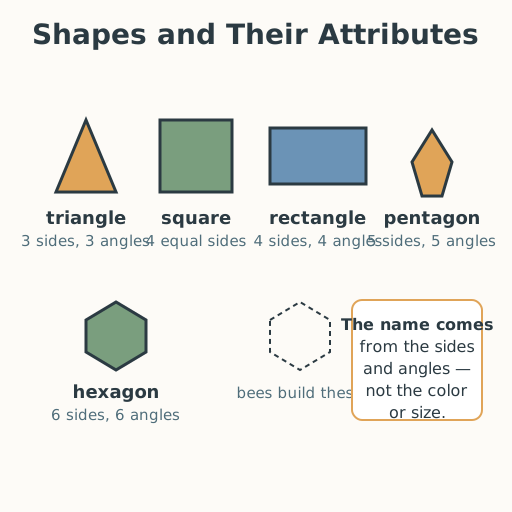
Learners name shapes by their attributes — how many sides, how many angles, which sides are equal. They sort shapes by these features and discover that a shape’s name comes from its attributes, not its color or size: a triangle is a triangle whether it is big, small, red, or blue.
Objectives
- Identify and draw shapes with given attributes, such as a certain number of angles or equal sides. (D05.S3.02.01)
Connection
Shapes are everywhere — a door, a tile, a roof, a honeycomb, a traffic sign. People in every land have named shapes by what they are — how many sides and corners they have — so that a builder in one place and a builder far away can mean the same thing by “triangle” or “square.” A shape’s name is a shared language for the world’s structure.
Materials
- Shape cards or cut-out shapes (triangles, squares, rectangles, pentagons, hexagons)
- Paper or slate and a drawing tool
Preparation
- Prepare a mixed set of shapes in varied sizes and colors.
- Plan to model counting sides and angles of one shape as a worked example.
- Have a sorting surface ready.
Facilitator note
This lesson is written to the learner (“you”). It builds on Grade 1’s composing and taking apart shapes and now asks learners to name shapes by attributes. Teach with a worked example (philosophy §13): take a triangle, count three sides and three angles, and say its name. The key ideas are that attributes (not color or size) decide the name, and that a square is a special rectangle (a rectangle with four equal sides). Keep this gentle — the goal is counting sides and angles and matching them to names, not memorizing definitions. Shapes and their names appear in the geometry of many cultures — from Islamic star patterns to the kente cloth patterns of West Africa to the hexagons bees build everywhere. No one’s speed at naming shapes measures their smartness; shapes are for everyone to see and build. For learners who are Deaf or hard of hearing, count sides in sign and point; for learners who are blind or low-vision, feel cut-out shapes and count corners by touch. A learner who does not speak points to the shape or holds up the number of sides.
Procedure
- Gather — recall shapes (5 min). You already know some shapes — circle, square, triangle. Today you learn their secret: every shape’s name comes from what it is — its sides and angles.
- Worked example — count and name (10 min). Take a triangle. Count its sides: 1, 2, 3. Count its angles (corners): 1, 2, 3. Three sides and three angles — that is a triangle. Its color and size do not matter. Say it together.
- Sort by attributes (15 min). Sort your shapes. Put all the shapes with three sides together (triangles), all with four sides together, all with five, all with six. Count sides and angles to be sure. Name each group.
- Notice the special one (5 min). Look at your four-sided shapes. Which have four equal sides? Those are squares. Which have four sides but not all equal? Those are rectangles. A square is a rectangle with all sides equal.
- Draw and label (8 min). Draw each shape and write its name and how many sides and angles it has. Does your drawing match the name?
- Close (2 min). A shape’s name is its attributes in words. Count the sides, count the angles — and you can name any shape in the world.
Differentiation
- Support: Start with only triangles, squares, and rectangles; count sides with the learner’s finger on the shape.
- Support (motor): Use large cut-outs and have a partner trace while the learner counts.
- Extension: Sort the shapes by two attributes at once (for example, four sides AND all sides equal), or find a shape with six sides and six angles in real life.
Assessment
- Formative (observation): Can the learner identify shapes by counting sides and angles and match each to its name?
- Formative (peer): Can the learner check a friend’s sorted groups and agree or gently correct with the count?
Home connection
At home, find five shapes and tell a grown-up each one’s name and how many sides and angles it has.
Resources
- Van de Walle, J. A., Karp, K. S., & Bay-Williams, J. M. (2019). Elementary and Middle School Mathematics: Teaching Developmentally (10th ed.). Pearson. (Classifying shapes by attributes such as sides and angles.)