Lesson 11 — Drawing Shapes With Given Attributes
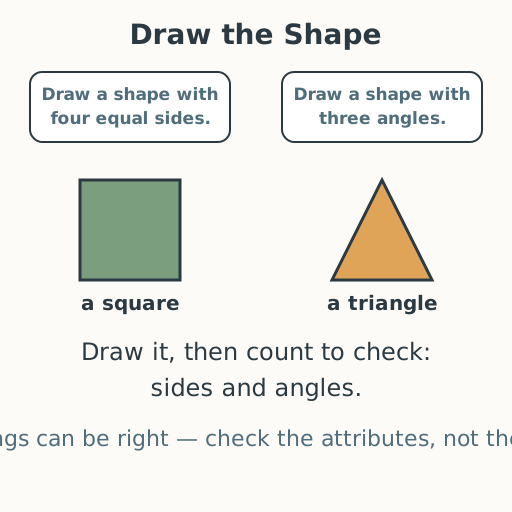
Learners draw shapes from given attributes — "draw a shape with four equal sides," "draw a shape with three angles." They check their drawings by counting sides and angles, turning words into pictures.
Objectives
Objectives
- D05.S3.02.01 Identify and draw shapes with given attributes, such as a certain number of angles or equal sides.
Essential question
How do I draw a shape when someone tells me its attributes — like a certain number of angles or equal sides?
Key vocabulary
Materials
Standard materials
- Paper or slate and a drawing tool · per learner To draw shapes from spoken or written attributes
- Rulers or straight edges (optional) · 1 per learner To draw straight sides
Low-tech / no-cost
- The ground and a stick Draw shapes in the dirt from attributes called aloud
- Body and hands Make a shape with the body that matches the attributes called
Enriched / lab & device
- Dot grid or geoboard paper · per learner To draw shapes with counted sides and angles on a grid
- Geoboards and rubber bands · 1 per pair To build the shape first, then copy it onto paper
Works in different contexts
- large-group Call out attributes and have everyone draw the shape, then hold drawings up to compare
- self-directed A learner reads or chooses an attribute card and draws the shape, then checks the sides and angles
- outdoor-only Draw shapes with a stick or chalk from attributes called aloud, and check each other's
- multi-age Older learners call attributes while younger learners draw, then they check together
- level-grouped Learners who draw easily try two attributes at once; others draw from one attribute with a model to copy
Lesson 11 — Drawing Shapes With Given Attributes
Summary
Learners draw shapes from given attributes — “draw a shape with four equal sides,” “draw a shape with three angles.” They check their drawings by counting sides and angles, turning spoken words into pictures and back again.
Objectives
- Identify and draw shapes with given attributes, such as a certain number of angles or equal sides. (D05.S3.02.01)
Connection
A builder hears “make a frame with four equal sides” and draws a square; a weaver hears “six-sided cells” and thinks of a honeycomb; a child hears “a shape with three corners” and draws a triangle. Drawing from words is how an idea in one person’s head becomes a picture everyone can see — and a shape everyone can check by counting.
Materials
- Paper or slate and a drawing tool
- Rulers or straight edges (optional)
Preparation
- Prepare attribute cards or a list of drawing challenges.
- Have drawing tools and straight edges ready.
- Plan to model drawing one shape from attributes as a worked example.
Facilitator note
This lesson is written to the learner (“you”). It reverses Lesson 10: now the attributes come first, and the learner draws the shape. Teach with a worked example (philosophy §13): hear “four equal sides,” draw a square, count to check. Accept every drawing that honestly matches the attributes — a triangle can be wide or tall, and a rectangle can be long or short; there is no single “correct” drawing, only shapes that meet the attributes or do not. This is a gentle lesson in precision without punishment: checking sides and angles is how we know a drawing is right, and correcting a drawing is learning, not failing. Every learner can draw; the goal is matching attributes, not making “pretty” pictures. For learners who are Deaf or hard of hearing, show the attributes in writing or sign and let them draw; for learners who are blind or low-vision, build the shape with a geoboard or clay and describe it. A learner who does not speak draws the shape or builds it to answer.
Procedure
- Gather — recall attributes (5 min). Yesterday you named shapes by their sides and angles. Today it is a game: someone tells you the attributes, and you draw the shape.
- Worked example — hear and draw (8 min). Listen: “Draw a shape with four equal sides.” What could it be? A square. Draw it, then check: count the sides (4), check they are equal. Yes! Say it together.
- Draw from attributes (15 min). One at a time, hear or read a challenge and draw the shape: “three angles,” “four sides with two long and two short,” “five sides,” “six angles.” After each, check by counting sides and angles.
- Challenge a friend (10 min). Write or say an attribute challenge for a friend. Draw their challenge; they draw yours. Check each other’s drawings by counting.
- Check together (5 min). For each pair of drawings, ask: does it have the right number of sides and angles? If not, draw again together — kindly.
- Close (2 min). Words can become pictures, and pictures can be checked. When you can draw from attributes and count to check, you hold the whole shape in your mind.
Differentiation
- Support: Draw from one simple attribute at a time, with a model shape to copy first.
- Support (motor): Use a geoboard or large arm movements to make the shape before drawing, or have a partner trace while the learner directs.
- Extension: Draw a shape with two attributes at once (for example, “four sides AND all sides equal”), or draw two different shapes that both have four sides.
Assessment
- Formative (observation): Can the learner draw a shape from given attributes and check it by counting sides and angles?
- Formative (peer/self): Can the learner check their own and a friend’s drawing against the attributes and correct a mismatch?
Home connection
At home, ask a grown-up to say some attributes (“three sides,” “four equal sides”), draw the shape, and let them check it with you.
Resources
- Van de Walle, J. A., Karp, K. S., & Bay-Williams, J. M. (2019). Elementary and Middle School Mathematics: Teaching Developmentally (10th ed.). Pearson. (Drawing shapes from defining attributes.)