Lesson 12 — Sharing Into Halves, Thirds, and Fourths
Learners fold and cut circles and rectangles into equal shares — halves, thirds, and fourths — and name each share. They discover that equal shares are the heart of fair sharing, and that the more shares, the smaller each one is.
Objectives
Objectives
- D05.S3.02.02 Partition circles and rectangles into equal shares and describe the shares as halves, thirds, and fourths.
Essential question
How do I share a circle or rectangle into equal halves, thirds, and fourths, and what is each share called?
Key vocabulary
Materials
Standard materials
- Paper circles and rectangles · several per learner To fold and cut into equal shares
- Round and square foods or objects (optional) · per learner or pair A flatbread, tortilla, or paper circle to share into equal parts
Low-tech / no-cost
- A leaf, a flatbread, or a cloth Fold a real object into halves, thirds, and fourths by hand
- Voice and body Act out sharing one thing among two, three, and four friends, naming each share
Enriched / lab & device
- Fraction strips and circles · 1 set per pair Pre-cut pieces showing halves, thirds, and fourths to compare
- A picture of a shared food from another culture · 1 To show that sharing into equal parts is a worldwide practice
Works in different contexts
- large-group Fold one big circle together as a whole group, naming halves, thirds, and fourths in one voice
- self-directed A learner folds and cuts a circle and rectangle into halves, thirds, and fourths, labeling each share
- outdoor-only Share a real round or flat food outdoors into equal parts and name each share
- multi-age Older learners demonstrate folding into thirds while younger learners try halves and fourths
- level-grouped Learners who partition easily compare which share is larger (a half or a fourth); others fold halves first
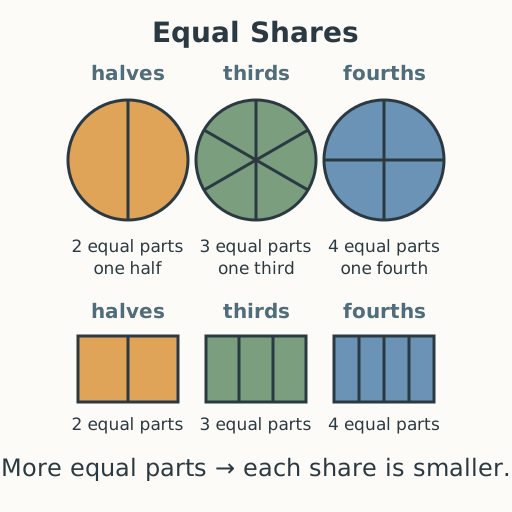
Lesson 12 — Sharing Into Halves, Thirds, and Fourths
Summary
Learners fold and cut circles and rectangles into equal shares — halves, thirds, and fourths — and name each share. They discover that equal shares are the heart of fair sharing, and that the more people share, the smaller each share becomes.
Objectives
- Partition circles and rectangles into equal shares and describe the shares as halves, thirds, and fourths. (D05.S3.02.02)
Connection
Sharing fairly is one of the oldest human acts. Two children share a flatbread — each gets a half. Three friends share a round cake — each gets a third. Four people share a pizza — each gets a fourth. In every land, when people share one thing among many, they cut it into equal parts so that everyone gets the same — because fair is not just kind, it is the way we live together.
Materials
- Paper circles and rectangles (several per learner)
- A round or square food or object to share (optional)
Preparation
- Give each learner several paper circles and rectangles.
- Have scissors (or tearing by hand) ready.
- Plan to model folding into halves, thirds, and fourths as worked examples.
Facilitator note
This lesson is written to the learner (“you”). It introduces equal shares — the first real meeting with fractions, taught through the ethics of fair sharing. Teach with worked examples (philosophy §13): fold a circle into two equal parts and say “two halves make the whole.” Emphasize that shares must be equal for sharing to be fair, and connect halves, thirds, and fourths to sharing among two, three, and four people. This is a values lesson as much as a math lesson: fairness means each person gets the same, and no one is worth more than another (egalitarianism). Avoid ranking “good” and “bad” folders. For learners who are Deaf or hard of hearing, show folding and name each share in sign; for learners who are blind or low-vision, fold real cloth or a flatbread and feel the equal parts. A learner who does not speak points to the share or holds up the number of parts. Every learner can share fairly.
Procedure
- Gather — recall sharing (5 min). Have you ever shared one thing with a friend? What did you each get? Today we learn to cut one thing into equal parts so sharing is fair.
- Worked example — halves (8 min). Take a paper circle. Fold it so the two parts match exactly. Open it — two equal parts. Each part is a half; two halves make the whole. Fold it again into four equal parts: each is a fourth.
- Make thirds (8 min). Take a rectangle. Fold it into three equal parts. This takes care — the parts must match. Each part is a third; three thirds make the whole.
- Cut and name (12 min). Cut a circle into halves, thirds, and fourths (three different circles). Label each share: “one half,” “one third,” “one fourth.” Put the parts back together to make the whole again.
- Notice the size (7 min). Compare: which is bigger, a half or a fourth? Which is bigger, a third or a fourth? Why? The more equal parts, the smaller each share.
- Close (3 min). Fair sharing is equal sharing. Halves, thirds, and fourths are the names of fair shares — and when everyone gets the same, everyone is cared for.
Differentiation
- Support: Fold and name only halves today; add thirds and fourths another day.
- Support (motor): Use larger paper or real flatbread, and have a partner fold while the learner names each share.
- Extension: Fold a rectangle into halves in two different ways and show they are still halves; or explain why a half is bigger than a fourth.
Assessment
- Formative (observation): Can the learner partition a circle and rectangle into halves, thirds, and fourths and name each share?
- Artifact (portfolio): A labeled set of equal-share shapes, kept as a record of the learner’s first fraction work.
Home connection
At home, share one flatbread, fruit, or paper circle among two, three, and four people, and name each person’s share.
Resources
- National Research Council. (2009). Mathematics Learning in Early Childhood: Paths Toward Excellence and Equity. The National Academies Press. (Equal partitioning and naming shares as the foundation of fractions.)