Lesson 13 — Measuring With Standard Units
Learners measure with standard units — centimeters and inches — and discover why a shared unit matters: one person's hand is not another's, but a centimeter is the same for everyone. They measure real objects and record each length.
Objectives
Objectives
- D05.S4.02.01 Measure length using standard units such as centimeters, meters, and inches, choosing the right tool for the job.
Essential question
How do I measure length with standard units like centimeters and inches, and why do standard units matter?
Key vocabulary
Materials
Standard materials
- Rulers with centimeters and inches · 1 per learner or pair To measure objects around the room
- Small objects to measure · several per learner or pair A pencil, a leaf, a book, a shoe, a stick
- Paper or slate and a writing tool · per learner To record measurements
Low-tech / no-cost
- Hand spans and foot lengths First measure with bodies, then see why a shared unit like a centimeter helps
- A marked string Make a ruler by marking equal spaces on a string or stick
Enriched / lab & device
- Meter sticks and measuring tapes · 1 per pair To measure longer things and see how centimeters make a meter
- A simple length conversion chart · 1 Showing 100 centimeters in a meter and 12 inches in a foot
Works in different contexts
- large-group Measure the same object together, calling out the number in centimeters, then check as a group
- self-directed A learner measures several objects with a ruler and records each length in centimeters or inches
- outdoor-only Measure leaves, sticks, and steps outdoors in centimeters or inches with a ruler or marked string
- multi-age Older learners read the ruler while younger learners line up the object and call out the number
- level-grouped Learners who measure easily estimate first then measure to check; others measure with a partner
Lesson 13 — Measuring With Standard Units
Summary
Learners measure length with standard units — centimeters and inches — and discover why a shared unit matters: one person’s hand is not another’s, but a centimeter is the same for everyone. They measure real objects and record each length.
Objectives
- Measure length using standard units such as centimeters, meters, and inches, choosing the right tool for the job. (D05.S4.02.01)
Connection
Long ago, people measured with their bodies — a hand span, a foot, an arm’s length. But one person’s foot is bigger than another’s, so two builders measuring the same door got different answers. That is why people invented standard units — a centimeter, an inch, a meter — that are the same for everyone, everywhere. With a shared unit, a builder here and a builder far away can agree on a length.
Materials
- Rulers with centimeters and inches
- Small objects to measure (pencil, leaf, book, shoe, stick)
- Paper or slate and a writing tool
Preparation
- Give each learner or pair a ruler and several objects to measure.
- Prepare a quick “why standard units?” story (two different hand spans).
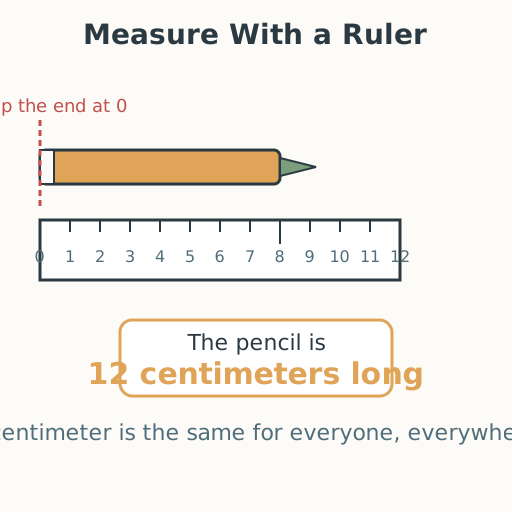
- Plan to model lining up the end at zero and reading the ruler as a worked example.
Facilitator note
This lesson is written to the learner (“you”). It builds on Grade 1’s non-standard measuring (hand spans, paper clips) and introduces standard units. Teach with a worked example (philosophy §13): line a pencil up at zero and read “12 centimeters.” The key idea is why a shared unit matters — different bodies give different measures, but a centimeter is the same for all. Keep it concrete: measure real things, first estimating by eye, then checking with the ruler. Measuring is not a contest; a learner’s pace is not their worth, and an estimate that is corrected is success, not failure. For learners who are Deaf or hard of hearing, show the ruler and write each number; for learners who are blind or low-vision, use a ruler with raised marks or count equal spaces by touch. A learner who does not speak points to the number on the ruler.
Procedure
- Gather — recall measuring with bodies (5 min). Last year you measured with hand spans and paper clips. Quick: is your hand the same size as a friend’s? Today we learn a unit that is the same for everyone.
- Worked example — the shared unit (10 min). Meet the centimeter and the inch on your ruler. Line a pencil up so one end is at zero. Read where the other end lands — “12 centimeters.” The centimeter is the same for you, for me, and for a builder far away. That is why we use it.
- Measure real things (15 min). Measure several objects with your ruler: a leaf, a book, a shoe, a stick, your pencil. Record each length in centimeters, and some in inches too. Line up the end at zero every time.
- Estimate, then check (8 min). Before measuring each new thing, guess its length by eye. Write your guess, then measure. How close were you? Guessing first makes your eye sharper.
- Check with a partner (5 min). Trade one object and measure it yourself. Do you and your friend get the same length? If not, measure again together — kindly. A shared unit should give a shared answer.
- Close (2 min). A standard unit is a promise we make together: the same length for everyone. With it, we can measure the world and agree.
Differentiation
- Support: Measure only whole centimeters, with a partner holding the ruler while the learner reads the number.
- Support (motor): Use large, easy-to-grip rulers and have a partner hold the object.
- Extension: Measure a longer distance (a table, a room) and guess how many centimeters or inches it is, then check; or measure the same object in both units and compare the numbers.
Assessment
- Formative (observation): Can the learner line an object up at zero and measure its length in centimeters or inches, recording the number?
- Formative (self): Can the learner estimate first, measure, and compare their estimate to the actual length?
Home connection
At home, measure three things with a ruler or a marked string, and tell a grown-up each length in centimeters or inches.
Resources
- National Research Council. (2009). Mathematics Learning in Early Childhood: Paths Toward Excellence and Equity. The National Academies Press. (Standard units and the need for a shared measure.)