Lesson 05 — A Habitat Is a Home
Learners discover that a habitat is a home — a place where living things find food, water, shelter, and a place to raise young. They observe and describe a real or pictured habitat and match the living things that call it home, from ponds, forests, and seashores to deserts, savannas, rainforests, and tundra.
Objectives
Objectives
- D06.S2.02.02 Observe and describe a habitat and the living things that call it home.
Essential question
What is a habitat, and what living things call it home?
Key vocabulary
Materials
Standard materials
- Pictures of different habitats · 1 set A pond, a forest, a desert, a meadow, a seashore, a savanna, a rainforest, a tundra
- Picture cards of living things · 1 set A frog, fish, bird, cactus, camel, tree, zebra, monkey, polar bear, and others to match to homes
- Paper and crayons · per learner
Low-tech / no-cost
- A real place to observe outside A patch of grass, a tree, a puddle — observe and name what lives there
- Voice and body Act out a living thing in its home (a fish swimming, a bird nesting)
Enriched / lab & device
- A habitat sorting mat per pair · 1 per pair A mat with a pond, forest, and desert drawn on it for placing living things
- A "home for a creature" drawing frame · per learner A frame to draw one habitat with its living things and label them
Works in different contexts
- large-group Show each habitat to the whole group and name its living things together, then pairs match cards to homes
- self-directed A learner chooses a habitat, matches living things to it, and draws and labels one complete home
- outdoor-only Choose a real place outside and observe it closely — name every living thing you find and the water, shelter, and food nearby
- multi-age Older learners read habitat names aloud and ask "who lives here?" while younger learners place the cards
- level-grouped Learners who can compare two habitats (desert vs. pond) explain how their living things differ; others match one habitat's creatures
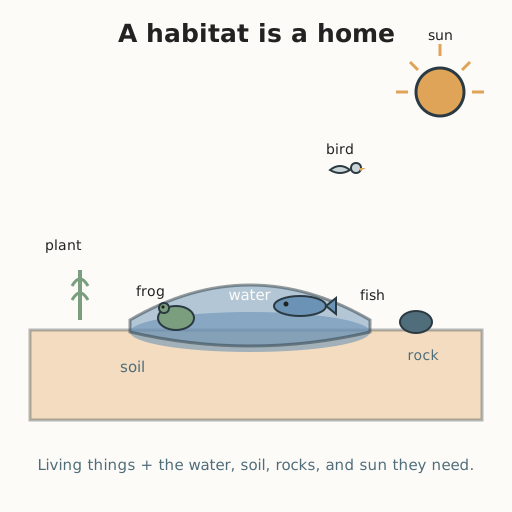
Lesson 5 — A Habitat Is a Home
Summary
A habitat is a living thing’s home — the place where it finds its food, water, shelter, and a place to raise its young. Learners observe and describe a habitat (a pond, a forest, a desert, a savanna, a tundra, or a real patch of ground outside) and name the living things that call it home, and the things they need there. They learn that homes differ all over the world, and each one fits the living things that live in it.
Objectives
- Observe and describe a habitat and the living things that call it home. (D06.S2.02.02)
Connection
Think of your own home — the place where you sleep, eat, and are safe. Every living thing has a home too. A frog’s home is a pond; a cactus’s home is the dry desert; a bird’s home is a tree; a zebra’s home is the wide savanna; a polar bear’s home is the cold, icy tundra. That home is called a habitat — the place that gives a living thing its food, water, shelter, and a safe place to raise its young.
Materials
- Pictures of different habitats (a pond, a forest, a desert, a meadow, a seashore)
- Picture cards of living things (a frog, fish, bird, cactus, camel, tree, and others)
- Paper and crayons
Preparation
- Choose one habitat everyone can observe or look at closely (a real place outside, or a clear picture).
- Set out the living-thing cards to match to each habitat.
- Prepare to ask the guiding question: “Who lives here, and what does this home give them?”
Facilitator note
This lesson is written to the learner (“you”). Keep it concrete before abstract: begin with the learner’s own home, then widen to the homes of other living things. Model describing one habitat aloud — “this pond has water, mud, and plants; the frog finds food and shelter here” — then let learners try. Use habitats from many biomes (pond, forest, desert, seashore, meadow, savanna, rainforest, tundra) so no single landscape or climate is treated as the default, and learners in Lagos, Lima, or Lahore can find a home that looks like the one they know. A light ethical thread: a habitat is not ours to spoil — caring for a home means caring for its living things. Where learners cannot go outside, a clear picture or a story works just as well; where they can, a few minutes of close looking outdoors is the richest version. Retrieval: link back to Lesson 3’s sorting by “where it lives” — this is that idea, grown.
Procedure
- Gather and remember (5 min). Last lesson we sorted by “where it lives.” Today we give that place a name: a habitat.
- Name the parts of a home (10 min). What does a home give you? Food, water, a safe place to sleep, a place to be with your family. A habitat gives living things the same things.
- Meet a habitat (15 min). Look at one habitat together — a pond, a forest, or a real patch of ground outside. Say what you see: water? soil? plants? shade? Then name the living things that call it home: “The frog lives here. The fish lives here.” What does this home give each one?
- Match living things to homes (10 min). With the cards, match each living thing to its habitat. Tell a partner why it fits: “The cactus fits the desert because it can live with very little water.”
- Draw one habitat (7 min). Draw one habitat with its living things and label them — the water, the shelter, the food.
- Close (3 min). A habitat is a home, and every living thing has one. Different homes, all over the world — each one just right for the ones who live there.
Differentiation
- Support: Describe one habitat with three named living things, using the frame “The ___ lives here, and it finds ___.”
- Support (non-speaking): Point to the living things in a habitat picture and to the food, water, and shelter they use.
- Support (blind/low-vision): Describe a habitat you can hear and touch (a pond you can listen to, moss you can feel) with a partner naming each part.
- Extension: Compare two habitats — a desert and a pond — and tell how their living things and needs differ.
Assessment
- Formative (observation): Can the learner observe a habitat and name two or more living things that call it home, and something the home gives them?
- Artifact (portfolio): The labeled “one habitat” drawing.
Home connection
At home or outside, pick one small habitat — a tree, a puddle, a patch of grass — and watch it quietly. Tell a grown-up every living thing you found there and what the home gives it.
Resources
- BBC Bitesize (KS1 Science), “What is a habitat?” — a place where living things find food, water, and shelter, with examples from many places. https://www.bbc.co.uk/bitesize/topics/zx882hv