Lesson 08 — The Sun Warms the Earth
Learners discover that the Sun is a star that gives the Earth two gifts — light and warmth — and that living things need both. They feel the difference between sun and shade, connect light and warmth to growing plants, and hold the Sun as a source of wonder as well as a source of energy.
Objectives
Objectives
- D06.S4.02.01 Describe how the Sun warms the Earth and gives light that living things need.
Essential question
How does the Sun warm the Earth and give the light living things need?
Key vocabulary
Materials
Standard materials
- Pictures of the Sun and Earth · 1 set To show the Sun sending light and warmth to the Earth
- A sunny spot or a warm surface · 1 To feel the Sun's warmth on the skin (or a safe lamp to model it)
- Paper and crayons · per learner
Low-tech / no-cost
- The sky and your own skin Step into the sun and feel its warmth; step into the shade and feel the difference
- Voice and a partner Tell each other what the Sun gives us and what living things do with it
Enriched / lab & device
- A sun-and-shadow thermometer or two cups of water · 1 Place one cup in sun and one in shade and feel the difference in warmth
- A "gifts of the Sun" drawing frame · per learner A frame to draw the Sun, the Earth, and a growing plant, labeled light and warmth
Works in different contexts
- large-group Compare sun and shade as a whole group, then pairs draw and label the Sun's two gifts together
- self-directed A learner observes sun vs. shade, feels the difference, and draws the Sun, Earth, and a growing plant labeled with light and warmth
- outdoor-only Feel sun and shade directly, find a plant in the light, and trace its shadow at two times of day
- multi-age Older learners explain that the Sun's light travels a very long way to reach us, while younger learners match light and warmth to growing plants
- level-grouped Learners who can compare sun and shade and predict a difference work there; others name the Sun's two gifts
Lesson 8 — The Sun Warms the Earth
Summary
The Sun is a star — a giant ball of light and heat — and it gives the Earth two gifts: light and warmth. Learners feel the difference between sun and shade, connect those two gifts to the living things that need them, and learn that plants grow and animals stay warm because of the Sun’s energy. They also hold the Sun as a thing to wonder at — where it came from is a big question with many stories, held as stories.
Objectives
- Describe how the Sun warms the Earth and gives light that living things need. (D06.S4.02.01)
Connection
Step into the sun and you feel warmth on your skin; step into the shade and it is cooler. That warmth, and the light that helps you see, both come from one place: the Sun, a star so big it could hold the Earth many, many times over. Without the Sun’s light and warmth, plants could not grow, and animals and people could not live. The Sun is far away, but its gifts reach us every day.
Materials
- Pictures of the Sun and Earth
- A sunny spot or a warm surface
- Paper and crayons
Preparation
- Find a place where learners can safely feel sun and shade (or set up a safe lamp to model it).
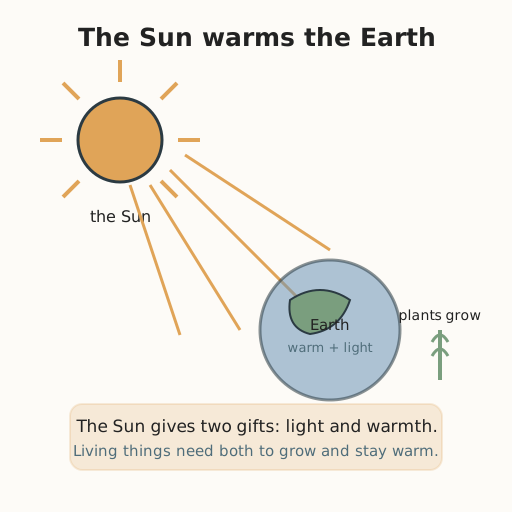
- Prepare a picture showing the Sun sending light and warmth to the Earth.
- Review safety: never look straight at the Sun; it can hurt eyes.
Facilitator note
This lesson is written to the learner (“you”). Teach the safety rule early and
gently: never look straight at the Sun — it is too bright for eyes. Keep the science
concrete: feel sun vs. shade; find a plant in the light; notice warmth on a dark
surface. The Sun is a star, and its light and heat travel about 150 million kilometres to
reach us — a fact to wonder at, offered lightly, not to memorize. Hold origins with
openness per docs/philosophy.md §11: people have told many stories about where the Sun
and the Earth came from, and scientists have a story too — they are all stories to wonder
at together, and we rank none above the others. Distinguish evidence from values: “the
Sun warms the Earth” is something we can feel and agree on; “I love sunny days” is a
feeling. In hot places the Sun can also be too strong — sunburn and heat are real, and
staying safe in strong sun (shade, cover, water) is a fair, hopeful note, not fear.
Procedure
- Gather and remember (5 min). Yesterday we met three kinds of energy. Today we meet the great giver of two of them: the Sun.
- Feel sun and shade (10 min). Stand (or reach) into the sun, then into the shade. What do you notice? The sun side is warmer, the shade side is cooler. The Sun’s warmth reaches your skin. (Never look straight at the Sun — keep your eyes safe.)
- The Sun’s two gifts (10 min). The Sun gives the Earth two gifts: light and warmth. Point to each in the picture. Which one lets you see? Which one warms your skin?
- Who needs the Sun? (10 min). Think of a plant, an animal, and a person. What does the Sun give each one? “The plant needs light to grow. The cat needs warmth. I need both.” Draw the Sun shining on a growing plant.
- Wonder about the Sun (10 min). The Sun is a star, far, far away — so far that its light takes a long, long time to reach us. Where did the Sun come from? People have told many stories, and scientists have a story too. We hold them all as stories to wonder at together.
- Close (5 min). The Sun gives the Earth light and warmth, and living things need both. Keep safe in its strong light — and keep wondering about it.
Differentiation
- Support: Match the two gifts (light, warmth) to a plant and a person using the frame “The Sun gives ___ and ___.”
- Support (non-speaking): Point to the Sun, then to the warm skin and the bright light, then to a growing plant.
- Support (blind/low-vision): Feel sun vs. shade and describe the difference; a partner names the light that others see.
- Extension: Predict which feels warmer — a dark cloth or a light cloth left in the sun — then test it with a hand and tell what you found.
Assessment
- Formative (observation): Can the learner name the Sun’s two gifts (light and warmth) and connect at least one to a living thing that needs it?
- Artifact (portfolio): The “Sun shining on a growing plant” drawing, labeled light and warmth.
Home connection
At home, feel a sunny spot and a shady spot with your hand. Tell a grown-up which is warmer and why. Then watch a plant in the light — that is the Sun’s gift at work.
Resources
- NASA Space Place (NASA Science), “All About the Sun” — the Sun is a star that gives the Earth light and heat that living things need. https://spaceplace.nasa.gov/all-about-the-sun/en/