Lesson 05 — A Movement Sequence
Learners create and repeat a short movement sequence with a clear beginning and end. They discover that a sequence is movement in order, and that every dance and every day is built from sequences.
Objectives
Objectives
- D07.S3.02.01 Create and repeat a short movement sequence with a clear beginning and end.
Essential question
How do I create and repeat a short movement sequence with a clear beginning and end?
Key vocabulary
Materials
Standard materials
- Open floor space · enough to move With a seated option for everyone
- A soft beat or clapped rhythm (optional) · 1 To move the sequence in time
Low-tech / no-cost
- The body alone Move in place or in a small space with no music at all
- A counted rhythm Count "one, two, three, four" aloud to order the sequence
Enriched / lab & device
- A few short music clips with a clear pulse · 1 set One steady beat to move the sequence along
- A mirror or a camera · 1 per group To see your own sequence, or watch it back
Works in different contexts
- large-group Move the sequence together as a whole group, one move at a time, so everyone moves at once and no one performs alone
- multi-age Older learners call the moves in order while younger learners do them; then trade who calls and who moves
- self-directed A learner makes a short sequence of three or four moves with a clear start and finish, repeats it, and tells a grown-up or recording the order
- level-grouped Some learners make a two-move sequence; others make a four-move sequence; match the challenge
- outdoor-only Make the sequence in a big open space, adding a start and finish pose under the sky
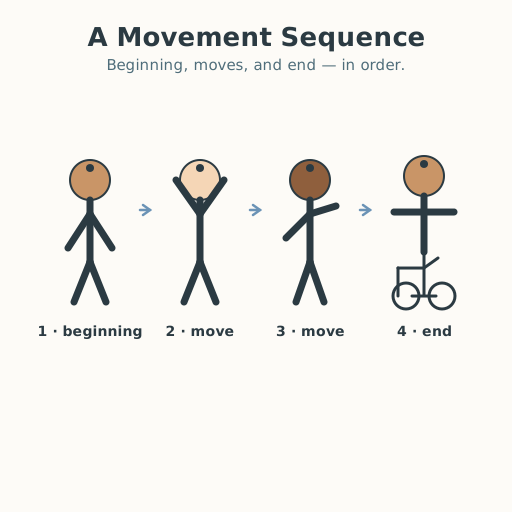
Lesson 5 — A Movement Sequence
Summary
Learners create and repeat a short movement sequence — a few moves in order with a clear beginning and end. They discover that a sequence is movement you can say again, and that dances, games, and everyday tasks everywhere are built from sequences.
Objectives
- Create and repeat a short movement sequence with a clear beginning and end. (D07.S3.02.01)
Connection
Think of the steps you already do in order — washing your hands, getting ready for bed, greeting a friend. A sequence is steps that go in order, with a clear start and a clear finish. Everywhere in the world, people move in sequences — in dances, in games, in the way they welcome and say goodbye. Today you will make your own short sequence and repeat it the same way.
Materials
- Open floor space (with a seated option)
- A soft beat or clapped rhythm (optional)
Preparation
- Clear a space big enough to move, and keep a seated option for everyone.
- Decide on a simple beat to move along, or count aloud.
Facilitator note
This lesson is written to the learner (“you”) so it works in a classroom and for a self-directed learner. A sequence is a skill structure, so model it once — a start pose, two moves, an end pose — before learners make their own (Kirschner, Sweller & Clark, 2006). There is no correct sequence; a learner’s own order is their dance, and every body tells its own story. A learner who uses a wheelchair or moves with support does the whole sequence from where they are — a “start” can be hands on knees, a “move” a raised arm or a turn of the head, an “end” open hands, still. A learner who is blind or has low vision follows spoken counts (“one, reach up; two, turn”) or holds a partner’s elbow to feel the moves. A learner who is Deaf or hard of hearing follows a visible beat — a tap on a drum or the floor — and your modeled moves. A learner who does not speak shows the sequence with the body itself and tells the order by pointing. Watching and copying is full participation.
Procedure
- Gather (5 min). Think of a little dance you could make with three or four moves. A sequence is those moves in order — with a clear beginning and a clear end.
- Choose your moves (10 min). Pick three or four moves — reach up, twist, clap, sway, stomp softly, turn. Put them in an order you like. Add a beginning (a ready pose) and an end (a still, finished pose). The beginning says “start,” and the end says “done.”
- Repeat it (15 min). Do your sequence the same way a second time — same moves, same order, same beginning and end. Does the second time match the first? If it drifts, that is okay — try again. Repeating is how a sequence becomes yours.
- Show and share (10 min). Do your sequence for a friend while they watch. Then tell them (or point to) your beginning, your moves, and your end. Swap, and watch theirs.
- Close (5 min). Remember: your body can make order out of movement. Every dance and every day is built from sequences — and now you have your own.
Differentiation
- Support: Give a two-move sequence with a clear start and finish (“hands on knees, reach up, hands on knees”) and let the learner copy, then repeat.
- Support (seated/adapted): Do the whole sequence from a chair — a start pose, raised arms, a turn of the head, and an end with open hands; that is full participation.
- Support (blind/low-vision): Follow spoken counts or hold a partner’s elbow to feel the moves.
- Support (Deaf/HH): Follow a visible beat on a drum or the floor and the modeled moves.
- Support (non-speaking): Show the sequence and tell the order by pointing.
- Extension: Invite learners to make a longer sequence that travels through the space, with a clear beginning and end, and repeat it without stopping.
Assessment
- Formative (observation): Does the learner create and repeat a short movement sequence with a clear beginning and end?
- Performance: The learner’s sequence, observed live (in any adapted form).
Home connection
Teach someone at home your movement sequence — beginning, moves, end — and do it together two times in a row. Then ask them to add one new move in the middle.