Lesson 06 — Leading and Following a Scene
Learners act out a small scene with a partner, taking turns leading and following. They discover that leading is a gift you share, following is an active skill, and both belong to every good partnership.
Objectives
Objectives
- D07.S3.02.02 Act out a scene with a partner, taking turns leading and following.
Essential question
How do I act out a scene with a partner, taking turns leading and following?
Key vocabulary
Materials
Standard materials
- A simple scene idea · 1 A small everyday moment to act (a market visit, carrying water, a greeting) told as a scene to play
- A turn marker · 1 A neutral object (a stone or cloth knot) to show whose turn it is to lead
- Open floor space · enough to move
Low-tech / no-cost
- Voice, face, and body only The body is the prop; no objects needed
- A told scene Hear the scene aloud and act it with a partner as it is told
Enriched / lab & device
- A mirror (real or paper) · 1 per pair To practice leading and following face to face
- A camera or tablet · 1 per group Optional, to watch the scene back and see the taking of turns
Works in different contexts
- large-group Pairs act the scene at the same time across the room, then swap leads; watch one or two pairs share if they wish
- multi-age Older learners lead first while younger learners follow, then trade; everyone leads once and follows once
- self-directed A learner acts a small scene with a partner or a mirror, leads, then follows, and tells which part they liked
- level-grouped Some learners focus on leading one small action; others lead and follow a whole scene; match the challenge
- outdoor-only Act the scene outside with found things — a stick for a cane, a leaf for a dish — taking turns leading and following
Lesson 6 — Leading and Following a Scene
Summary
Learners act out a small scene with a partner, taking turns leading and following. They discover that leading is a gift you pass along, following is an active skill that takes attention and care, and both belong to every good partnership.
Objectives
- Act out a scene with a partner, taking turns leading and following. (D07.S3.02.02)
Connection
Think of the times you move with someone else — dancing with a partner, carrying a heavy thing together, playing a mirror game. One person leads for a while, and the other follows — then they trade. Everywhere, people work and play this way: taking turns so both get to lead and both get to follow. Today you will act a small scene with a partner, leading and following in turn.
Materials
- A simple scene idea (a market visit, carrying water, a greeting)
- A turn marker (a stone or cloth knot)
- Open floor space
Preparation
- Choose a small, everyday scene with two clear roles, told as a scene to play.
- Clear a space for pairs, and set out the turn marker.
Facilitator note
This lesson is written to the learner (“you”) so it works in a classroom and for a self-directed learner. Keep the scene simple and everyday, and never co-opt sacred or ceremonial roles from any culture. Use a neutral turn marker (a stone or cloth knot) so no single culture’s object carries the turn. Model leading and following once — you move, a learner mirrors — before pairs try (Kirschner, Sweller & Clark, 2006). Emphasize that following is active, not passive: a good follower watches, listens, and matches. Never push a shy learner to perform; watching and mirroring is full participation. A learner who uses a wheelchair or moves with support leads and follows from where they are — a raised hand, a nod, a lean, and their partner mirrors it. A learner who does not speak leads with movement and face, and follows the same way. A learner who is blind or has low vision leads with voice and touch (a partner mirrors the sound or holds a hand to feel the move). A learner who is Deaf or hard of hearing leads and follows through visible movement and gesture. Celebrate both roles equally — there is no “better” part.
Procedure
- Gather (5 min). Find a partner. Today you will act a small scene together. One of you will lead, and the other will follow — then you will trade.
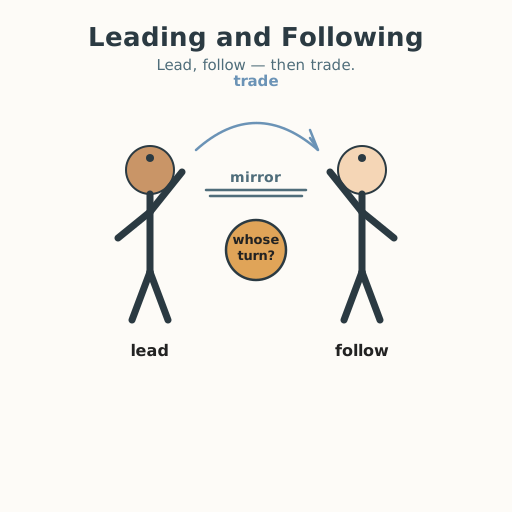
- Practice mirroring (10 min). Face your partner. One of you leads a slow move — raise a hand, tilt your head, reach out. The other follows by copying it at the same time, like a mirror. Go slowly so your partner can stay with you. Then trade: the follower becomes the leader.
- Act the scene (15 min). Act a small everyday scene together — visiting a market, carrying water, greeting a friend. The leader begins and sets the moves; the follower stays with them. Hold the turn marker to show it is your turn to lead, and pass it when you trade. Both of you get a turn to lead and a turn to follow.
- Share (10 min). Show a little of your scene to another pair if you wish. Tell (or point to) who led first and who followed, and how it felt to trade.
- Close (5 min). Remember: leading is a gift you pass along, and following takes care and attention. Every good partnership needs both — and now you have done both.
Differentiation
- Support: Offer one clear action to lead (“raise one hand, and your partner mirrors it”) and trade right away so both feel each role.
- Support (seated/adapted): Lead and follow from a chair — a raised hand, a nod, a lean; the partner mirrors it, and that is full participation.
- Support (non-speaking): Lead and follow with movement and face.
- Support (blind/low-vision): Lead with voice and touch; follow by holding a hand to feel the move.
- Support (Deaf/HH): Lead and follow through visible movement and gesture.
- Extension: Invite pairs to act a scene where the lead changes in the middle — the follower feels the moment and becomes the leader — then tell how they knew.
Assessment
- Formative (observation): Does the learner act out a scene with a partner, taking turns leading and following?
- Performance: The learner’s scene with a partner, observed live (in any adapted form).
Home connection
With someone at home, play a mirror game — one of you leads a slow move and the other follows, then trade. Tell each other which role you liked and why.