Lesson 07 — Planning a Making Task
Learners plan a making task by choosing materials and saying the steps before they start. They discover that a plan is thinking made visible, and that makers everywhere plan before they build.
Objectives
Objectives
- D07.S4.02.01 Plan a making task by choosing materials and saying the steps before starting.
Essential question
How do I plan a making task by choosing materials and saying the steps before starting?
Key vocabulary
Materials
Standard materials
- A small pile of making materials · per learner or pair Paper, cloth, string, tape, boxes, sticks, cups — things to choose from
- A simple plan chart · 1 Three empty boxes labeled "what I'll make," "materials I choose," and "steps"
Low-tech / no-cost
- Found materials and the ground Sticks, stones, leaves, mud, sand — plan and build with what is near
- A plan told aloud or drawn in the dirt Say the steps, or scratch the plan in sand with a stick
Enriched / lab & device
- A picture of a real maker planning · 1 set A potter, a weaver, or a boat-builder choosing materials and steps before starting
- A sketching sheet and pencil per learner · 1 per learner To draw the plan before building
Works in different contexts
- large-group Plan one shared making task aloud together first — name the materials and the steps — then let small groups plan their own
- multi-age Older learners ask "what will you make? what materials? what steps?" while younger learners answer and choose; then trade
- self-directed A learner says or sketches what they will make, chooses materials, says the steps in order, then makes it
- level-grouped Some learners plan two steps and two materials; others plan a longer list; match the challenge
- outdoor-only Plan with nature's materials — a stick raft, a leaf boat, a stone path — saying the steps before you start
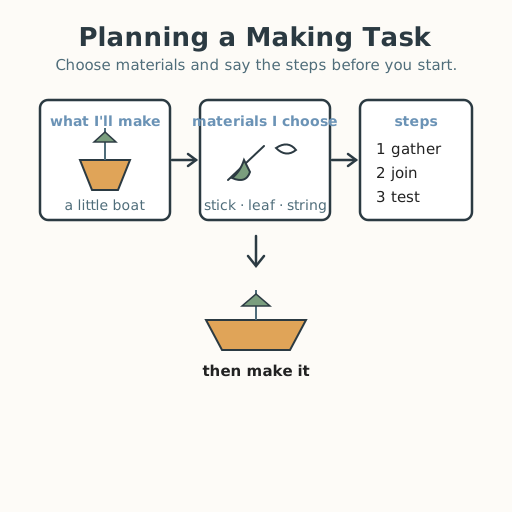
Lesson 7 — Planning a Making Task
Summary
Learners plan a making task before they build: they choose materials and say the steps in order. They discover that a plan is thinking made visible, and that makers everywhere — potters, weavers, boat-builders — plan before they make.
Objectives
- Plan a making task by choosing materials and saying the steps before starting. (D07.S4.02.01)
Connection
Think of someone cooking a meal, sewing a cloth, or building a small boat. Before they begin, they think: what will I make? what will I use? what do I do first, next, last? That thinking is a plan. A plan keeps you from getting lost in the middle, and it is how every maker begins. Today you will choose what to make, choose your materials, and say your steps — all before you start.
Materials
- A small pile of making materials (paper, cloth, string, tape, boxes, sticks, cups)
- A simple plan chart (three boxes: “what I’ll make,” “materials I choose,” “steps”)
Preparation
- Gather a small pile of varied materials so learners have real choices to make.
- Display or draw the plan chart where everyone can see the three boxes.
Facilitator note
This lesson is written to the learner (“you”) so it works in a classroom and for a self-directed learner. Planning before making is a skill, so model it once — “I will make a little boat; I choose sticks and string; my steps are gather, join, test” — before learners plan their own (Kirschner, Sweller & Clark, 2006). A plan can be spoken, pointed to, or drawn; writing is not required. The plan may change as the learner builds, and that is fine — a plan is a guide, not a cage. A learner with limited fine motor plans and directs while a partner handles the materials — choosing and sequencing are the heart of the task. A learner who is blind or has low vision chooses materials by feel and names the steps aloud; a partner can describe each material. A learner who does not speak points to the materials and to the step boxes in order. Every plan belongs.
Procedure
- Gather (5 min). Look at the materials in front of you. Today you will plan before you make — the way a cook or a builder does.
- Choose what to make (5 min). Decide what you will make — a little boat, a shelter for a toy, a path for a rolling ball, a basket. Say it, or point to a picture of it. That is box one: what I’ll make.
- Choose your materials (10 min). Look at the pile. Which materials will you use to make it? Pick them out and set them beside you. That is box two: materials I choose. You do not need many — only the ones your plan needs.
- Say the steps (10 min). Before you touch anything to build, say or point to your steps in order: first, next, last. That is box three: steps. You can say them aloud, draw them, or point to them on the chart.
- Now make it (10 min). Build your plan. If a step does not work, change the plan — that is a maker’s power. When you finish, show what you made and tell (or point to) the steps you planned.
- Close (5 min). Remember: a plan is thinking you can see. Choosing materials and saying the steps before you start is how every good thing gets made.
Differentiation
- Support: Offer one clear task (“make a boat”) and a two-step plan, and let the learner choose one material from two.
- Support (fine motor): The learner plans and directs while a partner handles the materials.
- Support (non-speaking): Point to the materials and the step boxes in order.
- Support (blind/low-vision): Choose materials by feel and name the steps aloud; a partner describes each material.
- Extension: Invite learners to write or draw a simple plan chart of their own, and to make a second plan if the first changes.
Assessment
- Formative (observation): Does the learner plan a making task by choosing materials and saying (or showing) the steps before starting?
- Artifact (portfolio): The plan chart (or a photo of it) and the finished thing, kept in the portfolio.
Home connection
At home, plan a small making job with a grown-up — a paper boat, a place for toys. Choose the materials together and say the steps before you start, then make it.