Lesson 08 — Asking for Help When I Need It
Learners practice asking a trusted adult for help in different situations — sick, hurt, lost, scared, or unsafe — and keep telling until someone listens. The lesson closes the unit by gathering everything learned: balanced meals, water, hygiene, rest, and trusted adults all keep a body healthy, safe, and strong.
Objectives
Objectives
- D03.S4.02.02 Identify trusted adults at home and at school to ask for help in different situations.
Essential question
How do I ask a trusted adult for help in different situations, and why does it keep me safe and strong?
Key vocabulary
Materials
Standard materials
- Scenario cards · 1 set Feeling sick, feeling hurt, feeling lost, feeling scared, feeling unsafe or uncomfortable
- The "help hand" from last lesson · per learner Each learner's own help hand, to remind them whom to ask
Low-tech / no-cost
- Voice and body Practice the help words aloud and act out asking a trusted adult; no cards needed
- A stick figure in the dirt Draw a person and practice telling; trace a hand to remember trusted adults
Enriched / lab & device
- Role-play puppets or dolls · 1 set To act out asking for help in each situation
- A "keep telling" reminder card · per learner A card showing tell one adult, then another, until someone helps
Works in different contexts
- large-group Practice the help words together, then let pairs role-play one situation each while others draw their "I can ask for help" picture
- self-directed A learner reads or hears the situations, practices the help words, and draws or tells one plan for asking for help
- outdoor-only Act out asking for help on a walk — a scrape, feeling lost — and practice finding the nearest safe grown-up
- multi-age Older learners play the trusted adult in role-plays so younger learners can practice asking a real person
- level-grouped Some learners practice one help phrase; others ready for more name a trusted adult for each of three situations
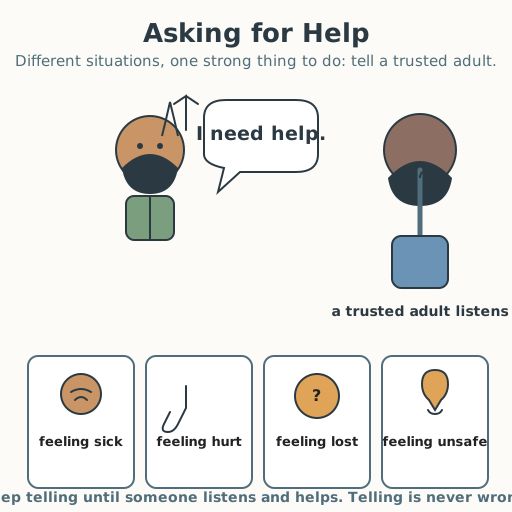
Lesson 8 — Asking for Help When I Need It
Summary
Learners practice asking a trusted adult for help in different situations — feeling sick, hurt, lost, scared, or unsafe — and learn to keep telling until someone listens. As the unit’s capstone, the lesson gathers everything learned: balanced meals, water, hygiene, rest, and trusted adults all keep a body healthy, safe, and strong.
Objectives
- Identify trusted adults at home and at school to ask for help in different situations. (D03.S4.02.02)
Connection
Some situations are small and some are big, but they have one thing in common: asking a trusted adult for help makes you safe. If you feel sick, hurt, lost, scared, or unsafe, you tell a trusted adult — and if the first one is busy or doesn’t understand, you tell another, and another, until someone listens and helps. Today you will practice asking for help, and then celebrate all the ways you keep your body healthy, safe, and strong.
Materials
- Scenario cards (feeling sick, hurt, lost, scared, unsafe or uncomfortable)
- Each learner’s “help hand” from last lesson
Preparation
- Prepare simple scenario cards of different situations.
- Have learners bring (or re-trace) their “help hand” from the last lesson.
- Read the facilitator note fully, including the safeguarding guidance, before teaching.
Facilitator note
This lesson is written to the learner (“you”). Read this note fully before teaching.
- Keep the tone warm and empowering. Asking for help is a strength, and telling is never wrong. Never frighten learners with graphic content; stay with “tell a trusted adult.”
- Frame “keep telling” as persistence, not as “adults won’t believe you”: if the first grown-up is busy or doesn’t understand, tell another, and another, until someone listens and helps.
- Practice every situation with the doll or a role-play partner, never with real bodies. Greetings and touch differ around the world — hugs, handshakes, joined palms, bows — but consent applies to all: a child may decline any touch they do not want, and “no” and “stop” are always okay.
- Honor every way of asking: speaking, signing, pointing, showing a picture, or tapping a shoulder all work. A learner who is deaf or hard of hearing practices in their sign language and points to the scenario cards; face the learner for every demonstration.
- If a child discloses abuse or an unsafe situation: stay calm; believe them; thank them for telling you; do not promise secrecy; do not press for details or ask leading questions; tell your designated safeguarding lead and follow your local child-protection procedure immediately.
- This lesson closes the unit; the help hand and scenario drawings are portfolio artifacts. Celebrate how much each learner can now do for their own health and safety.
Procedure
- Gather (5 min). Look at your help hand. These are the trusted adults you can ask. Today we practice asking for help in different situations.
- Meet the situations (10 min). Look at the scenario cards: feeling sick, feeling hurt, feeling lost, feeling scared, and feeling unsafe or uncomfortable. In every one, the strong thing to do is the same: tell a trusted adult.
- Practice asking (15 min). Practice the words in a clear, calm voice: “I need help.” “I feel sick.” “I feel lost.” “I feel unsafe.” You can also sign, point, or show a picture. Take turns with a partner or a doll — one asks, one listens. Then match each situation to a trusted adult on your help hand.
- Keep telling (5 min). If the first grown-up is busy or doesn’t understand, tell another one — and another — until someone listens and helps. Telling is never wrong, and you are never in trouble for telling.
- Gather the whole unit (10 min). Remember everything that keeps you healthy, safe, and strong: a balanced meal with foods from several groups, water when thirsty, washing hands, brushing teeth, rest, and trusted adults to ask. Point to each one on a chart or name it aloud — you know how to care for your body.
- Close (5 min). Say it together: “I can build a balanced meal and drink water. I wash, brush, and rest. I know my trusted adults and I can ask for help. My body is healthy, safe, and strong — and so am I.”
Differentiation
- Support: Use two or three situations and practice one help phrase many times; model the words and a calm voice.
- Support (non-speaking): Practice asking with a sign, a picture card, or a point; match situations to trusted adults by pointing to the cards.
- Extension: Practice telling two adults in order for one situation, as they would if the first were busy, and explain which adult fits which situation.
Assessment
- Formative (observation): Can the learner name a trusted adult for at least two different situations and practice asking for help, in their own way?
- Portfolio: The help hand and any scenario drawings become unit portfolio artifacts.
- Self: The learner names one situation and the trusted adult they would tell.
Home connection
With a grown-up, practice asking for help in one situation — feeling sick, hurt, lost, scared, or unsafe. Say the words clearly and name the trusted adult you would tell.
Resources
- World Health Organization, “Preventing violence against children” (telling a trusted adult keeps children safe): https://www.who.int/teams/social-determinants-of-health/violence-prevention