Lesson 07 — My Trusted Adults at Home and School
Learners identify trusted adults at home and at school — grown-ups who listen and help — and fill a "help hand" with five of their own. They learn that they get to choose who they trust, that asking for help is a strength, and that a trusted adult makes them feel safe.
Objectives
Objectives
- D03.S4.02.02 Identify trusted adults at home and at school to ask for help in different situations.
Essential question
Who are my trusted adults at home and at school, and how do I know I can ask them for help?
Key vocabulary
Materials
Standard materials
- A "help hand" template · per learner A hand outline with five fingers to fill with trusted adults
- Crayons · per learner For drawing trusted adults
- Picture cards of adults · 1 set Caregiver, grandparent, teacher, nurse, coach, neighbor — to sort into home and school
Low-tech / no-cost
- The learner's own hand Trace a hand in the air or in the dirt and name one trusted adult per finger; no paper needed
- Voice and body Name trusted adults aloud and act out going to ask one; no cards needed
Enriched / lab & device
- A "who can help" picture chart · 1 A chart of trusted adults at home and at school to sort and discuss
- Role-play puppets or dolls · 1 set To act out asking a trusted adult for help
Works in different contexts
- large-group Sort adult cards into home and school together, then let each learner fill their own help hand and share one name with a partner
- self-directed A learner sorts the cards, traces their hand, fills each finger with a trusted adult, and practices asking one
- outdoor-only Trace a hand in the dirt and name trusted adults; act out asking for help on a walk
- multi-age Older learners play the trusted adult in role-plays and help younger ones fill their help hands
- level-grouped Learners who can write add names to their hands; others draw faces and point to the cards
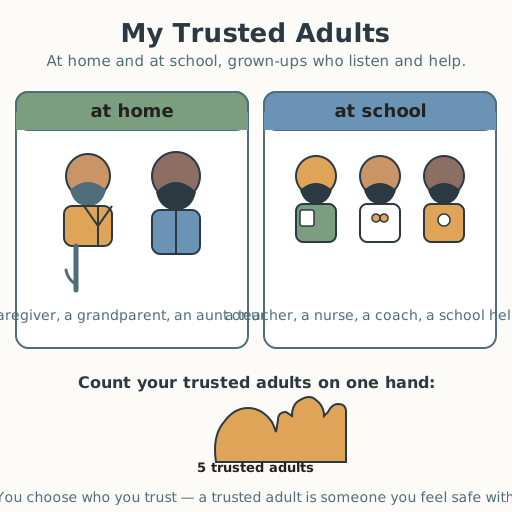
Lesson 7 — My Trusted Adults at Home and School
Summary
Learners identify trusted adults at home and at school — grown-ups who listen and help — and fill a “help hand” with five of their own. They learn that they get to choose who they trust, that asking for help is a strength, and that a trusted adult makes them feel safe. The help hand becomes a portfolio artifact.
Objectives
- Identify trusted adults at home and at school to ask for help in different situations. (D03.S4.02.02)
Connection
When you fall and scrape your knee, you tell a grown-up. When you feel sick, lost, scared, or unsafe, you tell a grown-up too. Some grown-ups are trusted adults: people who listen to you and help you. You have trusted adults at home and at school. Today you will name yours.
Materials
- A “help hand” template (a hand outline with five fingers)
- Crayons
- Picture cards of adults (caregiver, grandparent, teacher, nurse, coach, neighbor)
Preparation
- Prepare a “help hand” template for each learner.
- Prepare picture cards of adults to sort into “home” and “school.”
- Read the facilitator note fully, including the safeguarding guidance, before teaching.
Facilitator note
This lesson is written to the learner (“you”). Read this note fully before teaching.
- Keep the tone warm and reassuring. Asking for help is a strength, never a weakness, and telling is never wrong.
- Help each learner name trusted adults who are realistically available to them. If a learner names no one at home, gently guide them toward a teacher, nurse, school helper, or neighbor — without pressure and without implying anything about their family.
- A trusted adult is someone the learner feels safe with; the learner chooses. Adults vary across families and cultures — caregivers, grandparents, aunts, uncles, neighbors, teachers, nurses, coaches, and religious or community helpers can all be trusted adults.
- Honor every way of naming and asking: speaking, signing, pointing, drawing, or tapping a shoulder all work. A learner who is deaf or hard of hearing practices in their sign language and points to the picture cards; face the learner for every demonstration. A learner who is blind or has low vision names trusted adults aloud and traces the help hand in the air or by feel, naming one trusted adult per finger.
- If a child discloses abuse or an unsafe situation: stay calm; believe them; thank them for telling you; do not promise secrecy; do not press for details or ask leading questions; tell your designated safeguarding lead and follow your local child-protection procedure immediately.
- The help hand is a unit portfolio artifact; keep learners’ drawings. This lesson builds on Grade 1’s “Trusted Adults and Asking for Help” (U.01.008) and leads into the unit’s capstone on asking for help in different situations.
Procedure
- Gather (5 min). Remember last year: your body belongs to you, and if something feels wrong you tell a trusted adult. This year we learn who your trusted adults are at home and at school.
- Who is a trusted adult? (10 min). A trusted adult is a grown-up who listens to you and helps you. At home, that might be a caregiver, a grandparent, an aunt, or an uncle. At school, a teacher, a nurse, a coach, or a school helper. Sort the picture cards: which adults are at home, and which are at school?
- You choose who you trust (10 min). You get to decide who feels safe to you. A trusted adult is someone who listens, believes you, and helps you when you ask. Tell a partner one thing a trusted adult does (listens, helps, keeps you safe).
- Fill your help hand (10 min). Trace your hand. On each finger, draw or write one trusted adult — some from home, some from school. This is your help hand. Aim for five, and it is okay if you start with two or three and add more later.
- Close (5 min). Say it together: “I have trusted adults at home and at school. Asking for help is a strength.”
Differentiation
- Support: Sort just two or three cards first; fill the hand with drawn faces rather than words.
- Support (non-speaking): Point to picture cards and draw faces on the hand; practice asking with a sign or a tap.
- Support (blind/low-vision): Name trusted adults aloud and trace the help hand in the air or by feel, saying one trusted adult per finger.
- Extension: Name a third trusted adult and tell which situations each one could help with — a bridge to the capstone lesson.
Assessment
- Formative (observation): Can the learner name at least two trusted adults (home and school) and say what a trusted adult does, in their own way?
- Portfolio: The “my trusted adults” help-hand drawing becomes a unit portfolio artifact.
Home connection
With a grown-up, name the trusted adults at your home and school, and practice saying “I need help” in a clear, calm voice. Keep your help hand where you can see it.
Resources
- World Health Organization, “Preventing violence against children” (why safe, trusted adults and telling matter): https://www.who.int/teams/social-determinants-of-health/violence-prevention