Lesson 05 — What People Need From Their Environment
Learners name the four things people need from their environment — water, food, shelter, and materials — and see how people in different places meet those same needs in different ways, all of them real and valid.
Objectives
Objectives
- D08.S3.02.01 Explain what people need from their environment, such as water, food, shelter, and materials, and how people in different places meet those needs.
Essential question
What do people need from their environment, and how do people in different places meet those needs?
Key vocabulary
Materials
Standard materials
- "Needs" picture cards · 1 set Four cards — water, food, shelter, materials — plus cards showing different ways to meet each (a well, a river, a farm, a market, a tent, a house of wood or clay)
- A four-row "needs and ways" chart · 1 per learner or pair Rows for water, food, shelter, materials; a place to sort how different people meet each need
Low-tech / no-cost
- Found objects A cup (water), a seed or fruit (food), a cloth (shelter), a stick or stone (materials) — sort how each need could be met
- Body and voice Act out meeting each need — cupping hands to drink, planting a seed, sheltering under an arm-roof
Enriched / lab & device
- A picture book or photo set of homes and farms around the world · 1 To see many ways people meet the same four needs
- A small globe or map · 1 To point to different places and ask how people there get water, food, shelter, and materials
Works in different contexts
- large-group Sort the needs cards together on a big chart, the whole group calling out the need before one learner places each card
- self-directed The learner sorts the cards and fills the four-row chart alone, then tells a grown-up or peer one need and one way it is met
- outdoor-only Walk and find the four needs outside — water (a stream or rain), food (a plant), shelter (shade or a roof), materials (wood, stone, clay)
- multi-age Older learners read the need labels and scribe while younger learners place the cards and act meeting each need
- level-grouped Learners who finish early coach peers by asking "what need is this? how do people meet it here?" rather than telling
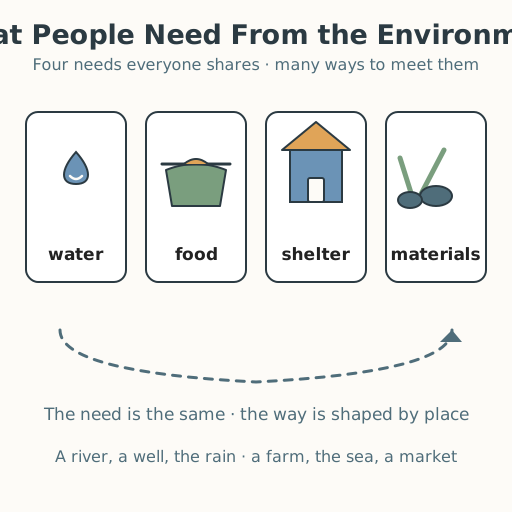
Lesson 5 — What People Need From Their Environment
Summary
Learners name the four things people need from their environment — water, food, shelter, and materials — and discover that people in different places meet those same needs in many different ways, all of them real and valid.
Objectives
- Explain what people need from their environment, such as water, food, shelter, and materials, and how people in different places meet those needs. (D08.S3.02.01)
Connection
Every person, everywhere, needs the same four things from the world around them: water to drink, food to eat, shelter to stay warm and dry, and materials — wood, stone, clay, cloth — to make the things they use. But the way people get each one depends on where they live. A family by a river drinks from the river; a family far from water draws from a well or catches the rain. The need is the same; the way is shaped by place.
Materials
- “Needs” picture cards (water, food, shelter, materials) plus “ways to meet them” cards
- A four-row “needs and ways” chart
Preparation
- Gather or draw the four needs cards and several “ways to meet them” cards (a well, a river, a farm, a market, a tent, a house of wood or clay, a clay pot).
- Prepare the four-row chart (water, food, shelter, materials).
Facilitator note
This lesson is written to the learner (“you”). Keep the needs universal and the ways many. The four needs — water, food, shelter, materials — are shared by every human; this is a factual, cross-cultural claim (every person needs water, food, and shelter to live). What differs is how, and every way is a real adaptation, never a deficiency. Do not rank: a well is not “better” than a river; a tent is not “worse” than a house of wood; each fits its place and its climate. Use examples from many regions (a desert well, a forest home of wood, a high-mountain stone house, a coastal fish dinner) so no single region is the default. Honor every body: describe the cards in words for a learner who cannot see them; a learner who does not use a speaking voice points or acts. A learner whose own way of meeting a need differs is never “wrong” — their way belongs on the chart too.
Procedure
- Gather (5 min). Close your eyes and think of what you needed this morning — something to drink, something to eat, a place to be warm and safe. Where did each come from?
- Meet the four needs (10 min). Say them together: water, food, shelter, materials. Every person, everywhere, needs all four. The world around us — the land, the water, the plants — is where they come from. That world is the environment.
- See the many ways (15 min). Look at the cards. People meet the same need in different ways: water from a river, a well, or the rain; food from a farm, a garden, the sea, or a market; shelter as a tent, a wooden house, a clay home, or a stone house; materials from wood, stone, clay, or plants. Sort each “way” onto its need row.
- Match a place and a way (10 min). For one need, say why a place shapes the way: “Where there is little rain, people dig wells. Where there is a river, people draw from the river.” Point, act, or sign.
- Close (5 min). The needs are the same for everyone; the ways are many. Every way is a real answer to a real place.
Differentiation
- Support: Focus on two needs (water and food) with one way each, using heavy picture support.
- Support (blind/low-vision): Feel the objects (a cup for water, a seed for food, cloth for shelter, a stick for materials) and name the need each one stands for.
- Support (non-speaking): Sort the cards onto the chart and point to each need and its way instead of speaking.
- Support (Deaf/HH): The cards are already visual — sign “water,” “food,” “shelter,” and “materials” as you place each one.
- Support (motor-difference): Use larger cards and a stable chart; direct a partner to place each card while you point, sign, or eye-gaze.
- Extension: For two needs, name two different places and tell how each place shapes the way people meet the need.
Assessment
- Formative (observation): Can the learner name the four needs — water, food, shelter, materials — and match at least one way people meet each?
- Formative (oral/performance): Does the learner explain, for one need, how a place shapes the way people meet it, without ranking any way as better?
Resources
- National Geographic Education, “Desert” — notes that people have adapted to life in deserts for thousands of years, drawing water from wells, springs, and oases, and using tents and light robes — a concrete example of how a place shapes how needs are met. https://education.nationalgeographic.org/resource/desert/
Home connection
At home, trace one need back to its source: where did your water come from today? Where did your food come from? Tell a grown-up how your place shapes the way your family meets that need.