Lesson 07 — Fair and Unfair Rules
Learners sort rules and ways of treating people into fair and unfair, and practice giving a reason why — the heart of noticing fairness, held gently and without blame.
Objectives
Objectives
- D08.S4.02.01 Identify a rule or a way of treating people that is fair or unfair and explain why, using a classroom or story example.
Essential question
What makes a rule or a way of treating people fair or unfair, and why?
Key vocabulary
Materials
Standard materials
- A set of rule cards · 1 set Simple cards with classroom and story rules — some fair ("everyone gets a turn"), some unfair ("only children wearing red may play")
- A "fair" spot and an "unfair" spot · 1 each Two labeled spots for sorting the rules, with a place to say why
Low-tech / no-cost
- Told and acted rules The facilitator states a rule aloud; learners sort by stepping to a "fair" or "unfair" spot and say why
- A drawn two-column chart Paper divided into "fair" and "unfair," with drawings or marks instead of printed cards
Enriched / lab & device
- A short, gentle story with a fair and an unfair rule · 1 A blame-free story, such as a game where one rule changes to leave someone out, ending in repair
- A set of picture scenes · 1 set Scenes of fair and unfair moments, for sorting and retelling
Works in different contexts
- large-group Hold each rule card up; the whole group steps or points to "fair" or "unfair" and one learner says why
- self-directed The learner sorts the rule cards and writes or draws one "why" for each side, then shares with a grown-up or peer
- outdoor-only Play a real game with a rule, then change the rule to be unfair, and notice and name the difference with the group
- multi-age Older learners read the rule cards and scribe the reasons while younger learners sort and act each rule
- level-grouped Learners who grasp the idea quickly coach peers by asking "does everyone get the same chance? is there a good reason?" rather than telling
Lesson 7 — Fair and Unfair Rules
Summary
Learners sort rules and ways of treating people into fair and unfair, and practice giving a reason why. The goal is noticing and naming fairness — a foundation of the study of power — held gently, without blame, and always ending in the possibility of making it right.
Objectives
- Identify a rule or a way of treating people that is fair or unfair and explain why, using a classroom or story example. (D08.S4.02.01)
Connection
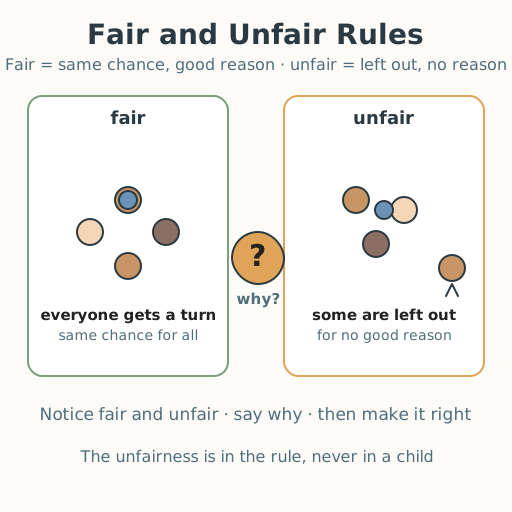
Every group has rules — in your classroom, your games, your home. A rule is fair when it gives everyone the same chance and has a good reason; a rule is unfair when it leaves someone out for no good reason. You notice this every day. Naming why a rule is fair or unfair is the first step toward making things fair.
Materials
- A set of rule cards (fair and unfair examples)
- A “fair” spot and an “unfair” spot
Preparation
- Prepare simple rule cards. Fair examples: “everyone gets a turn,” “everyone shares the crayons,” “we listen to each person.” Unfair examples: “only children wearing red may play,” “only the tallest may use the swing,” “one child may take two turns every time.”
- Prepare a gentle story (optional) where a rule changes to leave someone out, ending in repair without blame.
Facilitator note
This lesson is written to the learner (“you”). The skill is reasoning about fairness, not moralizing about the learners. Keep examples blame-free and end with repair: an unfair rule is something we can notice and change together — the unfairness is in the rule, never in a child. The “why” is the point: fair means everyone gets the same chance and there is a good reason; unfair means someone is left out for no good reason. (This is a values commitment, held as such — not a factual claim.) Honor every body: a learner who does not use a speaking voice points to the fair/unfair spots or acts the rule; a learner who is blind or has low vision hears each rule stated clearly and describes why aloud. Never require a learner to share a real unfairness from their own life — the given cards and stories are enough. Note the gentle bridge to the wider world: the same noticing of fair and unfair, applied to communities and peoples, is how fairness in the big human story begins to be studied in later grades.
Procedure
- Gather (5 min). Think of a game with rules. What makes a game fun and fair? What would make it feel unfair?
- Meet fair and unfair (10 min). Fair means everyone gets the same chance, for a good reason. Unfair means someone is left out, or treated differently, for no good reason. Say it together: “Fair = same chance, good reason. Unfair = left out, no reason.”
- Sort the rules (15 min). Take each rule card. Put it on the “fair” spot or the “unfair” spot. For each one, say why: “This is fair because everyone gets a turn.” “This is unfair because only children wearing red may play, and that is not a good reason.”
- Hear or act a story (10 min). Listen to a short story where a rule leaves someone out. Point to the moment it is unfair, and say why. Then hear the repair: someone notices, and the rule is changed so everyone is included.
- Close (5 min). Noticing fair and unfair, and saying why, is a skill you can use all your life — in games, in class, and in the wide world. And unfair things can be changed.
Differentiation
- Support: Sort just two rules (one fair, one unfair) and give one “why” together.
- Support (blind/low-vision): Hear each rule stated clearly and describe why it is fair or unfair aloud, or sort by pointing to a textured fair/unfair spot.
- Support (non-speaking): Point to the fair or unfair spot and act out the rule, or draw a fair and an unfair scene.
- Support (Deaf/HH): The rule cards and pictures are visual — read them with your eyes, and sign “fair” and “unfair” as you sort each one.
- Support (motor-difference): Direct a partner to move each card to its spot while you point, sign, or eye-gaze.
- Extension: Make up a new fair rule for the story’s game and tell why it is fair.
Assessment
- Formative (observation): Can the learner sort a fair rule and an unfair rule correctly?
- Formative (oral/performance): Does the learner give a reason why a rule is fair or unfair (everyone gets a turn / left out for no good reason)?
Home connection
With a grown-up, think of a rule at home or in a game you both know. Is it fair or unfair, and why? If it is unfair, what is one small way it could be made fair?