Lesson 08 — Someone Who Helped and Spoke Up
Learners hear the gentle, hopeful story of Wangari Maathai, who planted trees with women and communities in Kenya and spoke up for the environment, and describe what she did and why it mattered.
Objectives
Objectives
- D08.S4.02.02 Describe a story of someone who helped others or spoke up when something was unfair, and what they did.
Essential question
Who is someone who helped others or spoke up when something was unfair, and what did they do?
Key vocabulary
Materials
Standard materials
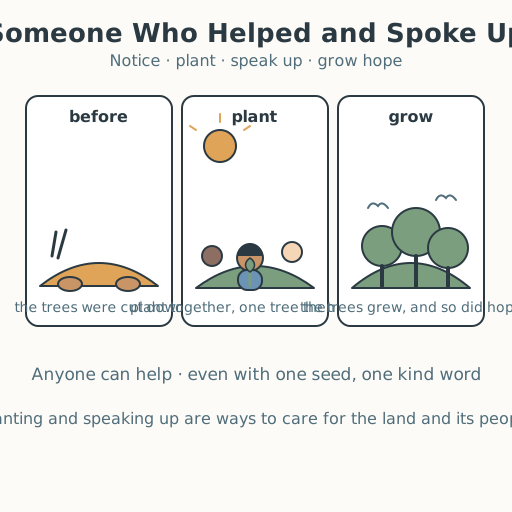
- A picture set of a tree-planting story · 1 set Cards showing trees being cut down, a person planting a seedling with others, and the trees growing tall — the shape of Wangari Maathai's story
- Paper and crayons · per learner For drawing someone helping or speaking up and one sentence about what they did
Low-tech / no-cost
- A told story and acting Tell the story of planting and speaking up; learners act planting a seed, watering it, and telling others
- A real seed or seedling to plant Plant one seed together — the story made real in your own hands
Enriched / lab & device
- A picture book about Wangari Maathai or another helper · 1 A gentle, accurate book of her life and the Green Belt Movement
- A short video or photo set · 1 Optional — a gentle clip or photos of people planting trees together
Works in different contexts
- large-group Tell the story once, then the whole group acts out planting together, and a few learners retell one part each
- self-directed The learner reads or listens to the story, draws one thing the person did, and tells a grown-up or peer why it mattered
- outdoor-only Plant a real seed outside and care for it; as you work, retell the story of someone who helped by planting and speaking up
- multi-age Older learners read the story and scribe captions while younger learners act planting and growing
- level-grouped Learners who grasp the story quickly coach peers by asking "what did she do first? what did it help?" rather than telling
Lesson 8 — Someone Who Helped and Spoke Up
Summary
Learners hear the gentle, hopeful story of Wangari Maathai, who began a movement of women planting trees in Kenya and spoke up to care for the land and the people who live on it. They describe what she did and why it mattered — a first, age-appropriate story of helping and speaking up, ending in growth, not blame.
Objectives
- Describe a story of someone who helped others or spoke up when something was unfair, and what they did. (D08.S4.02.02)
Connection
Sometimes people notice something that is not right — land being stripped of its trees, people being left out — and instead of looking away, they help and speak up. One such person was Wangari Maathai of Kenya. When she saw forests being cut down, hurting the land and the people who depended on it, she did not just worry. She planted.
Materials
- A picture set of the tree-planting story
- Paper and crayons
Preparation
- Prepare the story accurately and gently (see Resources): Wangari Maathai founded the Green Belt Movement in Kenya in 1977, encouraging women to plant trees; it grew across countries and helped plant more than thirty million trees, and she received the Nobel Peace Prize in 2004. Keep the telling warm and blame-free — no frightening content.
- Prepare or draw the picture cards (trees cut down, a person planting with others, trees growing tall).
Facilitator note
This lesson is written to the learner (“you”). Tell the story gently and hopefully. Wangari Maathai’s story is real and well-documented (see Resources), and its shape is perfect for this age: notice a problem, act with others, make things grow, speak up — and win a prize for peace, not for fighting. Keep it non-violent and blame-free: do not dwell on conflict or punishment; the lesson’s power is in planting, cooperating, and hope. No child is ever the problem, and no one must share a personal unfairness. Emphasize that anyone can help: a child can plant a seed, water it, and speak up for it. Honor every body: a learner who cannot see the cards hears the story told clearly and describes it; a learner who does not use a speaking voice acts the planting or points to the cards. Distinguish evidence from values: that she planted trees and won the Nobel Prize is fact (see Resources); that caring for the land and speaking up are good is a value we hold together.
Procedure
- Gather (5 min). Have you ever seen a plant grow because someone cared for it? What does a tree give us — shade, fruit, clean air, a home for birds?
- Hear the story (15 min). Listen to the story of Wangari Maathai. In Kenya, forests were being cut down, and the land was growing bare and dry. Wangari saw this and began something simple and strong: she encouraged women and children to plant trees. One tree, then many. The trees held the soil, gave shade and fruit and firewood, and gave people work and hope. Her movement spread to other countries, and together people planted millions of trees. She also spoke up — for the land, and for the people who care for it. For all this, she won the Nobel Peace Prize.
- Name what she did (10 min). Point to the cards and say it in order: she noticed the trees were gone; she planted with others; she spoke up; the trees grew, and so did hope.
- Draw and tell (10 min). Draw one thing Wangari (or someone like her) did, and write or tell one sentence about why it mattered.
- Close (5 min). Helping and speaking up are things anyone can do — even with one seed, one kind word, one question. That is how caring grows.
Differentiation
- Support: Tell just three beats (notice, plant, grow) and ask one question: “What did she do to help?”
- Support (blind/low-vision): Hear the story told clearly and describe what she did aloud; plant a real seed and feel it in the soil.
- Support (non-speaking): Act out planting, watering, and growing, and point to the story cards in order.
- Support (Deaf/HH): Tell the story with the picture sequence and signs — the pictures carry it; sign “plant,” “tree,” and “help” as you go.
- Support (motor-difference): Direct a partner to act or point while you sign or eye-gaze; plant a seed in a cup that is easy to reach.
- Extension: Think of one small thing you could do to help your place — plant a seed, pick up litter, speak up kindly — and tell why it matters.
Assessment
- Formative (observation): Can the learner retell at least two things Wangari (or the story’s helper) did?
- Formative (oral/performance): Does the learner say why it mattered, in their own words, with hope rather than blame?
Resources
- Nobel Prize, “Wangari Maathai — Facts” — documents that Wangari Maathai founded the Green Belt Movement in 1977, that it spread to other African countries and contributed to planting over thirty million trees, and that she received the Nobel Peace Prize in 2004 “for her contribution to sustainable development, democracy and peace.” https://www.nobelprize.org/prizes/peace/2004/maathai/facts/
Home connection
At home, plant one seed in a cup or a corner of ground and care for it. As you water it, tell someone the story of Wangari Maathai and why planting — and speaking up for the land — matters.