Lesson 06 — Living in a Very Different Environment
Learners see how people adapt to three very different environments — a desert, a coast, and a cold region — through clothing, shelter, and travel, and honor each adaptation as clever, not "primitive."
Objectives
Objectives
- D08.S3.02.02 Describe how people adapt to a very different environment, such as a desert, a coast, or a cold region.
Essential question
How do people adapt to a very different environment — a desert, a coast, or a cold region?
Key vocabulary
Materials
Standard materials
- "Environment and adaptation" picture cards · 1 set Three environment cards (desert, coast, cold region) plus adaptation cards (light robes and a tent, a canoe and a stilt house, warm clothing and a snow house)
- A three-column sort chart · 1 per learner or pair Columns for desert, coast, and cold region, to sort how people adapt in each
Low-tech / no-cost
- Body and voice Act out each adaptation — shading eyes and wrapping cloth for the desert, paddling and stepping up into a stilt house for the coast, bundling warm for the cold
- Found objects A cloth (robe/tent), a stick (canoe), a warm wrap (cold clothing) — match each object to its environment
Enriched / lab & device
- A picture book or photo set of desert, coastal, and Arctic life · 1 To see the real adaptations side by side
- A globe or map · 1 To point to a desert, a coast, and a cold region and imagine living there
Works in different contexts
- large-group Sort the adaptation cards onto a big three-column chart together, the group calling out "desert!", "coast!", or "cold!" for each card
- self-directed The learner sorts the cards and fills the chart alone, then tells a grown-up or peer one environment and one way people adapt
- outdoor-only Feel the real environment outside — sun and shade (desert), wind and water (coast), cool air (cold) — and act how people adapt to each
- multi-age Older learners read the adaptation labels and scribe while younger learners place the cards and act each one
- level-grouped Learners who finish early coach peers by asking "what is this place like? how do people live there?" rather than telling
Lesson 6 — Living in a Very Different Environment
Summary
Learners meet three very different environments — a desert, a coast, and a cold region — and see how people adapt to each through clothing, shelter, and travel. Each adaptation is honored as clever and fitting, never “primitive.”
Objectives
- Describe how people adapt to a very different environment, such as a desert, a coast, or a cold region. (D08.S3.02.02)
Connection
Where you live shapes how you live. If you lived where it is very hot and dry, you would want shade and light cloth and to know where the water is. If you lived by the sea, you would want a boat and to know the tides. If you lived where it is very cold, you would want warm clothes and a snug shelter. People everywhere have adapted — found clever, fitting ways to live — in each of these places, over a very long time.
Materials
- “Environment and adaptation” picture cards
- A three-column sort chart (desert, coast, cold region)
Preparation
- Prepare or draw the three environment cards and the adaptation cards (light robes and a tent; a canoe and a stilt house; warm clothing and a snow house).
- Prepare the three-column chart.
Facilitator note
This lesson is written to the learner (“you”). Hold each adaptation with respect, as ingenuity, not struggle. Deserts, coasts, and cold regions are homes where people have lived for thousands of years, not places to feel sorry about. Be accurate and name the peoples where you can, without overclaiming: in deserts, people often wear long, loose, light robes that shield from sun and sand, live in tents that let cool air through, and know where the wells and oases are (see Resources); on coasts, people fish, build boats, and sometimes raise homes on stilts above the tide; in cold regions, Inuit peoples make warm parkas, kayaks, and winter shelters, and hunt and fish (see Resources). Never say any place is “hard to live in” in a pitying way — say instead: each place asks something, and people answer with knowledge. Honor every body: describe the cards in words for a learner who cannot see them; a learner who does not use a speaking voice points or acts the adaptations.
Procedure
- Gather (5 min). Think of the hottest, or wettest, or coldest place you can imagine. What would you need to be comfortable there?
- Meet the three environments (10 min). A desert is very dry, hot in the day and cool at night. A coast is where land meets the sea — windy, salty, and full of fish. A cold region is very cold much of the year, with snow and ice.
- See how people adapt (15 min). Sort the cards:
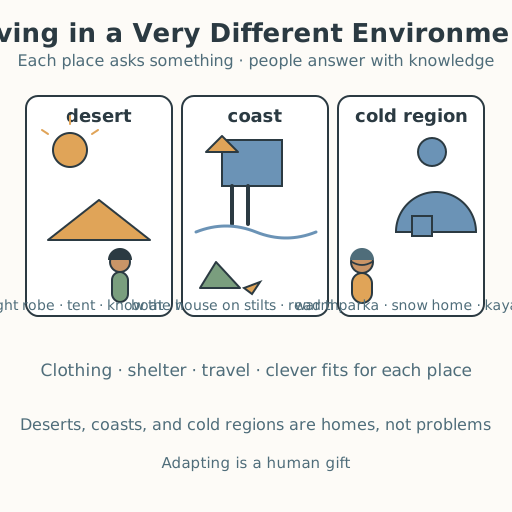
- Desert: long, loose, light robes that shield from sun and sand; tents that let cool air through; knowing where the wells and oases are.
- Coast: boats and canoes for fishing and travel; houses on stilts above the tide; knowing the tides and winds.
- Cold region: warm parkas of fur and hide; kayaks that glide on the water and over ice; winter shelters of snow; hunting and fishing for food.
- Match and explain (15 min). For one environment, say how each adaptation fits the place: “In the desert, light robes keep the hot sun off your skin. On the coast, a stilt house stays dry when the tide comes up.” Point, act, or sign.
- Close (5 min). Each place asks something of the people who live there, and people everywhere have answered with knowledge. Adapting is a human gift.
Differentiation
- Support: Meet one environment (the desert) and sort two adaptations with heavy picture support.
- Support (blind/low-vision): Feel objects — light cloth for the desert robe, wood for the canoe, a thick wrap for the cold parka — and match each to its environment by touch and description.
- Support (non-speaking): Sort the cards onto the three columns and point to each environment and adaptation instead of speaking.
- Support (Deaf/HH): The cards are already visual — sign “hot,” “water,” and “cold” as you place each card.
- Support (motor-difference): Use larger cards and a stable chart; direct a partner to place each card while you point, sign, or eye-gaze.
- Extension: Choose a fourth environment (a forest, a mountain, a grassland) and tell one way people adapt to it.
Assessment
- Formative (observation): Can the learner match at least one adaptation each to a desert, a coast, and a cold region?
- Formative (oral/performance): Does the learner explain how one adaptation fits its environment, in their own words, without ranking any place or people?
Resources
- National Geographic Education, “Desert” — describes how people in deserts adapt with long, loose, light robes, tents, camels, and knowledge of wells and oases. https://education.nationalgeographic.org/resource/desert/
- Inuit Circumpolar Council — the united voice of Inuit across Alaska, Canada, Greenland, and Chukotka; documents Inuit knowledge and ways of living in the Arctic. https://www.inuitcircumpolar.com/
- Polynesian Voyaging Society (Hōkūleʻa) — documents how Pacific island and coastal peoples read the sea and sail canoes, supporting the coast example. https://hokulea.com/
Home connection
Think of your own place: what is the weather like, and how does it shape what your family wears, where you live, and how you get around? Tell a grown-up one way your place has shaped your family’s way of living.