Lesson 09 — Our Community Timeline — Then and Now
Learners bring the unit's two time-skills together into one portfolio artifact: a family and community timeline that orders recent events and marks one thing that changed and one that stayed the same.
Objectives
Objectives
- D08.S1.02.01 Order a few events from their family's or community's recent past on a simple timeline and explain the order.
- D08.S1.02.02 Describe how one part of daily life, such as how people light their homes or get food, has changed over time, and one way it has stayed the same.
Essential question
How can I put my family's and community's recent past on one timeline and mark what changed and what stayed the same?
Key vocabulary
Materials
Standard materials
- A "family and community timeline" sheet · 1 per learner A long timeline with a "long ago" end and a "now" end, with room for events and a "changed / stayed the same" mark for one of them
- Crayons, pencils, paste · per learner For drawing the events and marking change and sameness
Low-tech / no-cost
- A line drawn in the dirt or on the ground Lay events out with found objects along a line, then mark one thing that changed and one that stayed the same
- Body and voice Walk the timeline and tell the events in order, then say one "changed" and one "stayed the same" aloud
Enriched / lab & device
- A class timeline roll of paper · 1 A long sheet where the group's family and community events are gathered into one shared timeline
- A camera or tablet · 1 per group Optional — photograph the finished timeline as a portfolio record
Works in different contexts
- large-group Build one big class timeline together, each learner adding one event in order, then the group marks the "then and now" pair
- self-directed The learner completes the timeline sheet alone, ordering events and marking one change and one sameness, then shares with a grown-up or peer
- outdoor-only Lay the timeline with found objects in a line, walk it in order, and mark one "changed" and one "stayed the same" with two different objects
- multi-age Older learners scribe captions and read labels while younger learners draw the events and place them in order
- level-grouped Learners who finish early coach peers by asking "what came before this? what changed? what stayed the same?" rather than telling
Lesson 9 — Our Community Timeline: Then and Now
Summary
Learners bring the unit’s two time-skills together into one portfolio artifact: a family and community timeline that orders recent events and marks one thing that changed and one that stayed the same. It becomes the unit’s recorded “simple family timeline and then-and-now comparison.”
Objectives
- Order a few events from their family’s or community’s recent past on a simple timeline and explain the order. (D08.S1.02.01)
- Describe how one part of daily life, such as how people light their homes or get food, has changed over time, and one way it has stayed the same. (D08.S1.02.02)
Connection
You have learned two big things about time: how to put events in order on a timeline, and how to see what changed and stayed the same from long ago to today. Today you will do both at once, on one page — the story of your family’s and community’s recent past, told in order, with a “changed” mark and a “stayed the same” mark. That page is a little history of the people closest to you.
Materials
- A “family and community timeline” sheet
- Crayons, pencils, paste
Preparation
- Prepare the timeline sheet: a long line with a “long ago” end and a “now” end, room for three or four events, and a small “changed / stayed the same” mark beside one event.
- Revisit the earlier lessons’ ideas — ordering events, and comparing light or food then and now — so the retrieval is fresh.
Facilitator note
This lesson is written to the learner (“you”). This is a retrieval-and-integration lesson, and a portfolio artifact — but it is practice, not a test. Learners are recalling two skills they already practiced (ordering events; comparing then and now) and combining them — spaced retrieval across the unit (Dunlosky et al., 2013). Model one full example first (Kirschner, Sweller & Clark, 2006): place three events on the line, then mark one “changed” and one “stayed the same” beside a chosen event, saying your reasoning aloud. Honor every family shape: no family is “correct,” and a learner may use events from their community (a new building, a festival, a harvest) if family events feel private. Honor every body: a learner who is blind or has low vision sequences objects by touch and says or signs the order; a learner who does not use a speaking voice points, acts, or draws. The artifact is evidence of growth, never a ranking.
Procedure
- Gather and remember (10 min). You know two skills. Say them together:
- A timeline orders events from long ago to now, using before and after.
- Some things change over time, and some things stay the same.
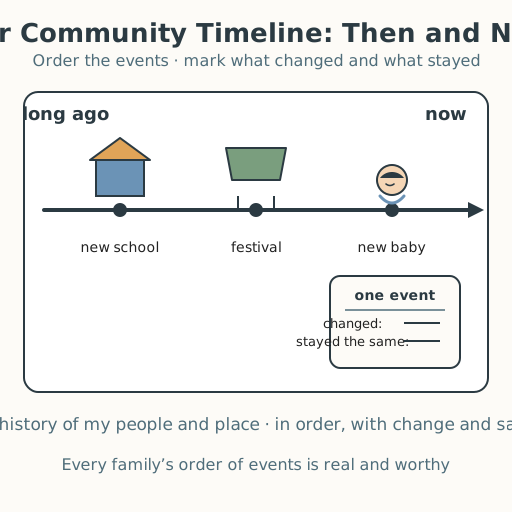
- Watch one example (10 min). Look at the model. Three events in order: a new school opening, a festival, a new baby. Beside “the new school opening,” a mark says: “changed: the road is now paved; stayed the same: children still walk to school together.”
- Build your timeline (20 min). On your sheet, draw or show three or four real events from your family’s or community’s recent past, in order from “long ago” to “now.” For one event, add the mark: one thing that changed and one thing that stayed the same.
- Explain your order (10 min). Point to each event and tell the order, then read your “changed” and “stayed the same” mark. You may speak, sign, act, or show your page.
- Close (5 min). You just made a small history of your own people and place — told in order, with change and sameness side by side. That is what historians do.
Differentiation
- Support: Order just three events with help, and mark one “changed” (or one “stayed the same”) with a partner.
- Support (blind/low-vision): Sequence real objects by touch and tell the order and the change/sameness aloud while a partner records it.
- Support (non-speaking): Draw the events and point to the “changed” and “stayed the same” marks, or act the events in order.
- Support (Deaf/HH): The timeline is visual — build it with pictures, and sign “before,” “after,” “changed,” and “same” as you go.
- Support (motor-difference): Use a large, stable sheet and easy-grip crayons; a partner places the drawings while the learner points, signs, or eye-gazes.
- Extension: Add a fifth event and mark a second “changed / stayed the same” pair.
Assessment
- Formative (portfolio): Does the timeline show three or four events in a sensible order, from furthest back to most recent?
- Formative (oral/performance): Does the learner explain the order and name one thing that changed and one that stayed the same?
Home connection
Take your timeline home and share it. Ask someone to add one more event — where would it go on the line, and why?