Lesson 10 — Our People, Places & Long Ago Story
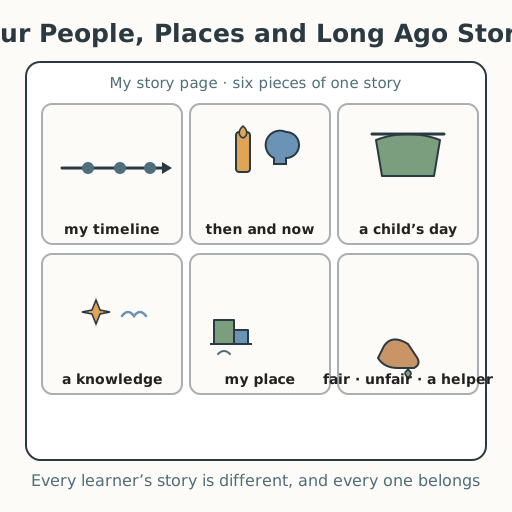
Learners gather everything from the unit into one "my story" page — a timeline, a then-and-now pair, a child's day, a knowledge, their place, and a fair/unfair with a helper — a first portfolio of their own place in the long, many-voiced human story.
Objectives
Objectives
- D08.S1.02.01 Order a few events from their family's or community's recent past on a simple timeline and explain the order.
- D08.S1.02.02 Describe how one part of daily life, such as how people light their homes or get food, has changed over time, and one way it has stayed the same.
- D08.S2.02.01 Describe the daily life of children in another place or time, including food, homes, work, and play, using stories or pictures.
- D08.S2.02.02 Identify one knowledge or skill a particular people has developed, such as farming, weaving, or wayfinding, and explain what it helps them do.
- D08.S3.02.01 Explain what people need from their environment, such as water, food, shelter, and materials, and how people in different places meet those needs.
- D08.S3.02.02 Describe how people adapt to a very different environment, such as a desert, a coast, or a cold region.
- D08.S4.02.01 Identify a rule or a way of treating people that is fair or unfair and explain why, using a classroom or story example.
- D08.S4.02.02 Describe a story of someone who helped others or spoke up when something was unfair, and what they did.
Essential question
How do time, other children's lives, knowledge, environment, and fairness fit together in my own story of people, places, and long ago?
Key vocabulary
Materials
Standard materials
- A "my story" book page or foldable · 1 per learner A large page divided into sections — my timeline, then and now, a child's day, a knowledge, my place, and a fair/unfair with a helper
- Crayons, pencils, paste · per learner For drawing and assembling the capstone page
Low-tech / no-cost
- A drawn "my story" page A paper folded or divided into labeled sections; no printed template needed
- Voice and body The learner can tell the whole story by acting, pointing, and speaking — the page is optional
Enriched / lab & device
- A camera or tablet · 1 per group Optional — photograph the page or record the learner telling their story aloud
- A class mural paper · 1 A long sheet where the whole group's pages are gathered into one big "people, places, and long ago" mural
Works in different contexts
- large-group Each learner makes their page, then the group assembles a class mural and shares a few stories aloud
- self-directed The learner completes their page alone, then tells a grown-up or peer the whole story across all the sections
- outdoor-only Build the story with found objects in a line — one for time, one for a child's day, one for knowledge, one for place, one for fairness — and tell it as you walk the line
- multi-age Older learners scribe captions while younger learners draw and dictate; pairs share their pages together
- level-grouped Learners who finish early coach peers by asking "what did you learn about time? about people? about fairness?" rather than telling
Lesson 10 — Our People, Places & Long Ago Story
Summary
The capstone: learners gather the whole unit into one “my story” page — a timeline, a then-and-now pair, a child’s day in another place, a knowledge people developed, their own place, and a fair/unfair with someone who helped. It becomes the unit’s portfolio artifact and a first telling of their own place in the long, many-voiced human story.
Objectives
- Order a few events from their family’s or community’s recent past on a simple timeline and explain the order. (D08.S1.02.01)
- Describe how one part of daily life, such as how people light their homes or get food, has changed over time, and one way it has stayed the same. (D08.S1.02.02)
- Describe the daily life of children in another place or time, including food, homes, work, and play, using stories or pictures. (D08.S2.02.01)
- Identify one knowledge or skill a particular people has developed, such as farming, weaving, or wayfinding, and explain what it helps them do. (D08.S2.02.02)
- Explain what people need from their environment, such as water, food, shelter, and materials, and how people in different places meet those needs. (D08.S3.02.01)
- Describe how people adapt to a very different environment, such as a desert, a coast, or a cold region. (D08.S3.02.02)
- Identify a rule or a way of treating people that is fair or unfair and explain why, using a classroom or story example. (D08.S4.02.01)
- Describe a story of someone who helped others or spoke up when something was unfair, and what they did. (D08.S4.02.02)
Connection
All this time you have been gathering pieces of a bigger picture: how time unfolds on a timeline, how things change and stay the same, how children live in other places, what knowledge people develop, what everyone needs from their environment, and how noticing fairness and helping others can make things better. Today you will put the pieces together into one story — your story of people, places, and long ago. Every learner’s story is different, and every one belongs.
Materials
- A “my story” page divided into sections (my timeline, then and now, a child’s day, a knowledge, my place, a fair/unfair and a helper)
- Crayons, pencils, paste
Preparation
- Prepare the “my story” page template, or plan to divide a sheet into five or six labeled sections.
- Gather learners’ earlier work from the unit (timelines, then-and-now drawings, child-life charts, knowledge drawings, place charts, fair/unfair sorts) to revisit.
Facilitator note
This lesson is written to the learner (“you”). This is the unit’s portfolio artifact and summative moment — but it is a celebration, not a test. Retrieval practice across the whole unit is the engine: learners are recalling and using everything they learned, spaced across the unit (the science-of-learning payoff — Dunlosky et al., 2013). The page has five or six sections, one per idea; a learner may complete all, or tell some sections orally, by acting, or with a scribe. Honor every body and every family shape: no one must disclose their own timeline events, their own place, or a private unfairness — sections can be filled with any event, place, child’s day, knowledge, or helper met this unit. “No correct family,” “no correct place,” “no child is ever the problem.” Gather the pages into a class mural so the whole becomes a shared, many-voiced story — history told from many perspectives, never a single one.
Procedure
- Gather and remember (10 min). You have learned six things. Say them together:
- A timeline orders events from long ago to now.
- Some things change and stay the same from long ago to today.
- Children everywhere eat, live, help, and play — the parts are alike, the ways are many.
- Every people has developed knowledge and skill — like wayfinding, farming, and weaving.
- Everyone needs water, food, shelter, and materials, and people adapt to their place.
- I can notice fair and unfair and help or speak up to make things better.
- Make your story page (25 min). Fill each section — drawing, or telling an older
learner who scribes for you:
- My timeline: three or four events from my family or community, in order.
- Then and now: one thing that changed and one that stayed the same.
- A child’s day: one child’s day in another place — food, home, work, play.
- A knowledge: one knowledge or skill a people developed, and what it helps do.
- My place: my environment and how it shapes how we live.
- Fair and unfair, and a helper: one fair or unfair rule, and someone who helped or spoke up.
- Share your story (15 min). Tell your story to a partner or the group — point to each section as you go. You may speak, sign, act, or show your page.
- Gather the mural (10 min). Add your page to the class mural of people, places, and long ago. Stand back and see how many different stories now live side by side — each one true, each one worthy.
- Close (5 min). Your story is part of the long human story — told from many perspectives, never just one. You are the author of your own page in it.
Differentiation
- Support: Complete two or three sections with heavy support, and tell the rest orally.
- Non-speaking: Build the story with picture cards, objects, or acting, with a peer or older learner scribing captions.
- Blind/low-vision: Tell the story aloud by section while an older learner or the facilitator records it; use textured markers to place each part.
- Deaf/HH: Build the story with pictures, objects, and a signed telling — the page itself is visual; sign each section as you point to it.
- Motor difference: Tell each section aloud or by pointing while a partner or older learner scribes or assembles the page; use larger sections and easy-grip crayons.
- Extension: Add a seventh section — “a second place, alike and different” — and tell one thing alike and one thing different.
Assessment
- Summative (portfolio): Does the “my story” page (or its told/scribed version) show evidence across the four strands — a timeline, a then-and-now comparison, a child’s day, a knowledge, a place/adaptation, and a fair/unfair with a helper?
- Performance (oral): Can the learner tell their story, moving through the sections, using the unit’s ideas in their own words?
Home connection
Take your story page home and share it with someone. Ask them: what is one thing they would add to their own people, places, and long ago story?