Lesson 07 — A Conflict and a Peaceful Way
Learners describe a small conflict — two people wanting the same thing, a knocked- over tower, a friend left out — and name a peaceful way to solve it: talking, taking turns, or getting help. No one has to be hit; no one has to lose.
Objectives
Objectives
- D09.S4.02.01 Describe a conflict and a peaceful way to solve it, such as talking, taking turns, or getting help.
Essential question
How do I describe a conflict and a peaceful way to solve it?
Key vocabulary
Materials
Standard materials
- Conflict picture cards · 1 set Pictures of small everyday conflicts — two children wanting the same swing, a knocked-over tower, both wanting the last of something, a friend left out
- Two puppets or soft toys · 2 For acting out a conflict and a peaceful way to solve it
Low-tech / no-cost
- Voice and body Act out the conflict and its peaceful solution together; no cards or toys needed
- A drawn "peaceful ways" list Draw the peaceful ways (talk, take turns, get help) on paper or in the dirt
Enriched / lab & device
- Laminated conflict cards · 1 set per pair Durable cards for repeated sorting of conflicts and peaceful solutions
- A peace-corner poster · 1 A wall poster of peaceful ways to solve a conflict, for the classroom
Works in different contexts
- large-group Act out a conflict with two volunteers while the group suggests peaceful ways, then rehearse in pairs
- self-directed The learner looks at each conflict card, describes it, and tells or writes one peaceful way to solve it
- outdoor-only Find a real small conflict outdoors (two wanting the same swing or spot) and practice a peaceful way right there
- multi-age Older learners model describing the conflict and the peaceful way; younger learners try with their own example
Lesson 7 — A Conflict and a Peaceful Way
Summary
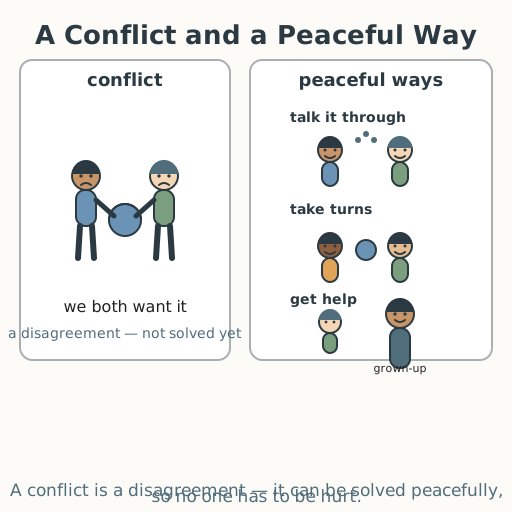
Learners describe a small conflict and name a peaceful way to solve it — talking it through, taking turns, or getting help. A conflict is just a disagreement; it can be solved without hurting anyone, and both sides can end up okay.
Objectives
- Describe a conflict and a peaceful way to solve it, such as talking, taking turns, or getting help. (D09.S4.02.01)
Connection
Think of a time two people both wanted the same thing — the same swing, the same ball, the last piece of fruit. That is a conflict: a disagreement, when two people want different things or want the same thing. A conflict does not have to end in hitting or grabbing or crying. There are peaceful ways to solve it: talk it through, take turns, or get help. People everywhere solve conflicts this way — two farmers deciding who waters first, children passing a ball, neighbors asking an elder to help. Today you will describe a conflict and name a peaceful way.
Materials
- Conflict picture cards (two children wanting the same swing, a knocked-over tower, both wanting the last of something, a friend left out)
- Two puppets or soft toys
Preparation
- Prepare the conflict picture cards.
- Set up a small space for acting out a conflict and a peaceful solution.
Facilitator note
Written to the learner (“you”). This lesson separates conflict (a disagreement, which is normal and healthy) from violence (hurting, which is not needed to solve it). Keep conflicts small, everyday, and blame-free — no one is “bad” for wanting the same swing; the question is only how we solve it. Offer three peaceful ways and let learners choose: talk it through (both sides say what they need), take turns (share the thing or the time), and get help (ask a trusted grown-up or peer to help both be heard). Getting help is strength, not weakness — people everywhere turn to an elder, a neighbor, or a friend. A learner who does not speak aloud describes the conflict by pointing to a card and shows the peaceful way by pointing, signing, or acting; a learner who is deaf or hard of hearing follows each conflict through the cards and sign; a learner who is blind or low-vision hears the conflict described and names the peaceful way aloud; a learner with a motor difference can direct a partner to move the puppets. Never ask a learner to confess a real, private conflict; invented or acted conflicts are welcome, and a learner may always pass.
Procedure
- Gather (5 min). Think of a time two people wanted the same thing. What happened? Did it end in hurt, or in a peaceful solve?
- Meet “conflict” and “peaceful” (10 min). A conflict is a disagreement — two people wanting different things or the same thing. Peaceful ways solve it without hurting: talk it through, take turns, get help.
- Describe and solve (15 min). For each conflict card, describe it: who wants what? Then name one peaceful way to solve it (say, sign, point, or act it). Wonder together: which way fits this conflict best?
- Act it out (10 min). With the puppets, show a conflict — both puppets want the same ball. Practice one peaceful way: talk, take turns, or get help. A learner who does not move the puppets can point to a way or direct a partner.
- Close (5 min). A conflict is just a disagreement. It can be solved peacefully — with talking, turns, or help — so no one has to be hurt.
Differentiation
- Support: Use one conflict and model one peaceful way with the puppets; a non-speaking learner points to the peaceful way; a learner with limited movement directs a partner.
- Extension: Invite learners to compare two peaceful ways for the same conflict and wonder which fits better and why.
Assessment
- Formative (observation): Can the learner describe a conflict and name a peaceful way to solve it?
- Performance: The acted-out conflict and peaceful solution, shared with the group.
Home connection
At home, if a small conflict comes up, describe it out loud (“two people want the same…”) and try one peaceful way — talk, take turns, or get help.