Lesson 08 — What Makes an Apology Real
Learners discover what makes an apology real — meaning it and trying to fix the harm — and tell the difference between an empty "sorry" and a real one that names what happened, notices the other person's feelings, and repairs the hurt.
Objectives
Objectives
- D09.S4.02.02 Explain what makes an apology real, such as meaning it and trying to fix the harm.
Essential question
What makes an apology real, not just words?
Key vocabulary
Materials
Standard materials
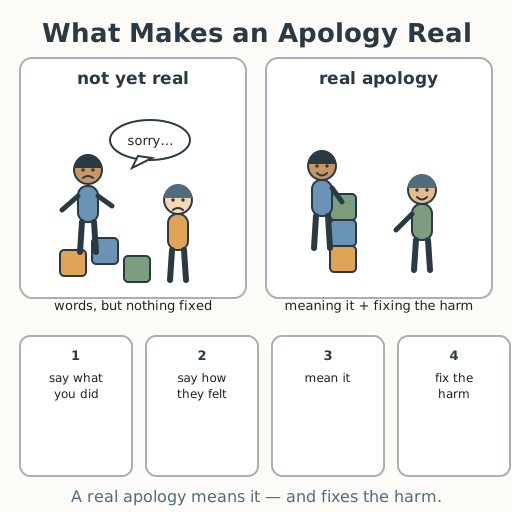
- A "real apology" picture strip · 1 Steps — say what you did, say how the other felt, mean it, and try to fix the harm
- Two puppets or soft toys · 2 For acting out an empty "sorry" and a real apology
- Crayons and paper · per learner
Low-tech / no-cost
- Voice and body Act out the empty and the real apology with hands and words; no strip or toys needed
- A drawn "real apology" strip Draw the steps together on paper or the ground
Enriched / lab & device
- Laminated "real apology" cards · 1 set per pair Durable reminder cards for the classroom peace corner
- A recording of two apologies · 1 Optional audio of an empty and a real apology, for a learner to compare alone
Works in different contexts
- large-group Act out an empty "sorry" and a real apology with two puppets while the group names the difference, then rehearse in pairs
- self-directed The learner compares the two apologies and tells or writes what makes one real
- outdoor-only Use a real small harm (a knocked-over pile of stones, a broken twig) and practice an empty and then a real apology
- multi-age Older learners model the real apology; younger learners try saying what they did and how the other felt
Lesson 8 — What Makes an Apology Real
Summary
Learners discover what makes an apology real: meaning it and trying to fix the harm. They tell the difference between an empty “sorry” and a real apology that names what happened, notices the other person’s feelings, and repairs the hurt — so both people can be well again.
Objectives
- Explain what makes an apology real, such as meaning it and trying to fix the harm. (D09.S4.02.02)
Connection
Think of a time someone said “sorry” but did not seem to mean it — the words came out, but nothing changed, and you still felt hurt. Then think of a time someone said sorry and did something — helped you up, returned the toy, fixed what was broken. The second one was a real apology. Words alone are not enough; a real apology means it and tries to fix the harm. People everywhere do this — mending a torn net, returning a borrowed tool, replanting a broken branch, saying sorry with their hands and their work. Today you will practice telling the difference, and making a real one.
Materials
- A “real apology” picture strip (say what you did, say how the other felt, mean it, fix the harm)
- Two puppets or soft toys
- Crayons and paper
Preparation
- Prepare the “real apology” picture strip.
- Set up a small space for acting out an empty and a real apology.
Facilitator note
Written to the learner (“you”). This lesson teaches apology as repair, not as words alone. An apology is real when the person means it and tries to fix the harm — naming what happened, noticing how the other felt, and doing something to make it right. Hold this as a question (“what does this apology do for the other person?”), never as a forced ritual: never make a learner perform an apology or confess a real, private hurt — invented or acted harms are welcome, and a learner may always pass. Name the act, never the child; there are no “bad children,” only hurts to repair. The goal is understanding, not shame: an empty “sorry” is a starting point, and a learner can always add the repair to make it real. A learner who does not speak aloud shows the steps by pointing or signing; a learner who is deaf or hard of hearing follows the strip and the acted apology by sign and gesture; a learner who is blind or low-vision hears the two apologies described and names which is real and why; a learner with a motor difference can direct a partner to do the repair while they choose it. The aim is that every learner can say, in their own way, “a real sorry fixes the harm.”
Procedure
- Gather (5 min). Think of a “sorry” that felt real and one that felt empty. What was different?
- Meet “real apology” (10 min). A real apology has four steps: say what you did, say how the other felt, mean it, and fix the harm. Words alone are not enough.
- Hear both (15 min). With the puppets, show an empty “sorry” — one puppet knocks over the other’s tower and mumbles “sorry” while turning away. Then show a real apology: “I knocked your tower. You look sad. I am sorry — can I help you build it again?” Then help rebuild. Wonder together: which was real, and why?
- Practice a real apology (10 min). Pick a small, acted harm. Practice a real apology with all four steps (say, sign, point, or act each one). A learner who does not move the puppets can point to a step or direct a partner.
- Close (5 min). A real apology means it and fixes the harm. Then both people can be well again.
Differentiation
- Support: Practice two steps at a time — first “say what you did,” then “fix the harm.” A non-speaking learner points to the steps on the strip; a learner with limited movement directs a partner.
- Extension: Invite learners to compare two repairs for the same harm and wonder which better fixes it — and whether words or actions matter more.
Assessment
- Formative (observation): Can the learner explain what makes an apology real (meaning it, fixing the harm)?
- Performance: The acted-out real apology, shared with the group.
Home connection
At home, if a small hurt happens, notice whether the “sorry” fixes the harm. With a grown-up, practice adding the fix so the apology is real.
Resources
- International Institute for Restorative Practices (repairing harm rather than only punishing): https://www.iirp.edu/