Lesson 09 — Conflict to Repair: A Role-Play
Learners put the whole peace path together in a role-play: describe a conflict, choose a peaceful solve (talk, turns, or help), and make a real apology that fixes the harm. This rehearses the unit's restorative skill end to end.
Objectives
Objectives
- D09.S4.02.01 Describe a conflict and a peaceful way to solve it, such as talking, taking turns, or getting help.
- D09.S4.02.02 Explain what makes an apology real, such as meaning it and trying to fix the harm.
Essential question
How do I put a peaceful solve and a real apology together, from start to finish?
Key vocabulary
Materials
Standard materials
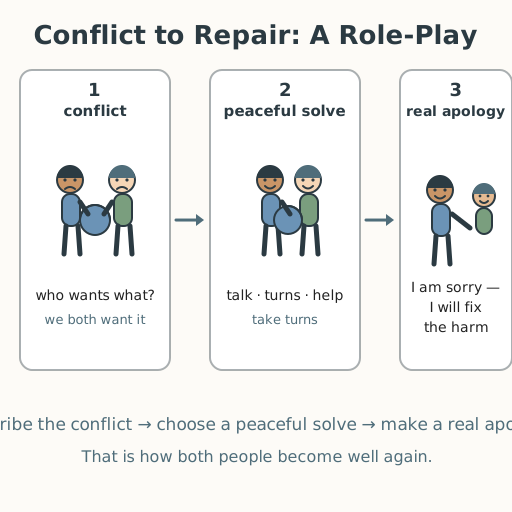
- A three-step "conflict to repair" strip · 1 Steps — describe the conflict, choose a peaceful solve, make a real apology that fixes the harm
- Two or three puppets or soft toys · 3 For acting out the whole path from conflict to repair
Low-tech / no-cost
- Voice and body Act out the whole path with partners; no strip or toys needed
- A drawn "conflict to repair" strip Draw the three steps on paper or the ground
Enriched / lab & device
- Laminated role cards · 1 set per group Cards naming each role (the one who was hurt, the one who hurt, the helper) and the steps
- A short video of a conflict-to-repair scene · 1 Optional, for a group to watch and name the steps
Works in different contexts
- large-group Model the full path with two volunteers while the group names each step, then rehearse in threes
- self-directed The learner works through all three steps alone with the strip, acting both sides or using the toys
- outdoor-only Use a real small conflict (a shared swing, a knocked-over pile) and walk the full path right there
- multi-age Older learners play the helper; younger learners play the two sides and try each step
Lesson 9 — Conflict to Repair: A Role-Play
Summary
Learners put the whole peace path together in one role-play: describe a conflict, choose a peaceful solve (talk, turns, or help), and make a real apology that fixes the harm. This is guided practice of the unit’s restorative skill, from start to finish, with no blame and no one left out.
Objectives
- Describe a conflict and a peaceful way to solve it, such as talking, taking turns, or getting help. (D09.S4.02.01)
- Explain what makes an apology real, such as meaning it and trying to fix the harm. (D09.S4.02.02)
Connection
Think back to what you have practiced: naming a conflict, choosing a peaceful way, and making an apology that fixes the harm. Real peace is all three, in a row — not just one piece. When two people disagree, they can talk or take turns or get help, and then the one who hurt can make it right, and both can feel better. People everywhere do this every day: two children over a swing, two neighbors over a wall, two friends over a toy. Today you will practice the whole path, from conflict to repair.
Materials
- A three-step “conflict to repair” strip (describe the conflict, choose a peaceful solve, make a real apology that fixes the harm)
- Two or three puppets or soft toys
Preparation
- Prepare the three-step strip and a small space for acting out.
- Have roles ready: the one who was hurt, the one who hurt, and (if you like) a helper.
Facilitator note
Written to the learner (“you”). This lesson is guided practice — the learner has seen each piece (conflict and peaceful solve in Lesson 7; real apology in Lesson 8) and now puts them together with scaffolding. Model first: a small, gentle conflict (a knocked-over tower, both wanting the same ball), then name each step aloud as the group or a volunteer works it. Use the three-step strip as a worked example, then let learners rehearse in small groups or pairs. Keep conflicts small, invented, and blame-free; never ask a learner to act out a real, private hurt, and never require a forced apology — the apology in the role-play is practiced as a skill, not extracted as a confession. The helper role (a peer or a trusted grown-up) is optional and shows that getting help is a real peaceful solve, not a last resort. A learner who does not speak aloud points to each step on the strip or signs; a learner who is deaf or hard of hearing follows the role-play through the strip and sign; a learner who is blind or low-vision hears each step described and names what comes next; a learner with a motor difference can direct a partner or play the helper. Every learner may pass. The aim is that each learner can say, in their own way, “I can go from conflict to repair.”
Procedure
- Gather (5 min). Remember Lessons 7 and 8: a conflict can be solved peacefully, and a real apology fixes the harm. Today you will do both, in a row.
- Meet the three steps (10 min). The path has three steps: (1) describe the conflict — who wants what; (2) choose a peaceful solve — talk, take turns, or get help; (3) make a real apology — say what you did, say how they felt, mean it, fix the harm.
- Watch it modeled (10 min). Watch (or act) one whole path: two children want the same ball. They take turns, and the one who grabbed says a real apology and offers the ball back. Name each step as it happens.
- Rehearse it (15 min). In a small group or pair, choose a small conflict and walk the three steps. Take turns being each side, and use the helper if you like. A learner who does not act can point to the steps or direct a partner.
- Close (5 min). You can go from conflict to repair — peacefully, with a real apology. That is how both people become well again.
Differentiation
- Support: Use a scripted two-line scene with the steps written out; a non-speaking learner points to each step as the group does it; a learner with limited movement directs a partner or plays the helper.
- Extension: Invite learners to try a second conflict where talking alone is not enough and getting help is needed, and wonder why different conflicts need different solves.
Assessment
- Formative (observation): Can the learner move through the three steps — describe the conflict, choose a peaceful solve, and make a real apology?
- Performance (portfolio): The role-play, with the steps noted (or photographed or drawn), kept as a portfolio artifact of the unit’s restorative skill.
Home connection
At home, teach someone the three steps: describe the conflict, choose a peaceful solve, make a real apology. Try them the next time a small conflict comes up.
Resources
- International Institute for Restorative Practices (repairing harm rather than only punishing): https://www.iirp.edu/