Lesson 04 — My Two Calm Tools
Learners recall the calming strategies they learned all year — deep breaths, slow counting, finding a safe space, shaking it out, naming it with words — choose their two favorites, and make a personal "calm card" they can use on their own when a strong feeling arrives.
Objectives
Objectives
- D01.S3.02.01 Name two strategies for managing strong feelings and choose one to use on their own.
Essential question
What two strategies can I use to calm a strong feeling, and how do I choose one on my own?
Key vocabulary
Materials
Standard materials
- A "My Calm Card" template · 1 per learner A small card with two spaces to draw or write their chosen calm tools
- Crayons, pencils · per learner
Low-tech / no-cost
- Voices, bodies, and breath Practice each calm tool with the body only — a deep breath, a slow count, a shake, a safe place
- A found object A smooth stone to hold and breathe with, in place of a card
Enriched / lab & device
- A class "calm corner" A quiet space with the calm cards displayed, for choosing a tool on one's own
- A timer or chime · 1 To practice pausing before acting, with a soft signal
Works in different contexts
- large-group Practice each tool as a whole group first, then learners choose their two favorites for their own cards
- self-directed A learner reads the tools, tries each alone, and records the two that help them most
- outdoor-only Practice a breath with the wind or the sky, and count five steps or five leaves as a calm tool
- multi-age Older learners model a calm tool for younger ones, then each learner picks their own two
- level-grouped Learners ready to extend write *when* they would use each tool (before a test, after a fall-out with a friend)
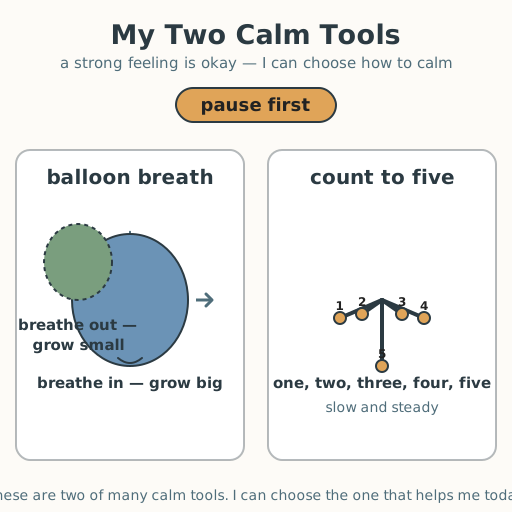
Lesson 4 — My Two Calm Tools
Summary
Learners gather the year’s calming strategies — balloon breath, counting to five, finding a safe space, shaking it out, naming it with words — and choose the two that help them most. They make a personal “calm card” and practice choosing a tool on their own, pausing before they react. This is the year’s self-regulation work, gathered into something a child can carry forward.
Objectives
- Name two strategies for managing strong feelings and choose one to use on their own. (D01.S3.02.01)
Connection
A strong feeling is like a big wave — it can knock you over, or you can learn to ride it. Everyone, in every place, has ways of meeting a big wave: some people breathe slowly, some count, some pray or sing, some walk it off, some find a quiet spot. All year you have collected calm tools of your own. Today you pick your two best ones, so that when a strong feeling comes, you do not have to wait for a grown-up — you can choose your own tool.
Materials
- A “My Calm Card” template
- Crayons and pencils
Preparation
- Prepare the calm card template with two spaces: “my tool 1” and “my tool 2.”
- Have the year’s list of calm tools ready on a chart (balloon breath, count to five, safe space, shake it out, name it with words, ask for help).
- Arrange a circle for practicing the tools together.
Facilitator note
This lesson is written to the learner (“you”). It gathers the year’s self-regulation work and gives it into the learner’s own hands: a strong feeling is okay, and the learner can choose how to meet it. No tool is better than another — the “right” tool is the one that helps this child, and every child may pick a different one. Honor a child’s own invention as a real tool (a song, a squeeze, a hum). Practice each tool slowly and without pressure; a learner who does not want to close their eyes or be still may choose a moving tool (shake it out, walk, press feet into the floor). For a learner who is blind or has low vision, describe each tool in body terms so it can be felt. For a learner who is Deaf or hard of hearing, use visual and felt cues — a counting hand, a breathing balloon drawn and shown — rather than a spoken chime. The point is a tool the child can reach for on their own.
Procedure
- Gather (5 min). Remember the calm tools you met this year: balloon breath, counting to five, a safe space, shaking it out, naming it with words, asking for help. Say them together.
- Try them again (15 min). Practice each tool as a group. Breathe in like a balloon growing big, and out as it grows small. Count slowly to five on your fingers. Notice how your body feels calmer each time. Which two help you the most?
- Choose your two (10 min). On your calm card, write or draw the two tools that work best for you. These are your tools — no two cards need to be the same.
- Practice choosing on your own (10 min). Close your eyes or look down. Think of a strong feeling you sometimes have. You cannot always wait for a grown-up — so pause, and choose one of your two tools, all by yourself. Take one slow breath or one slow count.
- Close (5 min). A strong feeling is okay. What matters is that you now have two tools, and you know how to choose one on your own. That is a grown-up power.
Differentiation
- Support: Choose from two picture tools instead of a list; practice with a partner modeling each step.
- Support (non-speaking): Point to or draw a tool; a partner names it and helps practice it.
- Support (Deaf/hard-of-hearing): Use visual and felt cues — a counting hand, a drawn balloon — rather than a spoken chime.
- Support (blind/low-vision): Describe each tool in body terms and practice by feel; make the card tactually.
- Extension: Write when you would use each tool (before a hard task, after a disagreement) next to each drawing.
Assessment
- Formative (self + observation): Can the learner name two strategies, and — when a strong feeling is imagined — choose and begin one on their own without a reminder?
Home connection
Show someone at home your calm card and teach them one of your two tools.
Resources
- CASEL SEL Framework (self-management): https://casel.org/fundamentals-of-sel/